Obsession is a dangerous trade. from Monsters of God
I found Monsters of God by accident on HBO. I was mindlessly scrolling for something to watch, but once I put it on, I didn’t get up.
I was hooked first by the characters, then the history, then the smuggling. It’s a crime story with every reptile I’ve never heard of in it. And the people…the people were exactly like you think they’d be. I kept thinking I’d turn it off after ten minutes and focus on work. I didn’t.

Hank Molt (great name) is one of the main characters and an apparent legend in that industry. He ran a pet store in Philadelphia and stocked it with animals he found overseas, often carrying them into the country in suitcases, which, customs barely checked.
Eric Goode, who created the series, says Molt liked that there were laws at all, because breaking them made it a better game. In the 1970s he went on what he called shopping trips with other dealers. The Wall Street Journal later quoted him on what they packed.
The gun to shoot someone, the machete to cut off our fingers if we were bit by a taipan.
There were no rules, a lot of private deals, and a snake that can kill you if you guessed wrong. They brought a blade to cut their own freakin’ fingers off if they were bit.
Then I got stuck on a price list.
Names, Then Numbers
Molt circulated lists of rare reptiles, snakes and turtles and lizards with prices next to their names, and mailed them to collectors and to zoos that competed for the same animals. Before that, collectors and zoos bought and sold by calling each other, or by shaking hands.
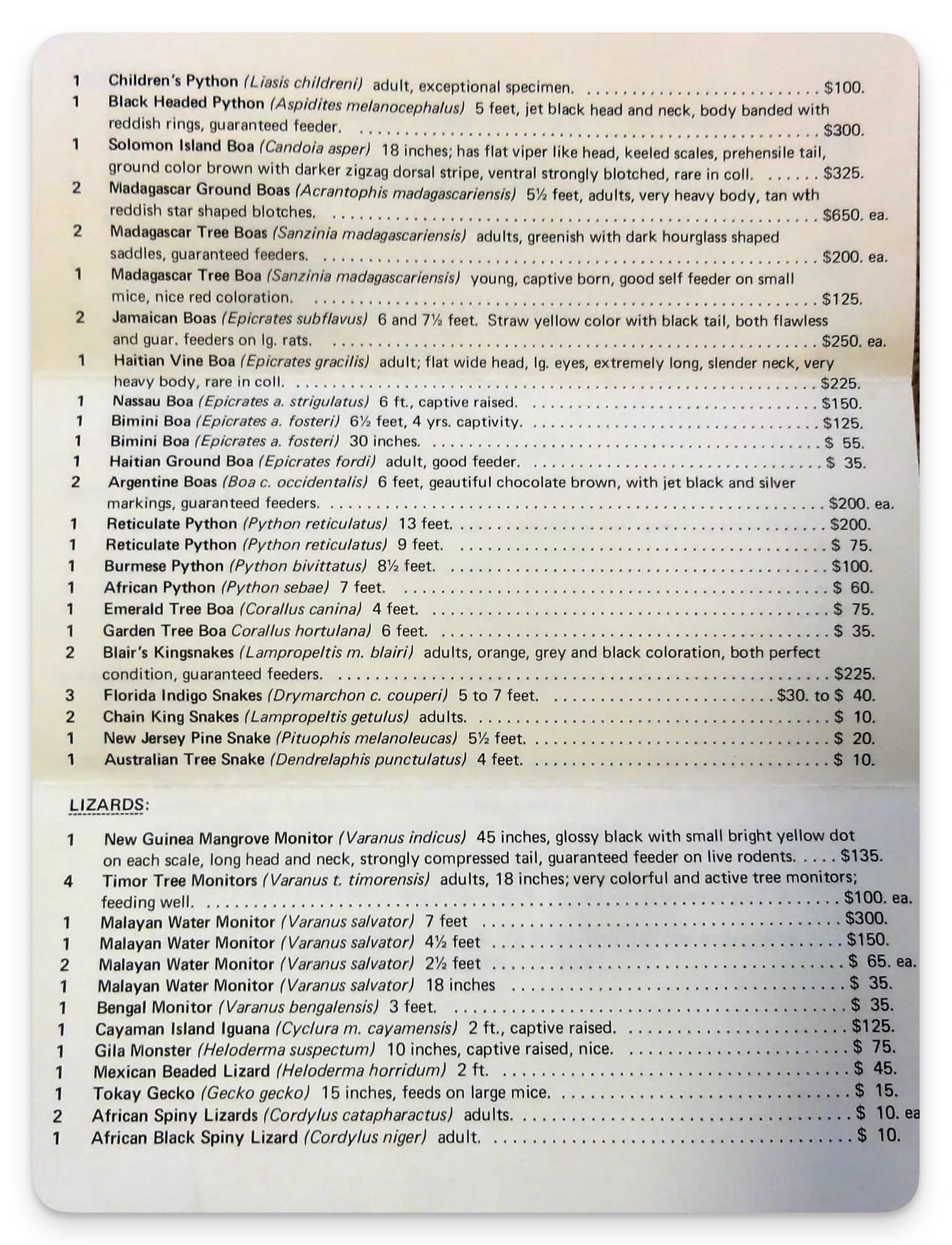
But the list did something more important than advertise inventory.
It told the market what to believe.
People saw prices that seemed absurdly high compared with anything they’d seen before. Yet, rather than immediately destroying demand, the list helped make the animals feel more rare and more collectible. A reptile that had been an obscure creature in a distant part of the world became a named item in a catalog, available through a person who appeared to have unusual access.
→ The price not only reflected the value.
→ The price helped create it.
Then Washington made the sheet more powerful by accident. The Endangered Species Act came into effect in 1973 and Molt’s business boomed, because an endangered label meant rarer, and rarer meant he could charge more. A law written to protect the animals raised their price instead.
Other dealers noticed. Tommy Crutchfield, a Florida rival, ran Molt’s playbook, selling smuggled reptiles to collectors, pet owners, and zoos. Time’s reporting on the series puts his sales and trades at millions a year.

There’s No Pudding
Harry Beckwith named this in 1997 in Selling the Invisible, then said it blunter in 2022 in The Invisible Promise.
“There’s no pudding in a service, so there’s no proof.”
Beckwith said, “Your price is not just your price. It is a quality cue.”
When people can’t inspect the thing, they inspect the tag. He tells the old story about the carpenter who charged $2 for hitting the nail and $43 for knowing which nail. Charge for the years it took to know which nail.
My favorite piece of evidence in his book is about coffee. At $18, buyers of organic coffee got more passionate about it, and they could recite roughly twice as many details about what they were drinking. The higher number made people believe more, and study the thing harder.
The reptile list ran the same experiment with snakes.
Invisible expertise
The blank page test
The $43 in the carpenter story was for knowing which nail. That knowing is invisible expertise. It’s the judgment that only shows up when you’re in your zone of genius. When you’re operating from unconscious competence.
You listen for two minutes and you already know what’s wrong, and if someone asked you to write down how you knew, you’d stall, because the steps aren’t sitting there as steps anymore. They compacted. You got so good at the work that the work disappeared from your ability to articulate it.

Why you can’t say it
That’s why it happens. Repetition sank the skill below words. The better you are, the less you can narrate it. You’ve been doing it for 10+ years and the manual you could have written as you were building those patterns has disappeared.
What’s left is a feeling in the call, a tell in their voice, a thing you notice that a competent person with a checklist will miss.
The borrowed job title
When you can’t say it, you sell familiar language or you borrow a job title. Someone asks what you do. You say you coach, or you consult, or you help people with the thing you’ve spent 10+ years getting really good at. The sentence comes out different every time, because you honestly aren’t quite sure HOW you do what you do. They nod, then they ask what you charge and if you are how I used to be you say “it depends.”
You leave the conversation having been treated like a less expensive version of someone you’re not, and you can’t correct it because you still don’t have a sentence for the actual thing.
I used to do this on my own calls. I can sit with a client and name their offer in one pass, then get on a sales call for my work and describe it as a pile of verbs (help, advise, extract, train). The work was there, I just never put it on a sheet.
What I Put On Mine
One line on my list is called Cognitive Fingerprint™.
The person who buys it is a founder whose team still has to wait for them after a call, because the knowledge is in one head. When we’re done they have a written extraction they can hand to people… their patterns, framework…their thinking, in their language.
That’s the whole card… a name, who it’s for, what they walk away holding, who it’s not for, and a price, which I put on the card I send them, not in this essay.
Here it is, item 001 on my actual sheet.
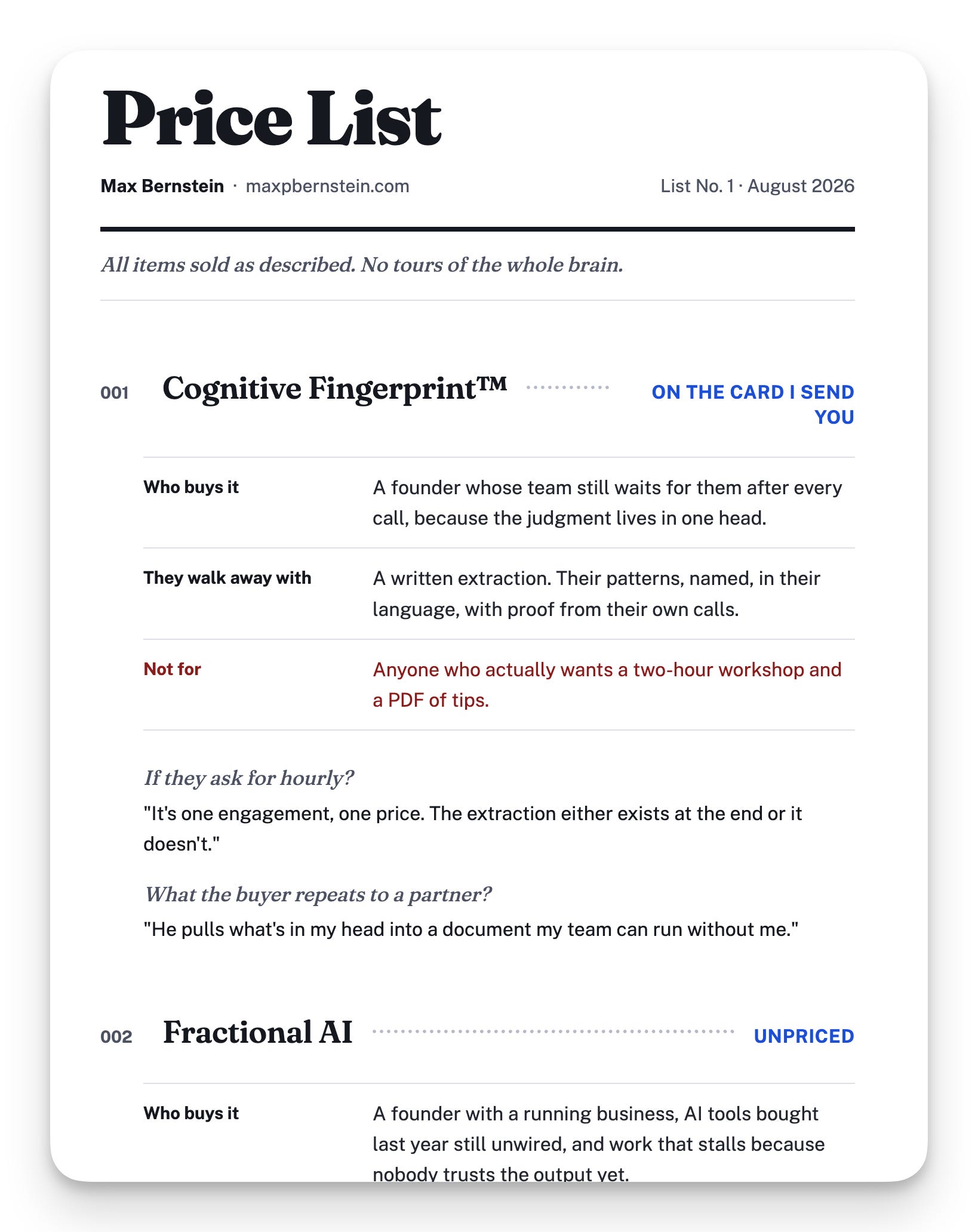
I have other lines with the same idea. Each one is something a buyer can say yes or no to without me giving a tour of my whole brain.
I can’t tell you how many opportunties I lost at workshops, calls or conferences when people asked how I could help them. I knew I could but I couldn’t articulate it.
The Gap
You can see what the sheet did, and you saw one of mine. Now it’s time to write yours.
The Monster Price List is the prompt (or the Skill) that digs that sheet out of your own calls. You feed it one to three transcripts of you working (your website and LinkedIn help, but the calls are where the expertise actually shows up), and it hunts for the moments a buyer valued… the “how did you know that,” the thing you fixed for free, the “could you also” you never invoiced.
Then it writes one to five cards… a name pulled from words that were actually said, a buyer you can picture, something they walk away holding, who it’s not for, a number they can argue with. Every card is quote-locked to a real moment from your own tape. You shouldn’t have to sit through a questionnaire first.
The full prompt and the downloadable Skill are below. Attach a transcript (or 3) of a coaching call, discovery, onboarding etc.. Send the first card.
It works from the moments your expertise already leaves on tape. It won’t map the whole of how you think (that’s a deeper extraction), but it will name and price what you already sell right now.