

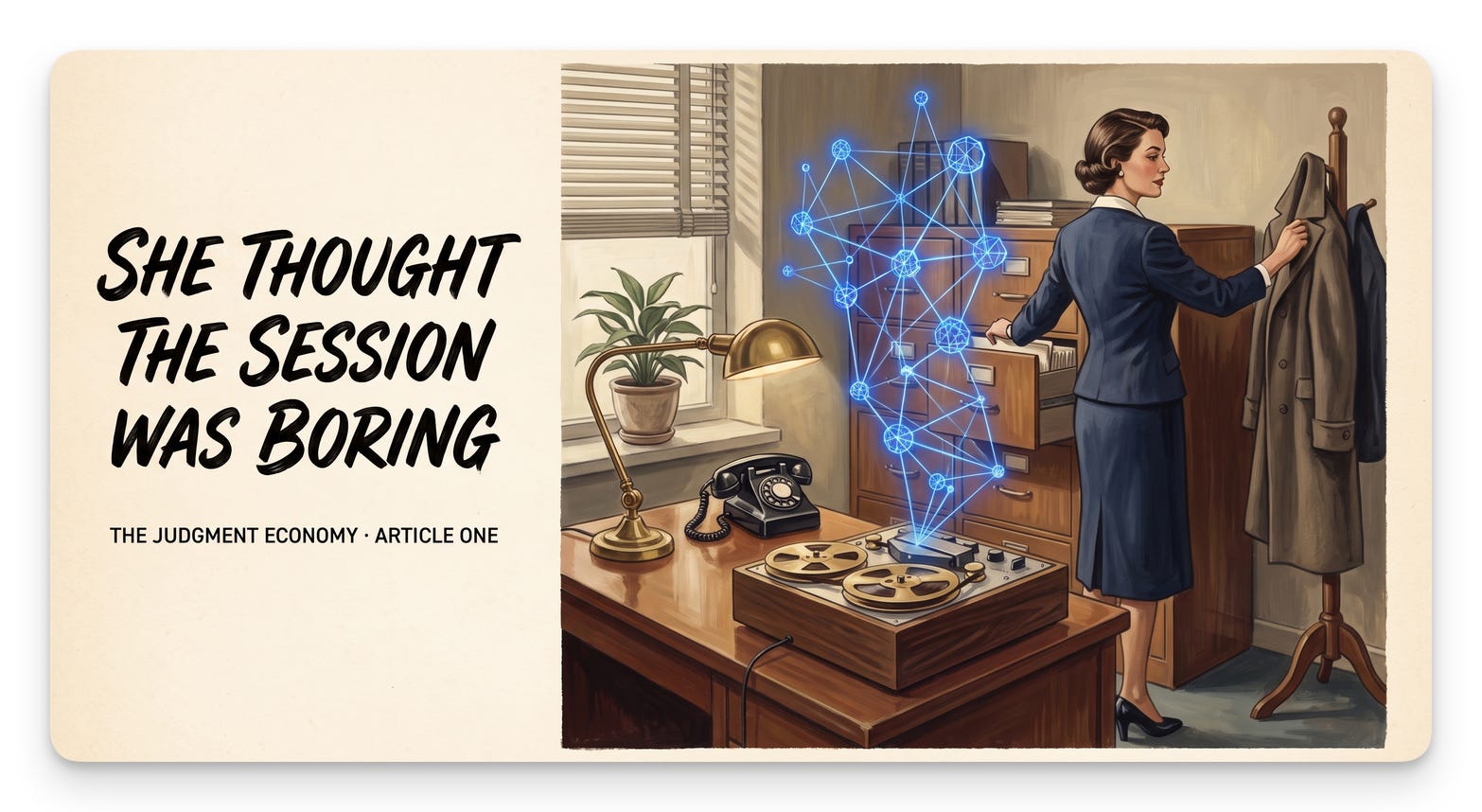
I was showing her what came out of a clinical session she had dismissed.
“I thought it was pretty boring,” she said. “And I wasn’t very helpful.”
The analysis had surfaced several pieces of content, recurring patterns, and decisions she had been using without ever naming them. She had seen nothing unusual because nothing unusual had happened from her perspective. Decades had been spent developing the ability to make those decisions.
Later, she said something else.
“This is 35 years of thinking from me.”
Thirty-five years of thinking had become a boring afternoon.
If you’ve ever solved something quickly and felt like you skipped a step, you know the feeling.
A founder reviews an AI draft. The facts are correct. The piece still feels wrong. They rewrite half of it and can’t explain what standard the first version violated.
A consultant joins a call after the team has spent an hour circling the problem. Two questions. The issue becomes obvious.
A creative director rejects seven concepts in five minutes. Asked why, they point to details that were never in the brief.
What looks like a secret method is years of experience compressed into fast recognition. The result feels suspiciously easy. And when something feels easy, it’s hard to believe it’s worth much.
The Expertise Paradox
As someone gains experience, they stop consciously walking through every step. They start recognizing patterns and responding to the situation as a whole.
A beginner sees fifteen separate clues.
The expert sees one familiar shape.
This saves enormous mental effort. It also creates a strange side effect. The expert loses conscious access to parts of the reasoning that produced the answer.
This is the Expertise Paradox.
AI Was Supposed to Close the Expertise Gap. Here's What Happened Instead.

Everyone said AI would be the great equalizer.
The better you get, the more automatic your judgment becomes. The more automatic it becomes, the harder it is to explain. The harder it is to explain, the less valuable the work starts to feel.
Michael Polanyi spent much of his career on this. His phrase was “we know more than we can tell.” Hubert Dreyfus mapped how experts move past rules and frameworks into something closer to recognition.
A chess master recognizes the position before calculating a single line.
Gary Klein found the same thing in fireground commanders. They sized up a fire and acted, with no checklist in sight.
The knowledge is all there. It has become invisible to the person who holds it.
Where This Shows Up
This isn’t just a therapist’s problem. I’ve watched it appear across four different domains.
1. AI keeps producing the average answer
A marketer I work with started using AI tools and ran straight into a wall.
She could tell the output felt like “telegram” when she wanted “magazine.” She knew the difference. She couldn’t explain what she wanted changed.
The model had access to every word but she held the standard.
Her frustration came from trying to communicate a judgment she had never needed to put into words. When you can produce a competent draft in seconds, the bottleneck moves from production to discernment.
The question stops being “can I make this?” and starts being “is this right?”
Answering that question requires standards most experts have never written down.
2. Your team needs you in the room
A founder I work with in the medical space has a team that can do the work. The hard part is transferring the patterns he uses in client conversations.
He was the bottleneck. Every unusual decision and every exception to the playbook climbed back to him.
Once I mapped those patterns, his team could walk into calls “super confident, not really worried if I’m on the call or not.”
The founder becomes the place where judgment goes when it can’t be transferred.
3. Your content describes the industry instead of your thinking
Another founder’s financial company has served its clients for years. Its published content was generic SEO material.
He put it bluntly.
“It’s not even anything extracted from the work we do. It’s all built for SEO.”
Anyone could find what the company published. Its most valuable thinking stayed trapped inside client conversations, in the moments when someone on the team knew something the industry didn’t.
4. You discount work that feels easy
The therapist had 35 years of experience and still treated an unusually rich session as unremarkable.
Another expert I work with put it this way.
“I work faster than my ability to tell you what I just did.”
Someone else sees speed and fluency. The expert feels like they skipped something.
That’s where underpricing begins. Doubt creeps in, and someone who should be charging for their judgment starts charging for their time, because time is the one thing they can prove they spent.
Why Introspection Usually Fails
So why can’t the expert sit down and write out their method?
Because when experts explain their work, they list what they remember learning…
The steps and the frameworks they can already name.
Those have value. They rarely contain the moments where expertise changes the result.
The missing judgment shows up while they’re doing the work. It’s in what they notice, what they correct, which rule they ignore, and what they refuse to accept.
The therapist couldn’t find her patterns by thinking harder about therapy. They were sitting inside a session she had stopped thinking about. The value had been there while she was living through it. She needed distance…to step back from her own work to see it.
The sessions experts dismiss are the first place to look.
Once I saw this happening across different experts, a larger question started bothering me. What happens when competent work becomes cheap enough to generate on demand? When AI can produce the draft, the proposal, and the code, the only thing that determines whether any of it is good is the judgment of the person looking at it.
That’s what the next article is about. But first…
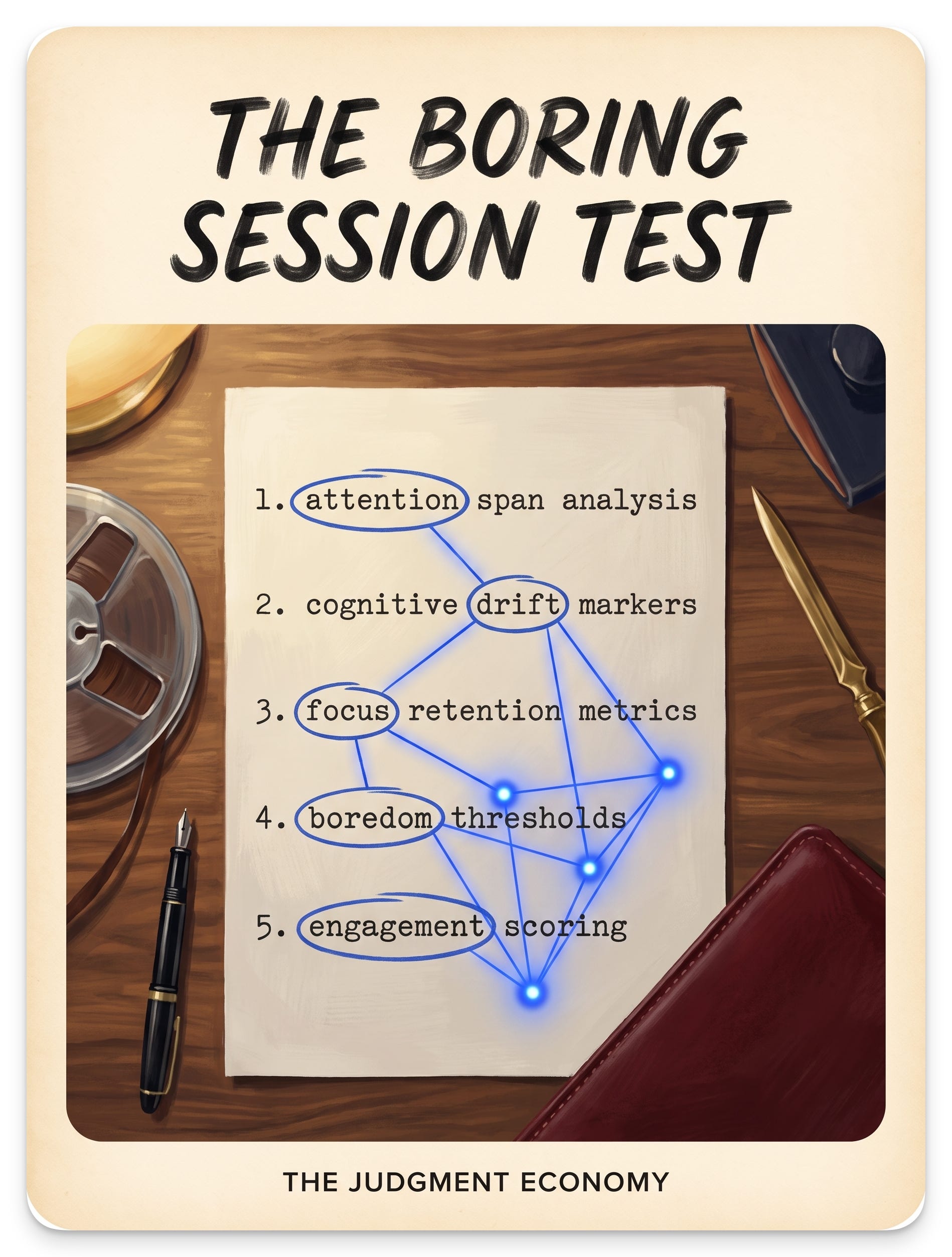
Try it on one of yours
Pick the most ordinary piece of recorded work you have from the last two weeks. A call transcript. A client email thread where you answered a question. A Slack thread. A draft you rewrote. The one you would call boring.
You can take out client names, but keep your own so the model knows which speaker is you. Paste the prompt below into Claude or ChatGPT, then paste the work underneath it.
The Boring Session Test
You are an outside observer reviewing a piece of my work. I am an experienced [your role]. Below is a transcript, thread, or document. In it, I am the speaker labeled [your name as it appears]. Everyone else is a client, colleague, or interviewer, and their decisions are not the subject. My own read is that nothing much happened in it. Your job is to test that read.
Rules:
Work only from what is on the page. Quote my exact words for every finding. If you cannot quote it, do not claim it.
Do not invent a framework, a name, or an acronym. Describe what I did in plain language.
Ignore what I said I was doing. Look at what I actually did: what I noticed, what I corrected, which rule I ignored, and what I refused to accept.
Do not flatter me. If a stretch is routine, say it is routine. If you find fewer than three decisions, say that too.
If you cannot tell which speaker is me, stop and ask before you begin.
Steps:
Step 1. Find the fastest decisions. Look for moments where I went from a question to an answer in one exchange, changed direction with no visible deliberation, answered something nobody asked, or asked a question that changed what the other person said next. List up to five. Quote each one.
Step 2. For each decision, write three lines.
What I did, in one plain sentence.
What a capable beginner would probably have done at that moment instead.
What I seem to have already known that made the beginner’s move unnecessary.
Step 3. Find the part I dismissed. Identify the stretch I would most likely call boring or unhelpful. Say what was actually happening in it.
Step 4. Name the standard. From my corrections and refusals, write one sentence describing a standard I appear to hold that I never said out loud. Quote the evidence.
Step 5. Tell me what you cannot know yet. Everything above comes from one source, so each finding is a candidate, not a pattern. List the two or three findings most worth checking against my other recordings, and say what you would look for.
Format: short headers, quotes in italics, no summary at the end.
[PASTE YOUR TRANSCRIPT, THREAD, OR DOCUMENT HERE]
Cognitive Fingerprint Lab is $20 a month right now. On Saturday, September 5th, new memberships move to $25. Anyone in before then keeps $20 for as long as their subscription stays active.
Part 1 of The Judgment Economy
Max, I get SO excited whenever I see your newsletter show up in my inbox, because I know I'm about to read something deeply thoughtful and I'll come away with an excellent prompt to use. Today's piece landed exactly when I needed it the most, addressing doubts about my own experience and knowledge that have been bubbling up a lot this year. I'm going to use the prompt on a few meetings I've had lately.
Thank you for sharing your brilliance!