

Our community call started where these things usually start now.
We were talking about agents, Claude Code, workflows, install paths, new tools. All the shiny stuff that makes everyone feel like the future is either already here or three terminal commands away.
Then Dionne (a member) said something that made me smile:
“I don’t want more input.”
Yes. Yes. Yes and yes.
People talk about agents like a coworker that runs on its own. Something that thinks, acts, hands off work, files things, writes drafts, keeps watch, sends updates, remembers it all, and politely asks you to approve something near the end.
It sounds great in theory.
It also sounds exhausting if your life already has too many tabs open.
Think about it. Agents get sold as the thing that takes everything off your plate. But if your new digital buddy hands you another inbox, another brief, another homework assignment, another pile of stuff to check before you can start your real work...
Then the agent is just one more thing to manage. One more place for work to pile up.
The Wrong Starting Point
Most people start with the question:
“What agent should I build?”
That drops you straight into tool land or whoever is shouting the loudest about the latest.
You start comparing frameworks. You watch someone build a CRM assistant on YouTube. You install something globally, then locally, then inside the wrong folder, and then the terminal yells at you in what sounds like a haunted printer.
Eventually you get something running.
Then comes the question I hear from almost everyone after they install something like OpenClaw for the first time:
“What do I do with it?”
Then there’s the other side, which is where I usually live. I install too much.
I over-build. I assign, I create, I keep going until there’s so much running I’m not even sure what I just did.
My phone kept buzzing with Telegram updates. New content ideas. Status updates on clients. Reminders to do something I swear wasn’t on my calendar that morning.
And here’s the real problem. None of the things it kept pinging me about were things I actually needed to do.
Now my whole day went to checking those messages, chasing new rabbit holes, bouncing between things and never finishing any of them.
My new employee had just made a new job. For me.
The Secret Elf Test
So instead of building something that makes more noise all day, what if we asked a better question:
“What should already be done when I show up?”
Picture a store before it opens.
Someone turns on the lights. Someone counts the register. Someone sweeps the floor. Someone pulls yesterday’s notes. Someone sets the right thing in the right place so the real work can start clean.
Nobody calls that “running the business on its own.”
They call it opening.
That’s the secret elf version of an agent.
Open the store before I get there. Do the small, quiet prep before I show up. Set the right thing on the counter.
For a founder, that might mean yesterday’s Slack messages, client emails, and meeting notes all get read before the day starts. The agent flags the few decisions actually waiting on you.
For a consultant, the agent might read a call transcript and pull the moments worth a follow-up. It hands you the sharpest pieces, ready to use.
Mine is built for the work I do. At the end of the day, it reads through all my call transcripts. It pulls out the strategic insights and content ideas, tosses them into a workflow, and writes the first draft. When I sit down, the drafts are waiting. I keep the good ones and toss the rest back into pile.
Same machine as the Telegram mess with a completely opposite result. One made noise all day. This one just has the work sitting there when I open the laptop.
Less flashy. Way more useful.
The First Job Is Prep
There’s a real gap between setting an agent up and actually using it. Most people stall at the setup, because the agent never found a real job in their day.
The first agent should make your pile smaller, not bigger.
It pulls the thing that matters to the front. It clears the stale stuff. It bundles the messy stuff so the next step is easy to see.
That’s the job. Make your starting line cleaner.
Your first agent probably lives in the part of your day you already dread.
The saved links you swore would turn into a post someday
The call transcript that just get filed instead of mined for insights and content
The morning scan of messages that get buried as soon as people start waking up
The weekly client update, where you dig through Slack, email, ClickUp, and your own half-finished notes
When you don’t know why the agent belongs in your day, every setup step feels like extra homework. The moment its job is obvious, the setup is still annoying. But now there’s a prize at the end of it. Even when they hand you a terminal.
The Default Is Actually Impressive…Kinda
The default is to build the most impressive agent you can dream up. (I lovvvvvved the default method)
Memory. Tools. Connections. A dashboard. Maybe a name (mine is named Meatball). Definitely a little personality, because apparently they all have to sound like your favorite celebrity.
The default feels advanced.
It also skips Level 1.
Level 1 is making the first 15 minutes of your day start with clarity.
You open your laptop and the right thing is already waiting. The little agent elves were hard at work while you slept, prepping all of the the store for opening.

Before you ask what agent to build, here are three tests you can run:
The 3 tests for your first agent’s job
Frequent. It hits most days, not once a quarter. A once-a-quarter task isn’t worth an agent. You want the thing pressing on you over and over.
Ex: Reading yesterday’s call notes happens every morning.Costly. It burns time or focus before your real work starts. This is the tax you pay just to reach the starting line. It’s the warm-up you resent so it probably doesn’t get done.
Ex: You rebuild last call’s context so it’s ready for the first 10 minutes of the next one.Elf-able. The agent can finish it overnight with no choice from you. If the agent has to stop and ask you something halfway, it isn’t done while you sleep. If you are giving it decision-making authority, make sure you do lots of testing first.
Ex: Running and analyzing sales data from the day before and comparing it week-over-week
If all three are yes, you found your elf’s first job.
It unlocks the door, turns on the lights sets the right thing on the counter.
Then it gets out of the way, so you can do the part that still needs you.
So What’s Your Elf’s First Job?
There is still one teeny problem.
Your highest-leverage prep is almost always something you’ve stopped noticing. You don’t see it anymore. You are too close to your own work (we all are).
The job that would change your day is hiding inside the part of your day you’ve gone numb to.
So you need something that drags it back into view. Either it interviews you until the cost you’ve been swallowing finally has a name, or it reads your actual last two weeks and finds the pattern you’re too close to see.
So I built two prompts that do exactly that. One runs in any chat window. One runs on an agent that can already see your email, Slack, calendar, and transcripts, so its answer is grounded in what really happened, not what you remember. Each one hunts for the single piece of overnight sludge worth handing your elf, and hands you back one job, not a menu.
The Elf Finder
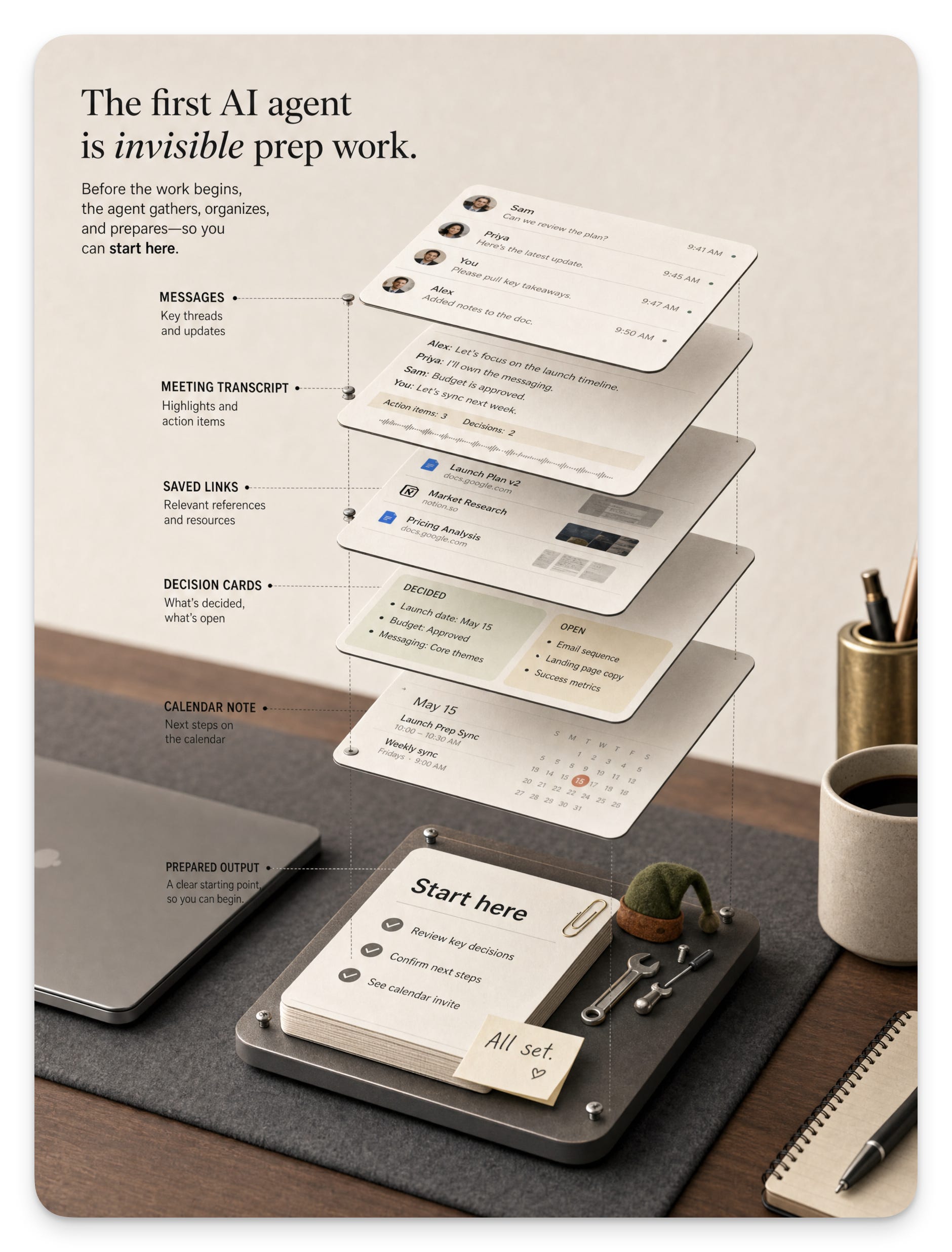
Two prompts that do one thing: Find the single piece of overnight prep that would change how your whole day goes, and hand you the one job your first agent should open with.
Pick by what your agent can reach today.
If you’ve got a chat window and nothing connected yet, run Version A. It interviews you.
If your agent can already see your email, Slack, calendar, and transcripts, run Version B. It skips the interview, reads your last two weeks, and can build the first artifact on the spot.
Version A: Any chat, no tools connected
Use this when you don’t have a connected agent yet. It works by interviewing you, one question at a time, then picking.
```text
You’re my operations partner. We’re hunting for one thing: the single piece of
prep an AI agent could finish before my workday starts that would change how my
whole day goes. One thing, not a list.
First, the bar. A high-leverage prep job is:
- Frequent: I hit it most days, not once a quarter
- Costly: it burns time, focus, or willpower before my real work begins
- Elf-able: an agent could do it while I sleep, with no decision from me midway
The thing I dread is a clue, not the answer. Sometimes the highest-leverage prep
is a cost I’ve stopped noticing because I just eat it every morning.
Interview me. One question at a time, five questions max. Start with the first
hour of my workday, then follow the friction: what I redo, what I hunt for, what
piles up, where I slip into busywork instead of the work that needs me.
Then stop and give me:
1. My real bottleneck, in one plain sentence. If the obvious answer is the safe
one and there’s a truer one I’ve been dodging, name that instead and say why.
2. The one prep job an agent should have done and waiting before I sit down.
3. What “done and waiting” looks like as a real artifact (a ranked list, a drafted
reply, a one-screen brief, name it).
4. The runner-up, and one line on why the winner beats it.
If you want to hand me two, you haven’t picked yet. Pick.
```
Version B: A connected agent (email, Slack, calendar, transcripts)
Use this when your agent can reach your actual tools. It finds the pattern in what really happened instead of asking you to remember it, and it can build today’s version of the artifact right there. Claude.ai, ChatGPT or Gemini should work, just make sure to toggle on the connectors.
```text
You have access to my email, Slack, calendar, and any meeting transcripts you can
reach. Use them. We’re hunting for one thing: the single piece of prep you could
finish before my workday starts that would change how my whole day goes.
Look across the last two weeks and find the pattern, not the one-off:
- Email and Slack: what do I open first, reply to fastest, or leave sitting? What
do I keep searching for before I can answer something?
- Calendar: what do I walk into unprepared? What recurring meeting needs the same
prep every time?
- Transcripts: what follow-ups, decisions, or ideas keep getting buried instead
of acted on?
Score every candidate against three tests:
- Frequent: shows up most days or every cycle
- Costly: burns time, focus, or willpower before my real work starts
- Elf-able: you could do it overnight with no decision from me midway
Then give me, grounded in what you actually found:
1. My real bottleneck, in one plain sentence, with the evidence that points to it.
2. The one prep job you should run before I sit down each morning.
3. What you’d have done and waiting, as a real artifact I could open and use.
4. The runner-up, and why the winner beats it.
If it can’t be done while I sleep, leave it off the list. One thing. Pick it.
Then, if you can, build today’s version of that artifact right now from what you
found, so I can see the elf’s first morning.
```
How to audit the answer
The finder worked if it handed you one job, not a list. If it gave you two, it didn’t finish. Send it back: “You handed me two. Pick one, and tell me why it beats the other.”
A good answer sounds like this:
> Your bottleneck isn’t volume, it’s that you rebuild yesterday’s context every morning before you can start. The one job: each night, pull the open follow-ups and waiting decisions out of yesterday’s calls and threads, so a one-screen brief per client is sitting there when you open the laptop.
A weak answer sounds like this:
> You should set up a system to stay organized and on top of your priorities.
Brilliant, as always!
This is epic. Called out. Thank you.