

When Obvious Becomes Invisible
You can’t explain what makes you different.
Not because you’re bad at marketing. Not because you lack expertise.
But because your most valuable expertise has become invisible, even to you.
And that invisibility is costing you everything.
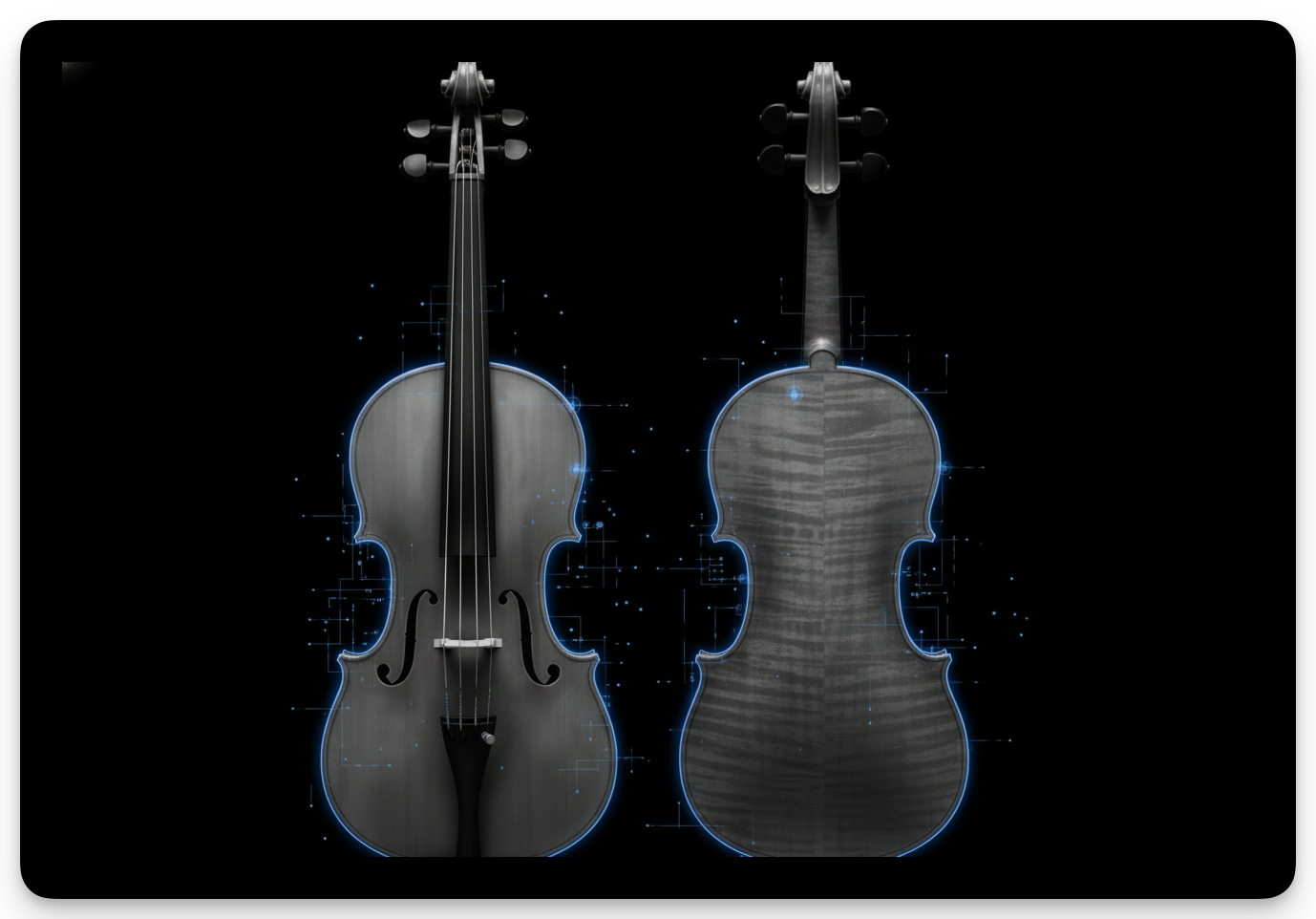
France, 1737. Antonio Stradivarius, the greatest violin maker who ever lived, knows he’s dying.
At 93, his breath is shallow and slow. His hands, callused from seventy years of chisel work, stained by countless coats of varnish, lie still against the bedsheets.
His two sons sit beside him. Francesco and Omobono. Men he’d trained since they were boys. Men who had spent decades in his workshop, watching every stroke of his chisel, every turn of the wood, every application of varnish.
Men who knew his methods better than they knew their own homes.
For years, musicians across Europe had begged Antonio to reveal his secrets. “What makes your violins sing while ours merely play?”
He’d always laughed. “I’ve taught my sons everything. Everything I know, they know.”
And he had. Everything he thought mattered, anyway.
The angle of the chisel, taught them that.
The mixing of the varnish, walked them through it a hundred times.
The selection of the wood, they’d felt every grain alongside him.
But when Antonio could no longer work beside them daily, something changed.
The instruments Francesco and Omobono crafted were still beautiful. Still functional. Musicians would describe them as “excellent, but no more than that.”
Excellent violins. Just not Stradivarius violins.
What died with Antonio wasn’t knowledge. He’d shared all of that.
It was the hundreds of micro-adjustments he made without thinking.
The pressure of his hand that felt “obvious” to him. The timing that felt “natural.” The quality he could sense in wood by running his fingers across it. A sensation he’d never thought to mention because it felt too simple to matter.
Scholars would later write that the workshop’s downfall “was embedded in all the subtle connections he didn’t record because they didn’t seem important at the time.”
Antonio Stradivarius couldn’t explain his expertise because he’d become too good at it.
His brain had automated the patterns so completely that they bypassed conscious thought.
The same thing is happening to you.
The Fatal Flaw in “Just Make It Obvious”
Most people think this is a communication problem.
Just find the right words. The right framework. The right documentation system.
For two centuries after Stradivarius died, that’s exactly what we assumed.
Then in 1916, a book called Obvious Adams appeared that became a business bible. The subtitle promised “The Story of a Successful Businessman.”
Its premise was seductive in its simplicity: If something is truly valuable, it should be obvious to everyone.
The author, Robert Updegraff, gave readers five tests of obviousness.
Does it solve a problem?
Is it obvious at first glance?
Can you do it immediately?
Will it pay for itself?
Will everyone understand it?
Adams built a career on this philosophy. Make everything clear. Make everything simple. Make everything obvious.
For over a century, this framework shaped how we thought about value and communication.
But Adams missed something crucial.
He was talking about ideas being obvious. Not expertise.
You can make an idea obvious by explaining it clearly.
But expertise doesn’t live in explanation.
It lives in execution. In pattern recognition that happens before conscious reasoning. In sensing mechanisms that bypass language entirely.
Adams’ framework worked for communicating ideas. It failed for transferring expertise.
Then in 1966, a Hungarian philosopher named Michael Polanyi published The Tacit Dimension and explained why.
He’d spent decades studying how scientists actually think, not how they say they think.
He discovered:
“We can know more than we can tell.”
Not won’t tell. Not don’t want to tell.
Can’t tell.
Study after study validated Polanyi’s discovery.
Cognitive psychologist John Flavell measured how much of our mental processing we can actually observe ourselves doing. His 1979 research showed only 15% is visible to us.
The other 85%? We can’t see it happening.
Hubert and Stuart Dreyfus, who spent decades studying how people develop expertise from novice to master, proved that expert intuition is 95% accurate but unexplainable.
70-90% of expert knowledge operates below conscious awareness.
It’s tacit. Invisible even to the expert themselves.
And your brain does this on purpose.
Conscious processing is slow and energy-intensive. As you master something, your brain moves it from conscious to unconscious processing.
And when it becomes unconscious, you stop seeing yourself do it.
When you can’t observe the complexity, it feels simple.
But it’s far from simple.
It’s ten thousand hours of pattern recognition, embedded in your neural wiring, executing in milliseconds.
It’s your exact combination of experiences, clients, failures, and breakthroughs processed in a way only you can.
It’s your Cognitive Fingerprint™.
Where This Pattern Shows Up (And What It Costs)
You might think this is just a violin thing. A quirk of craftwork.
But it shows up everywhere expertise exists. Even where millions of dollars ride on getting it right.
The Getty Museum, Los Angeles, 1984.

The museum is about to spend $10 million on an ancient Greek statue. They’ve done everything right. Fourteen months of scientific testing. Electron microscopes. X-ray diffraction. Core samples.
Every test says the same thing: authentic, ancient, buy it.
But before signing the check, they bring in one more group. Not scientists. Experts. People who’d spent their lives with Greek sculpture.
The first expert walks up. Looks at it. “The fingernails are wrong.”
The second expert stares. “It just looks too fresh.”
Evelyn Harrison, who’d spent forty years studying ancient Greek sculpture, has a different reaction entirely. She walks up to the statue. Her stomach drops before her brain can explain why.
Forty thousand hours of pattern recognition, firing faster than thought. She can’t explain it. Just a visceral ‘wrongness.’
The statue was fake.
The experts were right. The science was wrong.
When asked to explain HOW they knew, they couldn’t. The fingernails felt wrong. It looked fresh. It made her sick.
That’s 40,000 hours of pattern recognition firing in seconds.
The same pattern appears in life-or-death situations.
Johns Hopkins Hospital, One of the Nation’s Leading Medical Centers, 1986.
A nurse walks past a patient’s room. Glances in. Keeps walking.
Then stops. Goes back.
“Something’s wrong with that patient.”
The monitors say everything’s fine. Vitals are stable. No alarms. But the nurse knows and calls the doctor to insist.
The doctor, trusting her judgment, runs additional tests.
The patient was minutes from cardiac arrest. The monitors hadn’t caught it yet.
The nurse saved his life.
When asked how she knew, she shrugs. “I just... I’ve seen thousands of patients. Something was off.”
Hubert and Stuart Dreyfus studied expert nurses for years. They found they make critical decisions with 95% accuracy using intuition they cannot explain.
The better the nurse, the less they could articulate their process.
Your brain compresses 10,000 experiences into a feeling.
Consultants do the same thing.
A Discovery Call, 2024.
A prospect describes their business challenge. Three sentences in, the consultant knows exactly what the problem is.
Not the problem they’re describing. The actual problem underneath it.
The prospect keeps talking for 20 more minutes.
The consultant is already running mental simulations:
What they’ll recommend
Where the resistance will come from
What the sequence needs to be
By the time the prospect finishes explaining, the consultant has a complete strategy.
Ask them how they knew in three sentences, and you’ll get: “I’ve just seen this pattern before.”
But what they’re actually doing, according to cognitive scientist John Anderson’s decades of research at Carnegie Mellon, is running 50-100x more pattern recognition rules than a novice consultant.
They’re processing complex situations in milliseconds while novices need hours.
Why This Matters MORE Now
You might be thinking, if this has always been true, why worry about it now?
Because for the first time in history, you’re competing in a market where:
INVISIBLE = IRRELEVANT.
Here’s what’s happening right now.
A potential client needs strategic advice. They search for solutions. They find three types of sources:
Option A: Generic AI (ChatGPT, Claude) - Free, instant, good enough for 70% of problems
Option B: Consultants with visible frameworks - Recognized names, published methodologies, clear positioning. They can evaluate these experts because the frameworks are RIGHT THERE.
Option C: You - Exceptional results, decades of experience, but no visible framework. No proprietary methodology. No clear positioning.
Guess who’s invisible in that search?
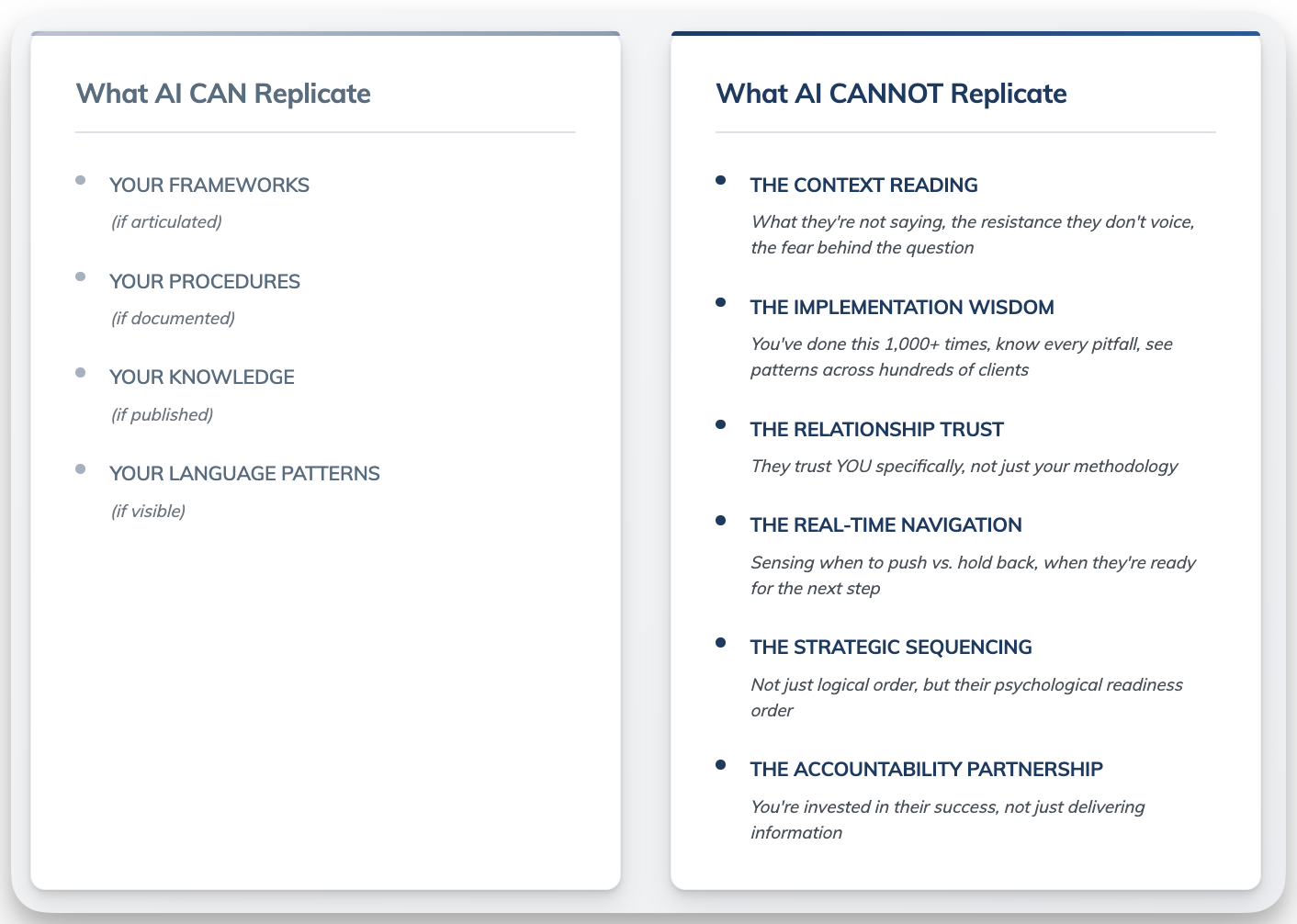
The threat isn’t AI copying your frameworks.
The threat is having NO frameworks to copy while others own your category.
Here’s what AI actually does to your expertise:
The Getty Museum experts saved a $10 million mistake with expertise they couldn’t explain. Incredible value.
But if you asked them to sell that expertise?
“I just... the fingernails felt wrong” is not a positioning statement.
The Johns Hopkins nurse saved a life with pattern recognition that happened faster than thought. Extraordinary skill.
But if you asked her to market that expertise? “I’ve seen thousands of patients. Something was off.”
That’s not a framework you can proliferate.
You right now, delivering brilliant results you can’t articulate.
That’s not a competitive moat.
That’s a visibility problem.
And in a noisy market where everyone claims to be an expert, invisible expertise might as well not exist.
The Jay Abraham Proof: When Sharing Everything Makes You More Valuable
Jay Abraham has shared his strategic frameworks publicly for over 50 years.
Books. Recordings. Seminars. Thousands of hours of content explaining exactly how he thinks.
Then he took it further.
He created an AI clone of himself. Not to replace him. To proliferate his thinking.
I co-author a AI newsletter with Michael Simmons and Jay where we publish prompts teaching people how to use AI to apply his strategies.
He’s literally helping potential clients replicate his frameworks without hiring him.
His frameworks are everywhere. Available. Copyable. Free.
He still commands $250,000+ per engagement.
Here’s what actually happens when your frameworks are visible:
The Proliferation Funnel:
Awareness - People discover your approach exists
Education - They learn your frameworks
Attempt - They try to apply them (via AI, DIY, competitors)
Barrier - They hit complexity, judgment, calibration needs
Demand - “I need THE expert, not the framework”
Jay’s AI clone isn’t competition.
It’s a lead generation machine that creates educated, pre-sold prospects who’ve already tried the frameworks and discovered they need him.
They don’t call Jay asking “What’s your methodology?”
They call saying “I tried using your frameworks. I need you to guide me through this specific situation.”
The visible framework created the market for the invisible execution.
People don’t pay for maps. They pay for guides.
But without a visible map, nobody knows you exist to hire as their guide.
What Stays Invisible (And Why That Limits You)
The stories you’ve read aren’t about expertise dying. They’re about expertise that stayed invisible, and what that invisibility cost.
Antonio Stradivarius made 10-12 violins per year for seven decades. Exceptional violins. The greatest ever made.
But he worked alone in his workshop, unable to systematize what made his instruments sing.
No “Stradivarius Method” for violin mastery. No book establishing him as the authority on instrument craftsmanship. No way to scale beyond his personal output or teach others to replicate his level of sophistication.
When Antonio died, his competitive advantage died with him.
Not because he was stingy with his sons. Because he genuinely couldn’t see what made him exceptional.
The Getty Museum experts save millions with intuition they can’t explain. “The fingernails felt wrong” isn’t something you can build a methodology around.
One expert, one authentication at a time.
Their sophistication is extraordinary, but sophistication you can’t articulate stays trapped at the scale of your personal capacity.
You deliver exceptional results. Clients love working with you.
But if someone asks what makes you different, you probably fumble.
You’re competing on credentials, not frameworks. “Experienced strategist” in a sea of experienced strategists.
Your sophistication stays locked in your execution, invisible to the market that could pay premium for it.
Jay Abraham understood what they didn’t.
Extract the patterns. Make them visible. Share them everywhere.
The frameworks create awareness and establish authority. Then the frameworks generate educated demand for the guide expertise that maps alone can’t provide.
Visibility unlocks proliferation.
↓
Proliferation creates positioning.
↓
Positioning commands premium pricing.
What Becomes Possible When Obvious Becomes Visible
Your intuitive “feel” becomes a named methodology. Not something you use internally, but the framework you’re known for.
The approach clients specifically seek out.
“I work with someone who uses The [Your Name] Method” becomes how they describe you.
Category ownership, not credential competition.
Your invisible sophistication becomes proliferated authority.
Stradivarius made 10-12 violins per year, maximum.
Imagine if he’d extracted his patterns into a teachable method. The definitive book on instrument mastery. Workshops. Certification programs.
Ownership of the violin craftsmanship category while still commanding premium for personal commissions.
His expertise compounding instead of capped at available hours.
You face the same constraint. You’re competing on credentials.
Extract your sophistication into visible frameworks you share everywhere—content, speaking, training, even AI versions—and you shift from generic positioning to category ownership.
From referral-dependent to sought-out specifically.
From trading hours to building authority that generates premium demand.
Stradivarius had the expertise but lacked the extraction tools.
You have both.
Stay invisible and compete on credentials?
Or extract, proliferate, and own your category?
Your Invisible Expertise Detector
You’ve just read about how mastery creates blindness.
You’ve seen it across art history, medicine, consulting, and countless other domains.
You understand that 70-90% of your expertise operates below conscious awareness.
But how do you know what your invisible expertise actually is?
I built something for that.
The Stradivarius Scanner.
It’s an AI-powered framework that analyzes transcripts of you working—client calls, workshops, strategy sessions—to reveal the sophisticated patterns you execute unconsciously.
The micro-adjustments, sensing mechanisms, and split-second calibrations that feel “obvious” to you but are actually your competitive moat.
Here’s what it finds:
The patterns you didn’t know you were running
The sophisticated systems operating on autopilot
The expertise that would die with you if not extracted
The valuable frameworks hiding in your “I just know” moments
Let me show you how it works.
I ran the scanner on a transcript from a coaching call. Not the whole thing, just a 12-minute segment where the coach was helping a client work through a business challenge.
Here’s what the scanner revealed:
STRADIVARIUS SCAN RESULTS
Executive Summary:
This consultant operates with a three-layer diagnostic system that would be invisible to anyone watching the call. The first layer tracks what the client explicitly says they need. The second layer identifies what they actually need (usually different). The third layer detects implementation blockers before the client even realizes they exist. All three run simultaneously, in under 5 seconds, every time the client speaks.
Micro-Adjustment Pattern #1: The Complexity Calibrator
The Visible Move: Mid-explanation, the consultant suddenly shifts from technical jargon to practical demonstration—seemingly at random.
The Invisible Sophistication: This isn’t random. When the client made a self-deprecating comment about having wine (”I had a glass of wine or two, so that’s probably why I’m not remembering”), the consultant registered it as cognitive overload. Not the words. The vulnerability signal underneath them. Most consultants would laugh and move on. This consultant unconsciously recalibrated the entire delivery approach in that moment.
Shifted from explaining WHAT the technology does... to showing HOW to use it.
From abstract to concrete. From lecture to demonstration.
The decision happened faster than conscious thought.
The Stradivarius Element: The trigger isn’t what the client says—it’s the gap between their question and their self-correction. That wine comment revealed overwhelm masked as humor. The consultant’s brain processed: “She’s tracking but saturating. Reduce cognitive load. Show, don’t explain.”
This can’t be taught as a rule because the detection window is measured in milliseconds. It’s a feeling, not a formula.
Evidence from Transcript:
[After the wine comment] Consultant immediately pivots: “So ChatGPT? Actually, they all use RAG databases already. So when you’re creating a GPT here, when you’re putting stuff in the knowledge file, this essentially is a RAG database.”
Translation: “You don’t need to understand the technical concept. You’re already using it.”
Normalized. Simplified. Zero condescension.
Micro-Adjustment Pattern #2: The Diagnostic Redirect
The Visible Move: Asked a simple clarifying question that seemed almost too basic: “And you’re saying it’s not easy to do for them to do, or not easy for AI to do for them?”
The Invisible Sophistication: This wasn’t a clarifying question. It was a diagnostic scalpel.
The client was spiraling into technical solution-seeking (”Should I use Relay? What about vector databases? Maybe custom GPTs?”). Classic consultant mistake would be answering those questions directly. This consultant recognized the real problem: she hasn’t clarified her actual goal yet.
That one question did three things simultaneously:
Forced separation between user experience and technical capability
Revealed whether this is a UX problem or a prompt engineering problem
Demonstrated active listening (not just waiting to pitch solutions)
The Stradivarius Element: The timing. The question came exactly when the client was about to get lost in the technical weeds. The redirect snapped her back to outcome-thinking.
You can’t learn this timing from a playbook. It requires detecting the moment someone shifts from “explaining their problem” to “drowning in possibilities.” That detection is pure pattern recognition—built over thousands of hours.
Evidence from Transcript:
Client: “...sometimes the AI output is, I think, because it’s in custom right now. Like, I’m wondering, is there somehow to create something that would be more... what’s the word?”
Consultant: “Customize.”
[Finishes her thought. Validates it. Then immediately reframes the actual constraint.]
Consultant: “Yeah, yeah, yeah. That’s the problem with GPTs...”
THE IRREPLACEABLE FINGERPRINT
Your 3 Most Distinctive Patterns:
1) The Demonstration-First Teacher
You don’t explain then show. You show then explain.
This inverts the traditional consulting model. Instead of building credibility through credentials, you build it through capability. “Let me show you” is your default response. Not “let me tell you about.”
This creates belief through experience, not persuasion.
2) The Four-Language Code-Switcher
You seamlessly move between technical, strategic, practical, and philosophical language—sometimes within the same sentence. Most consultants live in one mode. You switch based on what the moment requires. And you do it so smoothly the client doesn’t notice the transitions.
3) The Generosity Calibrator
You unconsciously calculate how much value to give away for free. Most consultants either hoard knowledge (to protect billable hours) or give away everything (and devalue expertise).
You’re doing neither.
You give away the “what” and “how” freely—while positioning the “for you, specifically” as the paid engagement.
When you offered to process her transcripts for free? That wasn’t random generosity. That was strategic demonstration. She experiences your diagnostic process firsthand. The offer itself proves capability. And it naturally leads to: “If you want the full extraction, here’s what working together looks like.”
What This Sample Means:
The diagnostic system you run unconsciously is your most valuable asset.
Right now, it only exists in execution.
If someone watches you work, they see the moves. They miss the sophistication.
What Dies If You Don’t Extract This:
The calibration system that adjusts complexity in real-time
The readiness detection that knows when to go deeper vs. pull back
The objection anticipation that removes blockers before they form
Your ability to diagnose what someone ACTUALLY needs (vs. what they say they need) is operating at a level most consultants never reach.
That’s not teachable from a playbook.
That’s 10,000 hours compressed into pattern recognition.
The question is: what are you going to do with it?
