

On a clear day in 2006, a controller at Chicago O’Hare’s TRACON facility was handling approach traffic. Twelve aircraft on scope. Seven in a descent sequence, five holding. Routine volume for the busiest airspace in the country.
Then three things happened in 90 seconds:
A regional jet missed its speed restriction
A FedEx heavy requested an early turn
A Cessna called in on the wrong frequency
The controller didn’t panic. He didn’t freeze. He looked at his radar strips. Moved two of them to the left side of his bay. Keyed the mic. Started sequencing. One instruction at a time. No rush in the voice.
But here’s what he didn’t do.
He didn’t try to hold all twelve aircraft in his head.
Every approach controller at O’Hare manages 20 to 25 aircraft at a time. That’s 857,000 movements a year. One every 37 seconds. The system works because controllers externalize almost everything.
Each aircraft gets a paper strip. Callsign, type, altitude, assigned heading. The strip sits in a physical bay, and when the controller issues an instruction, they mark it. The radar screen shows positions. The strips hold the plan.
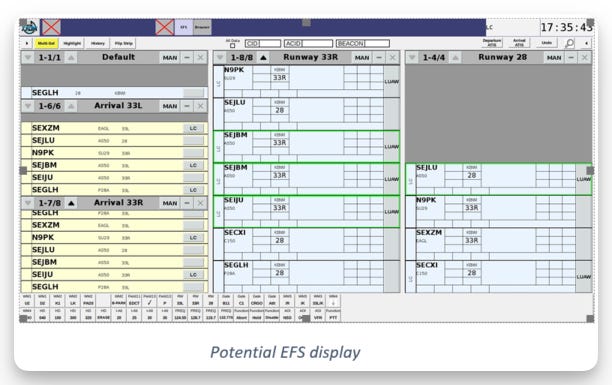
The controller’s working memory holds almost nothing. That’s by design.
On January 29, 2025, a controller at Reagan National was working a quieter shift. But the traffic was mixed in a way the system wasn’t built for. An Army helicopter was flying a training route along the Potomac. At the same time, a regional jet was circling to land on a runway whose approach path crossed the helicopter’s route. The two aircraft were on different radio frequencies which meant neither crew could hear the other.
At O’Hare, two separate controllers would have handled this. At Reagan that night, one controller was managing both. Federal investigators found the combined workload caused a loss of situational awareness. The controller lost track of the helicopter. In a disaster that years of warnings should have prevented, sixty-seven people died.
The Reagan controller’s working memory hit a wall. It wasn’t a skills wall or a training wall. It was a biological one, baked into every human brain, unchanged since before we had language to describe it.
Two types of traffic converging on the same airspace, two radio frequencies to monitor, and no second controller to split the load.
His brain was asked to hold what the system should have carried. It couldn’t.
Before You’ve Done a Single Thing
Your thumb finds your phone before your brain finds the morning. A red notification badge. An email you shouldn’t have opened. A calendar reminder for something you forgot to prepare. This list is already overflowing.
The client request you’ve been avoiding. Something about taxes. Your kid’s school project. The 30 emails you haven’t opened. A promise you made to review someone’s deck. A dentist appointment you keep rescheduling. And a nagging feeling you’re forgetting something important that you can’t quite remember.
Each one of those is an aircraft on your radar. And you’re holding all of them in your head.
And if you are like me there are no strips and no real system.
Just you, staring at the screen, wondering why you feel paralyzed before you’ve done a single thing.
What’s Actually Happening in Your Head
“The Magical Number Seven, Plus or Minus Two” (1956)
George Miller figured out the first piece in 1956. His paper, “The Magical Number Seven, Plus or Minus Two,” pinned down a hard limit. Human working memory holds about seven chunks of information. Not items. Chunks. The ceiling is the same either way.
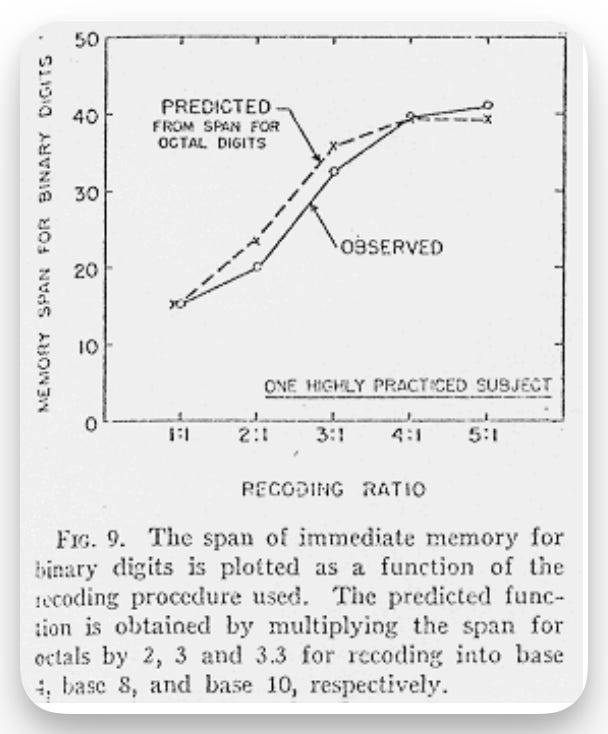
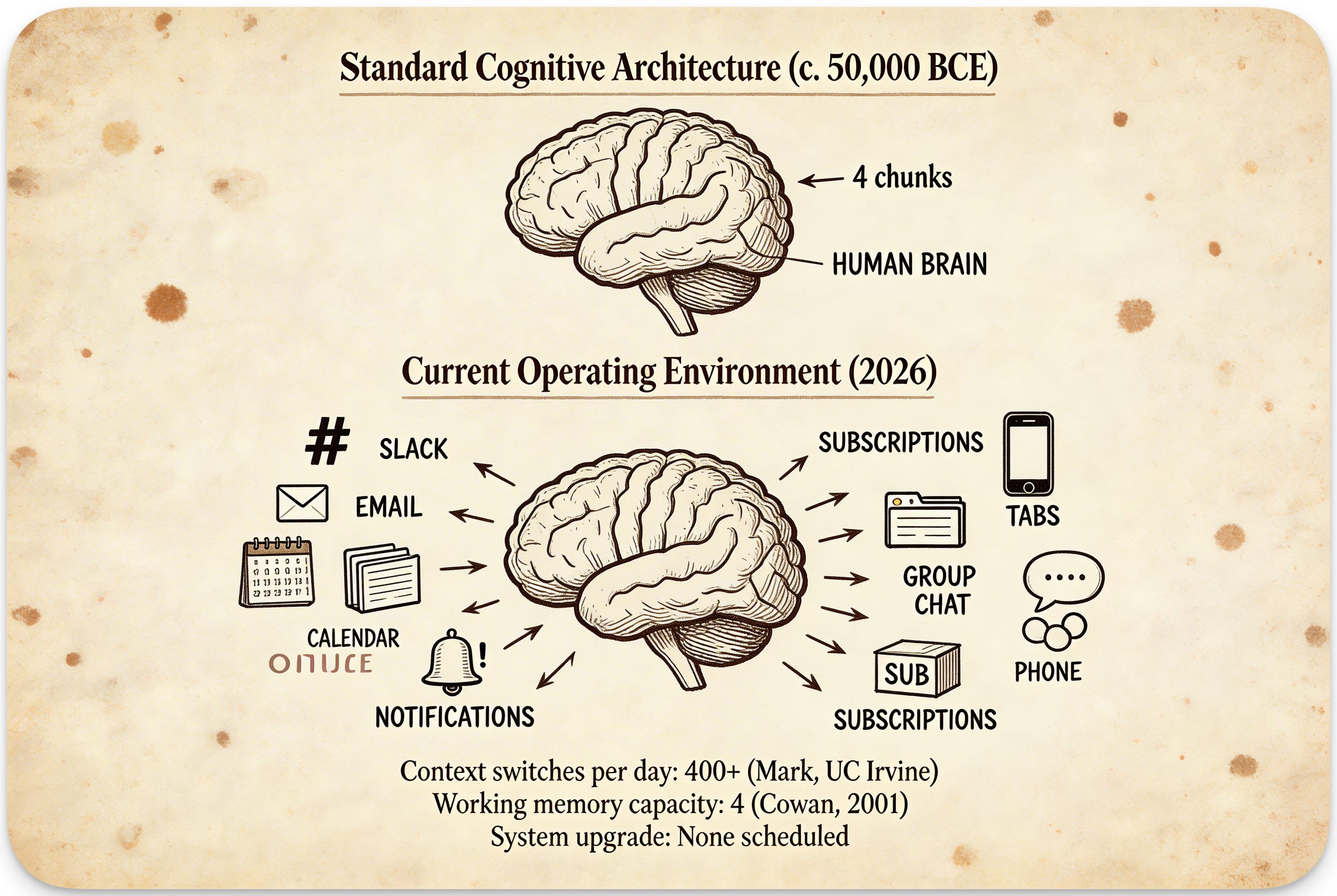
(Nelson Cowan revised it downward in 2001. His research suggests the real number is closer to four. That’s it. That’s what you have to work with.)
Miller himself was almost apologetic about it. He opened the paper by saying he’d been “persecuted by an integer.” The number is a hard constraint. Like the number of plates a waiter can carry. You can get better at stacking them, but you can’t change the size of your hands or arms or shoulders. (Some of these waiters are insane with how many plates of sizzling fajitas they can stack just on their forearms.)
“On Finished and Unfinished Tasks” (1927)
The second piece came earlier, from a Berlin restaurant in the 1920s. Kurt Lewin, a psychologist, noticed something about a waiter. The man could remember every detail of every open order... who ordered what, which modifications, which table. But the moment the bill was paid, the order vanished from his memory. Gone.
Lewin’s student, Bluma Zeigarnik, turned that observation into an experiment in 1927. She gave people tasks. Interrupted some of them halfway through. Then tested what they remembered. The interrupted tasks were recalled roughly twice as often as the completed ones.
Your brain does not let go of unfinished work. It keeps pinging you over and over like a social media app with those annoying notifications.
Every open loop takes a slot and holds it. Every vague commitment. Every “I should really...”
But oh buddy, it gets worse. The vaguer the task, the harder your brain grips it. “Something about taxes” can’t be chunked. Can’t be filed. It just sits there, taking up space, because your brain doesn’t know what to do with it and refuses to let go until it does.
I watched this happen to a client last month. Brilliant marketing guy about to launch a new campaign. He popped into our Zoom session and I could see the hopelessness on his face right away. He said, “I can’t think straight and I don’t know why.” We spent 11 minutes writing down everything competing for his attention. The list hit 23 items. He stared at it and said, “I thought it was three or four big things.” It wasn’t. It was 23 invisible things. Most of them small. None of them planned. All of them taking a slot.
You’re not carrying 14 tasks. You’re carrying 14 open notifications that your brain can’t swipe away.
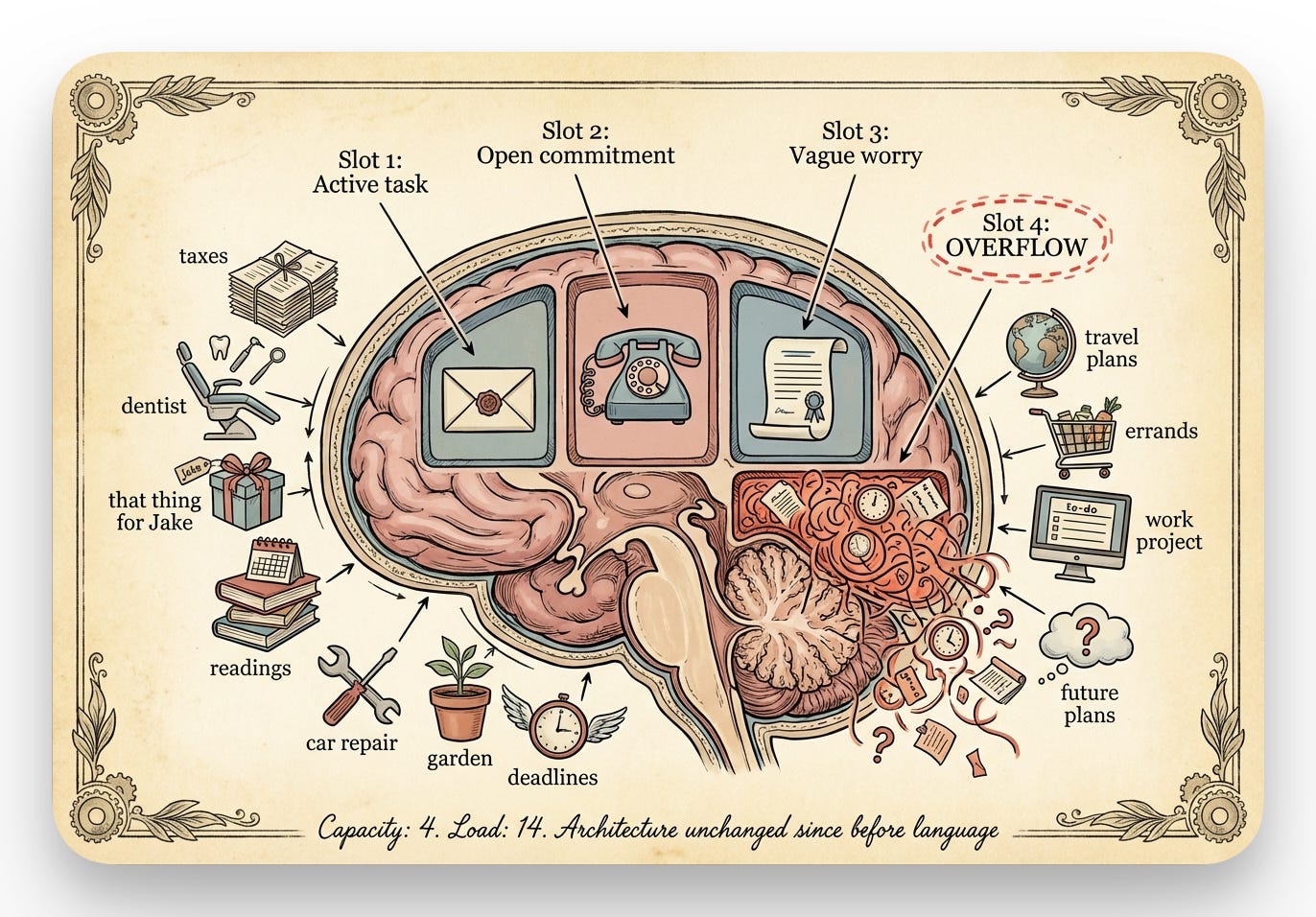
So it feels like you’re overwhelmed by how much you have to do. Like the volume is the problem.
In reality, you never had too much to do. You just couldn’t see what you were carrying. The tasks aren’t hard. They’re hiding. And you can’t take action on what you can’t see.
“Consider It Done” (2011)
The third piece came from Roy Baumeister in 2011. His paper was called “Consider It Done.” The title tells you everything.
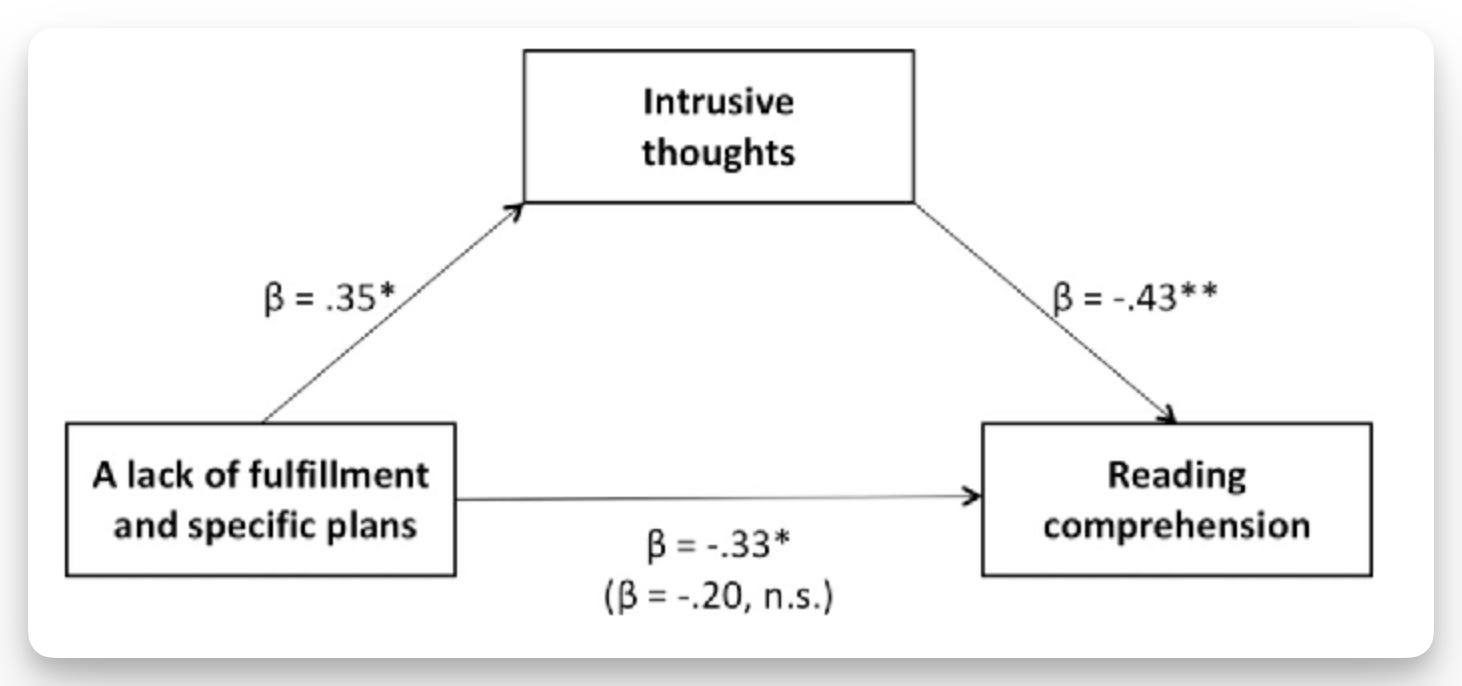
You don’t have to DO the task to release it from working memory.
You just have to make a plan.
A specific plan. Not “I’ll deal with it later.” A plan with a when and a how. “I’ll check the tax deadline tomorrow at 9 AM on the IRS website.” That’s enough. Baumeister showed that once the brain has a concrete plan, it files the task as handled. The intrusive thoughts stop. The notification clears.
The controller at O’Hare doesn’t remember which planes are descending. The strip remembers. His brain is free to handle what’s happening now.
Your brain is trying to be the strip AND the controller. At the same time. For 14 aircraft.
No wonder you’re anxious before 9 AM.
The People Who Look Calm
The people you know who seem calm under heavy workloads aren’t carrying less than you. They’re not better at tolerating the weight. They’re better at putting it down.
Their working memory is nearly empty. They probably have more to do than you. But nothing is living in their head unplanned. Every open item is visible somewhere. Every item has a next step. Every next step has a slot.
The anxiety doesn’t come from the work. It comes from it flying out of control in your head.
And the most counterintuitive part... the anxiety drops before you do a single task. Baumeister proved it. The moment the items move from your head to a visible, sequenced list, something loosens. Your brain stops clenching around every open item and lets the list hold them instead.
You don’t need to do less. You need a radar.
The Radar
Ten years ago, your scope held fewer aircraft. Now Gloria Mark at UC Irvine finds the average person switches context over 400 times a day. Each switch burns a slot you don’t get back before the next one lands. You’re running 2026 traffic volume on a 1956 cognitive architecture.
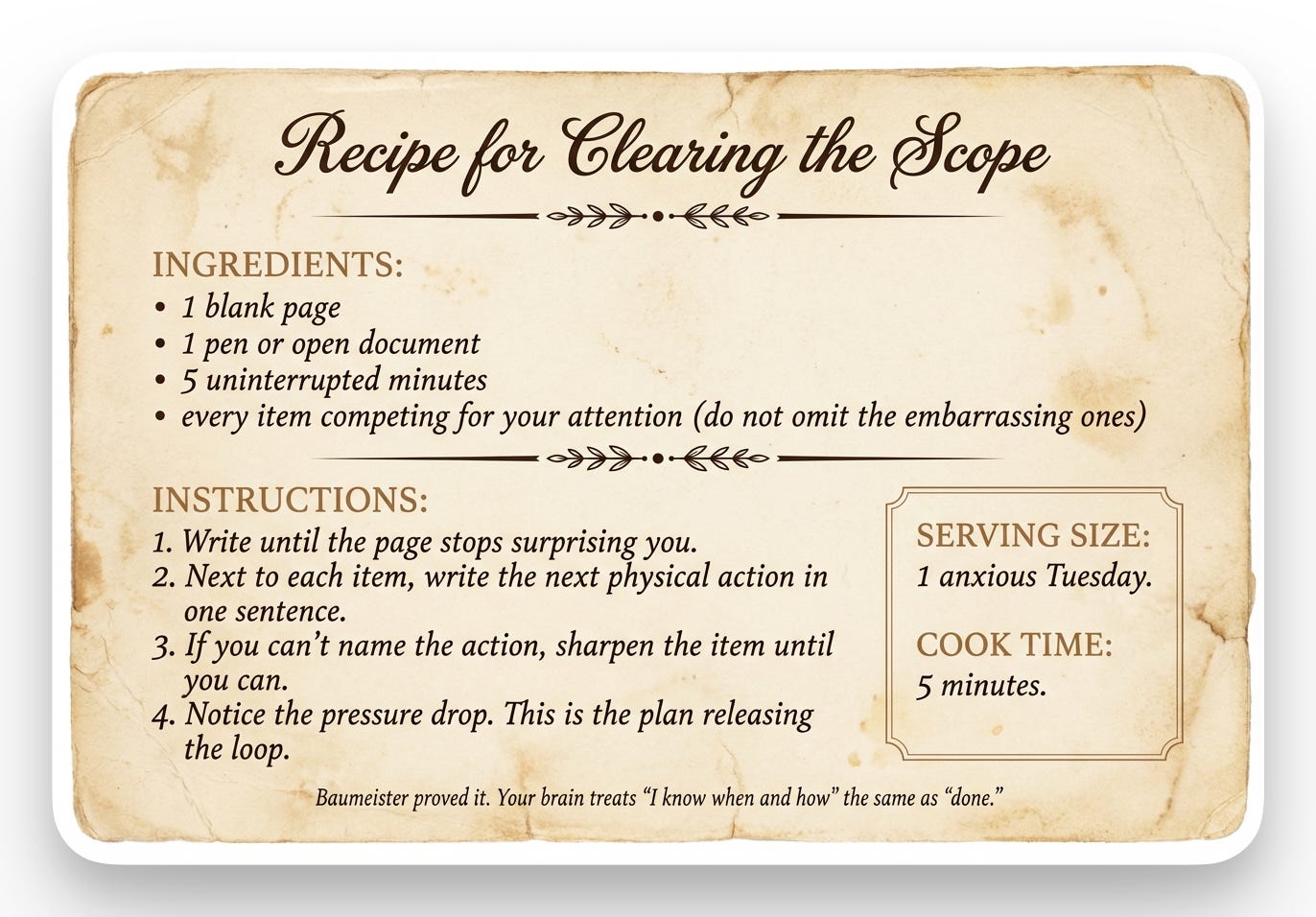
The next time the blob hits, try this. One thing. Five minutes.
Open a blank page. Write down every item competing for your attention until the page stops surprising you. Work, personal, half-formed, vague, embarrassing... all of it. Don’t organize. Don’t prioritize. Just get it out of your head and onto something you can see.
Then... before you do a single one... write the next action next to each. Not the project. Not the goal. The action. “Something about taxes” becomes “Google quarterly tax deadlines.” “That thing for Jake” becomes “Text Jake and ask for latest deck.” If you can’t name the action in one sentence, the item is still vague. Sharpen it until your brain can chunk it.
That’s the moment the pressure drops. Not when you finish the list. When your brain believes every item has a plan.
Baumeister proved it. Your brain treats “I know when and how” almost identically to “done.” The strips are in the bay. The radar is on. You can start working now.
One page. One pass. The anxiety has nowhere left to hide.
The Article Is the Proof
Your brain has been running an approach control facility with no external systems this entire time. Every unfinished thought from this morning, every half-read email, every “I should really...” has been sitting in working memory. Taking up one of your four slots. Refusing to leave.
The most anxious people I know aren’t the ones with the most to do. They’re the ones with the least visibility into what they’re carrying. The blob isn’t big. It’s opaque.
Feels like a character flaw. Like everyone else handles this better. Like you should be able to just... manage it.
The cost is that you’ve been blaming yourself for a design problem. Your working memory was never meant to carry your entire life.
Miller told you in 1956
Zeigarnik told you in 1927
Baumeister told you the fix in 2011
The anxiety is a signal. But your system has no radar.
Build the radar. The anxiety has nowhere left to live.
What It Looks Like When the Radar Works
Marcus is 42. Solo leadership coach. Recently separated. Six active clients, keeps dropping balls. He sat down on a Monday morning with coffee feeling paralyzed.
He opened an AI conversation and started talking.
Marcus: I have a client deliverable due Friday, Rachel, she’s waiting on a leadership assessment report. And I need to prep for a call tomorrow with my newest client, James, and I haven’t even looked at his intake form yet. There’s invoicing I’ve been avoiding for like two weeks. And I need to figure out the kids’ schedule for next month because Sandra and I are still fighting about who has them when and I just…I can’t think about that right now but it’s sitting there...
The AI didn’t advise. Didn’t organize. Just said “keep going” and “what else?” When he said “it’s all a blob,” it said “That’s exactly why we’re doing this. Keep going.”
He kept going. Therapist he’s been meaning to find for two months. Conference early bird he keeps missing. Newsletter he skipped last week. Emails he’s afraid to open.
Then it mirrored everything back.
AI: That’s 15 items. They’re all here now. You can stop holding them.
Marcus: Seeing it like that is... weird. It felt like way more in my head.
Then it clarified each item. One question at a time.
AI: The kids’ schedule with Sandra — is there an action on your side?
Marcus: I need to text her with my availability for the next six weeks. I keep not doing it because every conversation turns into a fight. But the action is just sending the text.
AI: The therapist — do you have anyone in mind, or is step one finding names?
Marcus: I could ask my doctor for a referral I guess.
AI: So the action is: text or call your doctor’s office and ask for a referral.
Marcus: That’s so obvious. Why haven’t I done that.
Then it built his day.
Today’s queue:
Email scan (~25 min)
James call prep (~1 hr)
Tom — reschedule text (~5 min)
Invoicing (~20 min)
Rachel’s report (3–4 hrs) — This is the win.
You have 5 actions today, 7 this week, 2 parked, 2 waiting. Your next move is #1. Open the inbox. Go.
Marcus: I feel weirdly better. Like nothing changed but I can see it now.
Nothing changed. He just stopped holding all of it in his head at once.
Five minutes. Fifteen items. A sequenced plan. The anxiety dropped before he touched the first task.
The Gap
You now know what’s happening in your head. You have the blank page method. And you just watched it work on someone carrying 15 invisible items.
But here’s what I’ve watched happen next. You’ll try the blank page once. Maybe twice. The third time the blob hits... you’ll open the page, write four things, get stuck on the fifth because it’s vague, feel the anxiety spike again, and close the document.
The method works. The follow-through doesn’t.
Because doing this yourself requires you to be your own interviewer, your own clarifier, and your own sequencer... while your working memory is already full. You’re asking the overloaded controller to also be the strip, the bay, and the radar. At the same time.
Marcus didn’t do the blank page. He had a conversation. The AI asked the questions his brain couldn’t form. It held the items his working memory couldn’t carry. It clarified what he was too foggy to sharpen on his own. And it built the queue he didn’t have the bandwidth to sequence.
That’s the difference. The insight is free. The mechanism that runs it while your brain is drowning is what I built next.
The Clarity Protocol is a set of AI prompts you paste into Claude, ChatGPT, or whatever you already use. They do what Marcus experienced... interview you, surface everything you’re carrying, clarify each item into a concrete next action, and hand you a sequenced plan. Three prompts, a voice mode version that does it all in one conversation, and the full walkthrough are below.
Build the radar. The anxiety has nowhere left to live.
The Clarity Protocol
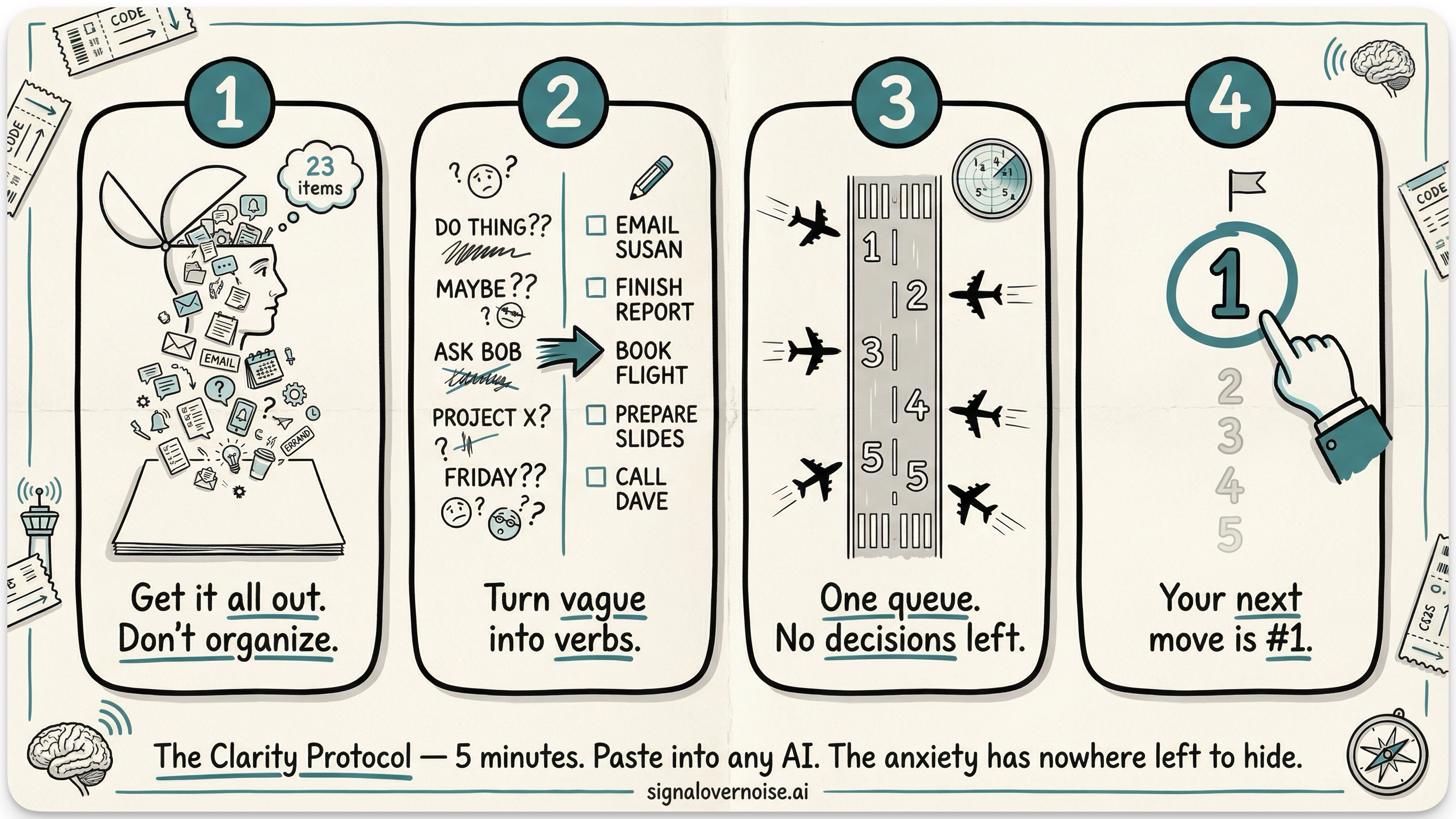
Four prompts. Paste any of them into Claude, ChatGPT, or Gemini. They work the same way Marcus experienced it….
