He takes a breath, drops backward off the side of a wooden boat with a spear, and disappears.
You wait. A minute. Two. Five.
There’s no way he’s still down there!
This is the Bajau, Southeast Asian sea nomads who have spent centuries living on boats, visiting land only for supplies, and spending five hours of every working day underwater. The most extreme of them can dive 200 feet on a single breath and stay submerged for thirteen minutes.
And for a long time, nobody could explain how.

In 2018, a Berkeley PhD student named Melissa Ilardo arrived with an ultrasound machine and started doing scans.
The Bajau spleens were 50% larger than those of their non-diving neighbors. She sequenced the DNA and found a specific mutation in the PDE10A gene. The Bajau had evolved a biological scuba tank inside their bodies, an oversized organ that stored extra oxygenated red blood cells and released them during dives.
They’d been carrying it inside them for generations and they had ZERO idea.
You too have a superpower that has been invisible to you your whole life. But you can’t see it because you’re too close to it.
I call this your Cognitive Fingerprint™. The signature patterns underneath your expert work. These are often invisible to you, but your transcripts can bring them to the surface…if someone knows what to look for.
That is exactly what happened with a financial advisor I’d spent weeks building a system for. He had no idea what was inside him or his transcripts, either.
He Started Typing Something I Never Taught Him
We fed twenty-some client meetings through the analysis. Pulled patterns out. Configured prompts to his specific sequences, decision DNA and even his blindspots.
One morning, he was on a Zoom call with me, poking around and testing things.
Then he stopped clicking and started typing:
“This prospect just ghosted me on our 2nd presentation after I thought we nailed it. Before I send my usual follow-up, can you look at this transcript and see if there were any red flags I was missing?”
That wasn’t in my documentation. That wasn’t part of any setup walkthrough. He just... felt it. I sat there watching him troubleshoot his own sales process with an AI that actually understood how he sells. What happened next was pretty darn incredible.
Eight Times Per Meeting
His system knows things about him that he didn’t know about himself.
It knows he says “How are you for time? Any questions before we move on?” eight times per meeting. Eight. I showed him the analysis and he laughed out loud. He’d never counted.
It knows his Bucket Framework. Soon, now, later. And that he runs the same sequence every single time without variation. Time horizon first. Then purpose. Then products. He thought he was improvising. He wasn’t.
It knows the spending permission reframe. This is the thing that makes him different from every other financial advisor running the same financial playbook.
And most importantly, when it has the full picture, it knows “why” he does all of these things and can give him “obvious” recommendations that he couldn’t see himself.
In the scenario above, AI told my client there were multiple red flags during the first meeting that indicated the couple was nervous and “do not send” his normal follow up email. They probably already feel guilty about not showing up and calling them out would just send them into the hiding.
Based on the recommendation, he pivoted and sent a completely different message than we was planning to.
“They called back an apologized 20 minutes later and were back in the office one week later! Incredible!”
This goes beyond just a one-time, “I need to save this account” situation.
For instance…
When projections show a client leaving $5 million to their kids, most advisors nod approvingly. He catches them by surprise and says “this means you could spend more now.”
His clients aren’t just afraid of running out of money. They’re afraid of dying before they enjoy retirement. Their spouses keep asking them to slow down. Take a trip. Actually live a little before it’s too late.
And then their financial advisor, the person they expect to lecture them about saving more, tells them to spend.
You can watch the tension leave their shoulders. According to him, “I don’t know, that is just what I do.”
But here’s what those patterns look like when you pull them out and document them:
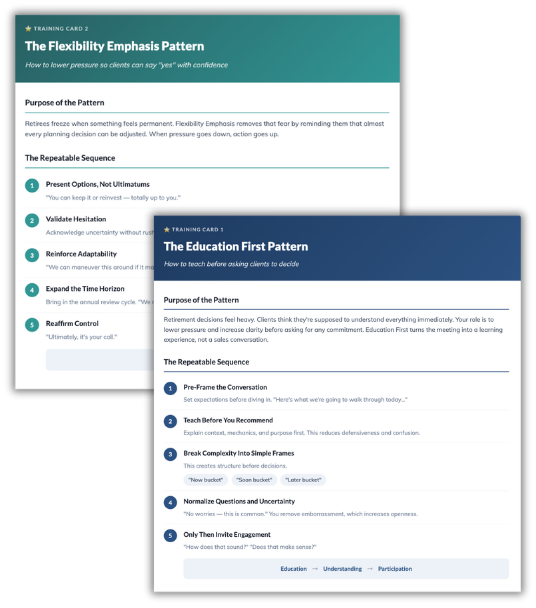
The “Flexibility Emphasis Pattern” on the left. Five steps he runs every time a client freezes up about making a permanent decision.
The “Education First Pattern” on the right. His sequence for teaching before asking.
He didn’t write these. I extracted them from his transcripts. He runs them automatically, the same way every time, and had no idea how consistent he was until someone showed him. When he needs to teach his junior advisors his process, the level of sophistication, customization and depth goes way beyond anything he’s done before or was able to generate from just prompting ChatGPT.
The 90% That Never Made It onto Paper
This is why expertise can’t be extracted from what people say about themselves. Books, courses, interviews, biographies. They all capture the explicit stuff. The 10% that made it onto paper.
The other 90% never got documented. It’s sitting in the nervous systems of people who’ve been doing the work for decades.
There is nothing new about the phenomenon. Cognitive scientists have been mapping it for sixty+ years.
Michael Polanyi called it tacit knowledge
The Dreyfus brothers tracked how it develops
Gary Klein watched experts make impossible decisions on instinct
Their conclusion came down to the same thing.
When things look familiar, experts don't deliberate. They execute.
Tacit knowledge (the execution) is the methodology hiding inside your transcripts. The patterns you run without realizing you run them.
But here’s the thing about this elusive little concept…
You can read everything ever written about tacit knowledge and still not have any.
You can’t prompt your way to it.
You can’t even ask the expert to explain it.
Polanyi himself said,“We know more than we can tell.”
You have to earn tacit knowledge yourself. There’s no shortcut.
And even after you’ve earned it, that sucker still refuses to let you know it’s there.
545%
A company wanted to figure out why some of their salespeople closed deals at 2-3x the rate of everyone else. They were using the same product, scripts and in the same market as their colleagues. But they were getting wildly different results.
So they studied them. Thousands of’em.
Almost half the managers and observers had no idea what made their best people the best.
So Cresta pointed AI at the transcripts.
Not asking anyone what they did.
Watching what they actually did.
They found four specific micro-behaviors that separated the top performers:
Setting expectations
Asking discovery questions
Handling objections
Closing
But the real hero was discovery questions. On average, top performers asked 48% more and on certain types )needs-focused, upsell) the gap widened to 545%.
Five hundred and forty-five percent.
These patterns were invisible to everyone, including the people doing them. The behaviors were so automatic that nobody could see them until AI surfaced them from the transcripts.
The Four Boxes He Checks When a Deal Dies
The financial advisor has his own checklist now.
At the end of each day his transcripts are auto-processed through his AI system, loaded with his Cognitive Fingerprint scanning for his superpowers in action. It’s helping him:
Scale his expertise without slowing down: Transforming his daily, unconscious habits into a tangible, growing library of training assets without requiring him to spend hours lecturing his team.
Decode his own “invisible” moves: Pinpointing the exact moment he successfully deployed a technique like “The Value Reframe” or “The Permission Check,” isolating the precise phrasing and timing that made the client say yes.
Feed his “training engine in a box”: Automatically generating fresh, one-page Advisor Training Cards based on real-world scenarios from that exact day, rather than relying on stale, hypothetical theory.
Standardize firm-wide excellence: Giving less experienced advisors a daily, updated playbook of recognition triggers, success indicators, and exact quotes they can review before their own meetings tomorrow.
Audit his own consistency: Providing a daily mirror to ensure he is continually executing his high-scoring patterns—like “The Education First” and “The Spending Shift”—at the highest possible level.
Protect and codify his intellectual property: Systematically capturing the unique, proven frameworks that drive his firm’s revenue so they become permanent, transferable assets rather than just ideas stuck in his head.
That’s the system surfacing what was inside him from the work he was already doing.
What Would Your AI Tell You?
What would your AI tell you about your last five calls?
Probably something useful. The kind of feedback most AI can give about most conversations in your industry.
Now imagine asking a different question.
“This one didn’t convert. Check it against my methodology. What did I miss?”
That requires something different. A system that knows your patterns. Your sequences. The micro-behaviors you’ve been running for years without realizing how consistent you are.
One reads the transcript. The other reads you.
You can see what he built. What you can’t see is how to build it for yourself.
THE THIRTEEN-MINUTE METHOD
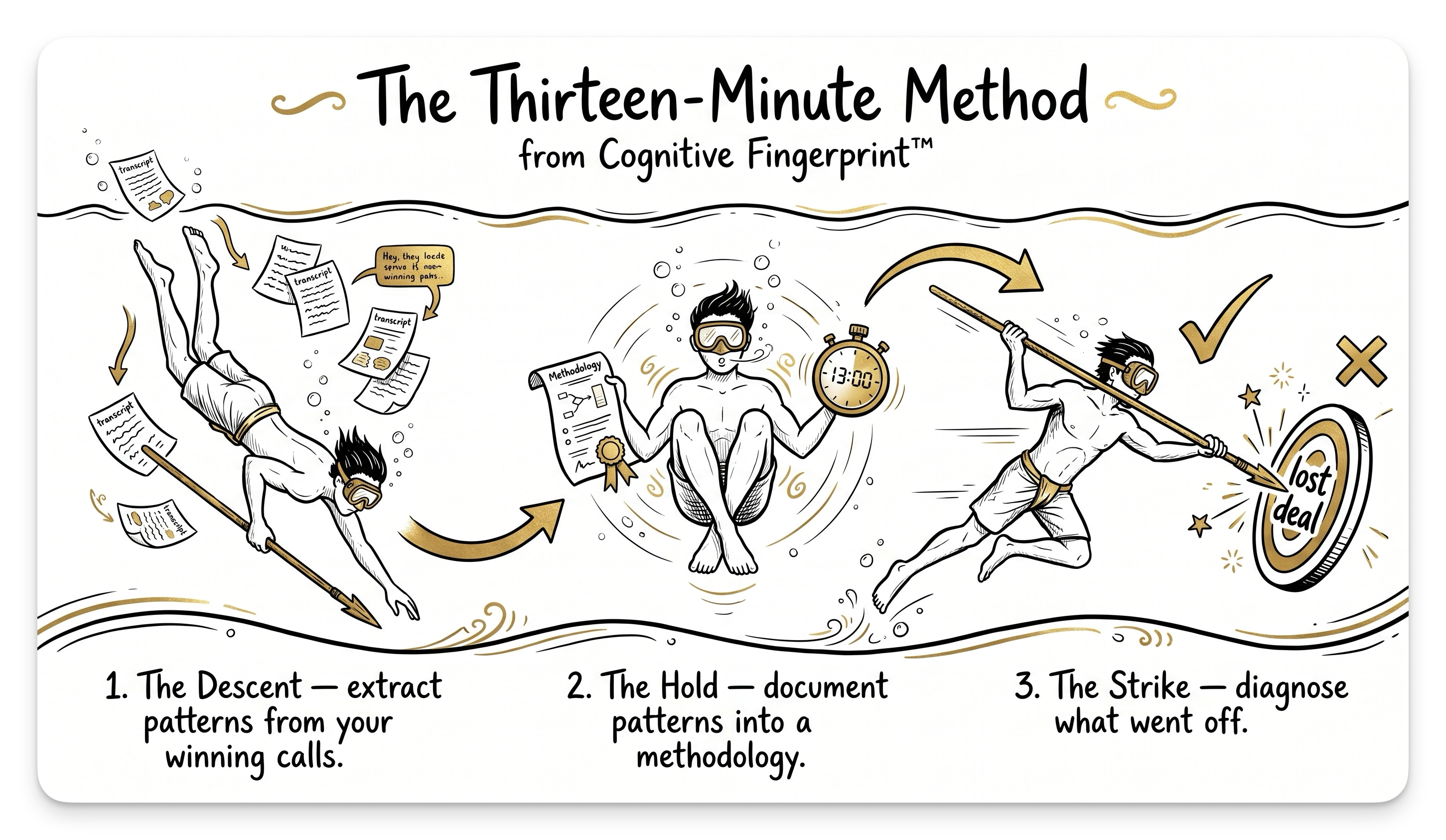
Three prompts that turn your transcripts into a closing edge you can run against any conversation, forever.
The Bajau go down with intent and come back with what they went for. Same idea applied to your transcripts.
How to Use This Kit