

The empty truck rattles loudest. Tonight, you’ll be sitting across from the loudest truck at the table.
Today, somewhere between the turkey and the pie, it will happen.
Your uncle will lean back in his chair and start explaining your industry to you.
He read an article. Maybe two. Caught something on a podcast last week. And for the next twenty minutes, he’ll hold the table’s attention while you sit there. Fifteen years of experience, waiting for a pause that never comes.
You’ll try once.
“It’s actually more complicated than that.”
The words hit the table like the announcement that you brought a salad. Polite nods.
Zero enthusiasm.
You bill $300+ an hour for this expertise. You’ve spent a decade learning what he just summarized in three confident sentences. But at that table, he’s the authority.
And you can’t figure out why.
The Empty Truck
There’s an old saying: The empty truck rattles loudest.
Tonight, you’ll be sitting across from the loudest truck at the table. Full of nothing.
Making all the noise.
Your uncle isn’t stupid. He’s just empty on this particular topic. And empty containers make noise.
Full containers don’t.
You’re full. Fifteen years of nuance, exceptions, edge cases, failures, hard-won lessons. Packed so tight that when you open your mouth, nothing rattles:
“Well, it depends on the context.”
“There are actually several factors.”
“It’s more complicated than that.”
He says: “The problem is simple, and here’s the solution.”
Guess which one sounds more credible to your aunt, who sells real estate, and your cousin who works in HR?
The empty truck wins. Not because he’s right.
Because he’s loud.
Mount Stupid Has a Megaphone
You’ve probably seen the Dunning-Kruger curve. There’s a peak early on called “Mount Stupid” where confidence is highest because you don’t know enough to doubt yourself.
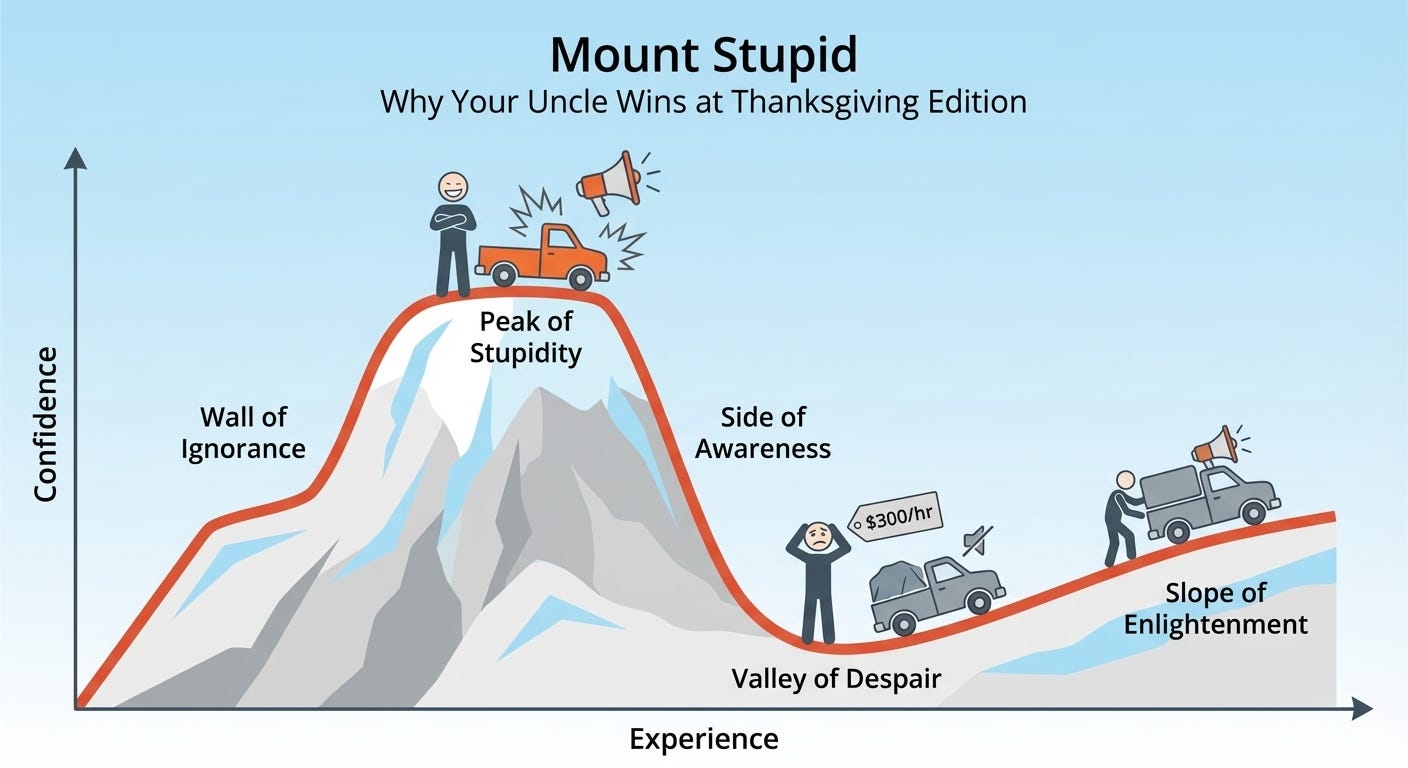
Your uncle lives at the peak. Great view. Zero cell service to reality.
But Mount Stupid has a megaphone. The Valley of Expertise (where you live after 10+ years) is basically soundproofed. You know too much. Every statement comes with seventeen caveats. By the time you’ve formulated a properly nuanced response, he’s on his third topic.
The Dunning-Kruger effect explains more than confidence. It explains volume:
→ The less you know, the simpler everything seems.
↳ The simpler it seems, the easier it is to explain.
↳ The easier it is to explain, the more persuasive you sound.
You’re losing because expertise creates silence. And silence doesn’t win arguments.
But silence isn’t the only thing working against you.
Why Confidence Beats Credentials
The Dunning-Kruger curve explains his confidence. But it doesn’t explain why confidence wins. For that, we need Robert Cialdini, who studies influence. One of his findings has always stuck out to me:
People followed actors in lab coats giving dangerous medical advice. The symbol of authority mattered more than actual expertise.
Read that again.
Your uncle has a symbol: certainty. It’s visible. It fills the room. When he says, “the problem is X and the solution is Y,” your aunt’s brain registers: this person knows things.
You have actual authority. But it’s invisible. When you say, “Well, there are multiple factors at play, and it really depends on the specific context of the implementation,” your aunt’s brain registers: this person seems unsure.
Cialdini’s research explains why your uncle wins.
Authority requires visible triggers to activate. Confidence is visible. Nuance is not.
This is why consultants with clear frameworks outperform experts with decades more experience. The framework is the lab coat. It’s the symbol that triggers authority.
Your expertise doesn’t have a lab coat. It’s usually dressed with “well, actually” hedges that make you sound uncertain.
The Hedging Tax
Every “it depends” costs you.
Every “well, actually” costs you.
Every “that’s complicated” costs you.
Not because you’re wrong (you’re almost certainly right) but because hedging is invisible. Your uncle pays no hedging tax because he doesn’t know enough to hedge.
Watch what happens at the table:
Him: “The real problem with [your industry] is that companies just need to focus on [oversimplified solution]. It’s honestly not that complicated.”
You: “Well, there’s actually a lot of nuance there. It depends on the size of the organization, the existing infrastructure, the regulatory environment, and honestly, most implementations fail not because of the strategy but because of internal politics that--”
Him (interrupting): “See, that’s the problem. People overthink this stuff.”
And somehow, he sounds like the expert. You sound like you’re not sure about your own job.
Your hedging doesn’t register as expertise. It registers as uncertainty. You’re transmitting on a frequency only other experts can hear. To everyone else at the table, you’re just... hesitating.
Why You Can’t Explain What You Do Best
Your uncle can explain everything he knows about your industry. Takes him about three minutes.
You can barely explain anything you know. Because you know too much.
Cognitive scientists call this the expertise paradox. The Dreyfus brothers studied skill acquisition for decades and found something that should bother you: at the highest levels of expertise, practitioners can’t explain what they do.
Novices follow rules. They can recite them.
Experts have internalized the rules so deeply they’ve transcended them. The rules are now invisible, automatic, unconscious. When you try to explain your expertise, you’re describing a process that no longer runs through conscious thought. The part of your brain doing the work can’t talk to the part that forms words.
Your uncle’s knowledge is 100% conscious. He can articulate every bit of it because it’s all surface-level.
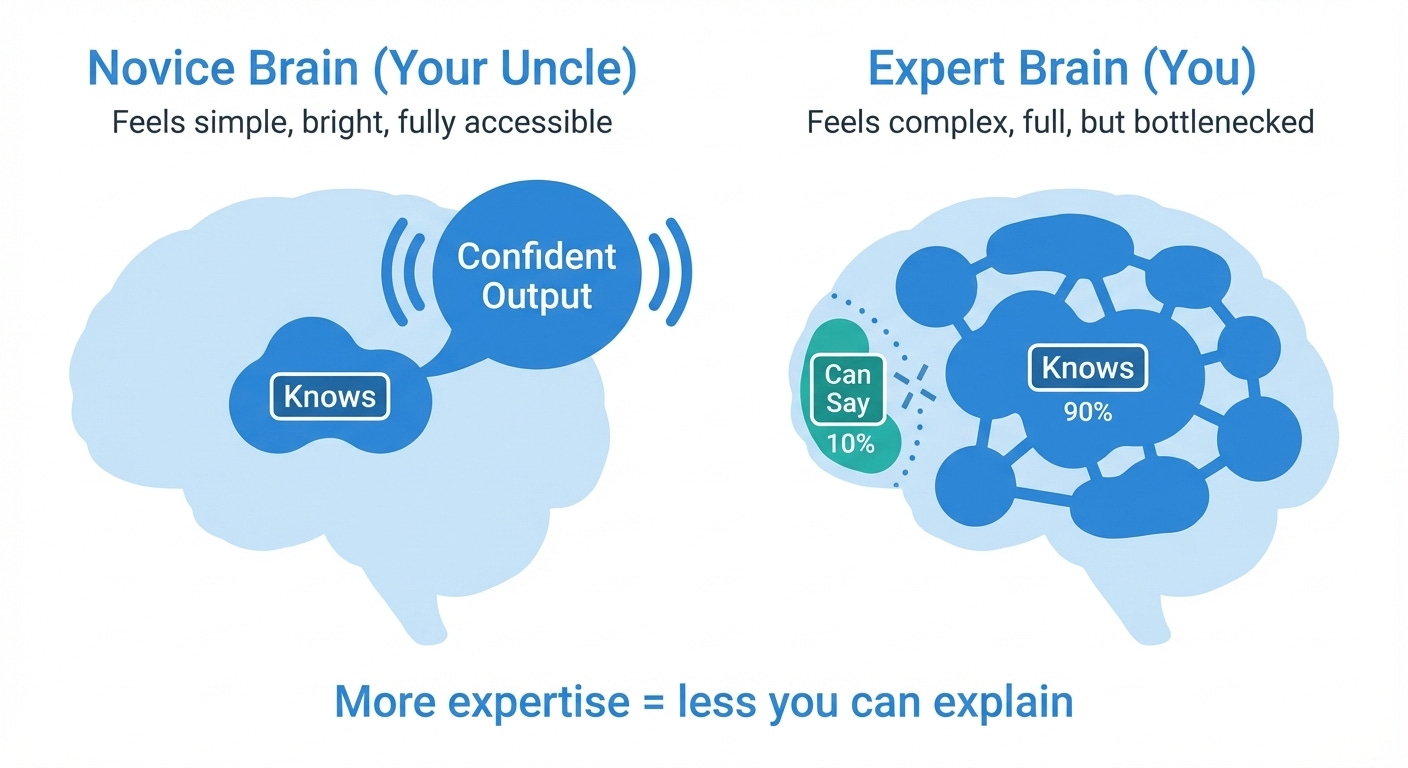
Your knowledge is 90% unconscious. The best stuff (the pattern recognition, the intuition, the instant diagnosis) runs on neural hardware that can’t talk to your speech centers.
“I just know” is actually a sign of mastery. But it sounds like BS to everyone who hasn’t earned it.
(There’s a test for this at the end. I ran it on myself. It was uncomfortably accurate.)
His Bad Framework Beats Your Good Instincts
That article your uncle read? It gave him a framework.
Probably a bad one. Oversimplified. Missing crucial nuance. Maybe even wrong.
But it’s visible.
Marketing expert Harry Beckwith spent years studying why services are hard to sell.
His conclusion: when people can’t see what they’re evaluating, they look for any clue they can find. Any clue at all.
Your uncle’s framework (even a bad one) is a clue. Your nuanced expertise is invisible.
A wrong framework beats no framework.
Every time.
This isn’t fair. But it’s predictable. And once you see the pattern, you at least know the game you are playing.
A friend told me last night,
“I’m always early on these things. Ahead of the curve. Then something happens, and I don’t capitalize. I don’t talk about them. I don’t ship. People who know half as much as me end up cashing in.”
He wasn’t talking about Thanksgiving. He was talking about his career.
This Pattern Is Costing You Clients
This dynamic doesn’t stay at dinner. It follows you to client pitches, sales calls, and competitive situations.
Every time a prospect says “you all seem pretty similar,” they’re telling you your expertise is invisible. They can’t see the difference between your fifteen years and someone’s fifteen months.
Every time you lose to a cheaper competitor with a clearer framework, you’re watching the empty truck win again.
Every time a client hires the confident bullshitter over the nuanced expert, Mount Stupid claims another victory.
The Thanksgiving table is just the small-stakes version of a pattern that’s costing you real money.
Which raises the question: what do you do about it?
The Real Problem (And What to Do About It)
The problem isn’t your uncle’s confidence.
The problem is your invisibility.
His certainty is a feature, not a bug. It’s supposed to be persuasive. That’s how confidence works.
Your silence is also a feature of expertise. It’s supposed to happen when you get really good at something. Your best patterns become automatic and invisible, even to you.
But invisible expertise doesn’t win clients. Doesn’t command premium fees. Loses to empty trucks with megaphones every time.
The solution isn’t to become a BS’r. You couldn’t do it if you tried. You know too much.
The solution is to make your expertise as visible as his confidence. Build the framework you’ve been running unconsciously. Turn what you “just know” into something others can see.
You don’t need to create expertise. You need to extract the expertise you’ve already built and make it visible.
THE UNCLE TEST
The Uncle Test takes your LinkedIn profile and shows you what people actually see when they look at your expertise and what they’re missing entirely.
Four parts:
Uncle Version: The oversimplified version a confident non-expert would repeat (what’s visible)
What Uncle Missed: The invisible expertise hiding in your work—the 90% you’ve never articulated
Aunt Test: Your work explained so clearly someone outside your field could repeat it tomorrow
Megaphone Draft: Your headline calibrated from “underselling” (where you probably are) to “Mount Stupid confidence” to “right-sized”
The gap between Part 1 and Part 2 is your invisibility gap. It’s exactly what’s costing you when prospects say, “You all seem pretty similar.”
Five minutes. You’ll laugh, then wince, then probably update your profile.
Here is some from mine…it actually made me “lol” then had the feeling of, “ah sh*t this is pretty accurate, I better change some things”.
What The Uncle Test Found (When I Ran It On Myself)
PART 1: THE UNCLE VERSION
“Max does marketing. He used to work at some big pet medicine company—did really well there, made them a lot of money. Now he’s a consultant who helps businesses with their messaging. He’s also really into AI for some reason. Basically, if you need help with your marketing or figuring out what to say about your business, he’s your guy. Oh, and he went to Auburn.”
The AI mention got reduced to “he likes AI” when it’s actually the mechanism—the first technology that can mirror cognitive patterns back to their owner.
Why This Matters: The Uncle Version reveals that my profile communicates “marketing consultant” when my actual work is something more specialized that doesn’t have a common name yet.
My Take: Let me know if this sounds familiar, but I check my LinkedIn profile less often than I get my oil changed (supposed to be every three months, right?). In reality, this is a landing page. It’s searchable, discoverable in Google, often the first thing people check before getting on a call. This needs to be more of a priority and honestly doesn’t require a ton of work. (Get it together, Bernstein.)
PART 3: THE AUNT TEST
“He’s like an investigative journalist for business experts. He digs into how they make decisions, finds the patterns they don’t even realize they use, and writes it all down so they can finally explain what makes them different.”
Why This Matters: If your aunt can repeat it, your prospects can remember it. My current tagline—” making invisible expertise visible”—is poetic but not concrete enough to survive retelling.
My Take: We’re too close to our own stuff. Can’t see the label from inside the bottle. This is such a great reminder.
THE VERDICT
AI pointed out with zero mercy:
“Your profile is heavy on what you’ve accomplished (NexGard numbers, budget sizes, sales growth) and light on how you think (the extraction methodology, the pattern recognition, the questions that unlock expertise). The irony isn’t lost on me: you make invisible expertise visible for others, but your own invisible expertise is... invisible in your own profile.”
Touché.
WHAT YOU’LL NEED
Grab ONE of these before you start:
Option A: LinkedIn PDF (Best)
Go to your LinkedIn profile
Click “More” button (next to “Open to”)
Select “Save to PDF”
Upload that PDF
Option B: Copy & Paste Copy your entire LinkedIn “About” section + your last 3-4 job descriptions
Option C: Bio/About Page Copy your website bio or about page (the longer the better)
Paste your LinkedIn into Claude or ChatGPT:
# THE UNCLE TEST
## Make Your Invisible Expertise Visible

You’re about to help me see what others see when they look at my professional profile—and more importantly, what they DON’T see.

Here’s my professional information:
[PASTE YOUR LINKEDIN PDF, ABOUT SECTION, OR BIO HERE]

---

Run The Uncle Test using this 4-part framework:

## PART 1: THE UNCLE VERSION
**Purpose:** See how a confident non-expert would oversimplify what you do. This reveals what’s VISIBLE about your expertise.

Create the version your uncle would confidently explain at Thanksgiving after reading your profile for 2 minutes. Make it:
- Oversimplified
- Missing all nuance
- Confidently stated
- The kind of thing that would make you cringe

Then explain: What’s actually WRONG about this version? What critical expertise does it completely miss?

---

## PART 2: WHAT UNCLE MISSED
**Purpose:** Identify the invisible expertise hiding in your work—the 90% that’s unconscious and never makes it into your profile.

Analyze my profile for INVISIBLE expertise signals:
- Pattern recognition I probably use but don’t mention
- Judgment calls that require years of experience
- Things I “just know” that took thousands of hours to develop
- Edge cases I handle automatically that novices would miss
- The “it depends” knowledge that makes me valuable

Format as: “You probably [do this thing] without realizing most people can’t. This comes from [underlying expertise].”

---

## PART 3: THE AUNT TEST
**Purpose:** Translate your expertise into language so clear that someone outside your field could repeat it accurately.

Write 3 sentences about what I do that my aunt (who sells real estate) could:
1. Understand immediately
2. Remember tomorrow
3. Repeat accurately to someone else

Rules:
- No jargon
- No hedging (”it depends,” “various factors”)
- Specific enough to differentiate me from others in my field

---

## PART 4: THE MEGAPHONE DRAFT
**Purpose:** See what your expertise sounds like with Mount Stupid confidence. You’ve probably been underselling yourself. This is permission to see what “too confident” looks like—then dial it back to “appropriately confident.”

Write a headline/tagline for me that has:
- Zero hedging
- Bold claim energy
- The confidence of someone who read one article about my field

Then write a CALIBRATED version that keeps the confidence but adds credibility. Show me the spectrum from “underselling” (where I probably am) to “overselling” (Mount Stupid) to “right-sized confidence” (the goal).

---

## BEFORE YOU START

If my profile doesn’t give you enough to work with, ask me 2-3 quick questions about:
- A recent win or project I’m proud of
- A time a client/colleague said “how did you know that?”
- What frustrates me about how competitors oversimplify my field

Don’t guess—ask if you need more.

---

## OUTPUT FORMAT

For each part, give me:
1. The output itself
2. **Why this matters:** One sentence on what this reveals about my visible vs. invisible expertise
3. **What to do with this:** One specific action I can take

End with: “The gap between Part 1 (Uncle Version) and Part 2 (What Uncle Missed) is your INVISIBILITY GAP. That’s exactly what’s costing you when prospects say ‘you all seem pretty similar.’”
Find out what’s visible. Find out what’s not.
The empty truck rattles loudest. But a full truck with a good horn? That’s the one people follow home.
Thanks, Max. Really timely stuff as I'm in the planning process for 2026 and wanting to take better advantage of the following I have on LinkedIn
Couldn't agree more, it's like what if your uncle confidently explained how to "fix" a complex alghoritm after watching a single podcast, and someone actually tried to implement that mess in production?