

Last night on a weekend trip, my friend and I were sitting around before dinner chatting about work.
He starts venting about his situation. He’s in workforce strategy at a company with 180,000 employees. Authority issues everywhere. His boss, the Chief HR Officer, won’t let him do anything.
“I don’t have a ton of leverage or seniority to make a lot of these decisions,” he says. “How do I get buy-in when I’m not the one making these decisions?”
Then he circles back: “Do I need to just find my own project, case studies to prove out the models on my own?”
I’m half-listening, offering thoughts as they come. ‘Maybe focus on what you can actually control.’ ‘Stop asking for permission, just build something small first.’ The kind of surface level advice you give when you are starving.
The steaks came off the grill and we moved on to dinner.
But something kept nagging at me. My friend was stuck, really stuck, in a way I couldn’t quite diagnose in the moment. Some pattern I couldn’t see but sensed was there.
That’s why I’d recorded the conversation.
Forty-five minutes later, that messy 15-minute vent session became a complete 90-day implementation plan. Not because I’m brilliant at diagnosis, but because I know how to use AI to find patterns I can’t see myself.
At a company that size, workforce strategy determines how hundreds of thousands of people work, which roles get automated, which capabilities get built, where millions in budget get allocated.
Getting unstuck would mean moving from writing reports no one reads to shaping decisions that actually matter.
The Three-Second Pause You Don’t Know You’re Using
Here’s what actually happened in that conversation that I couldn’t see in the moment:
I paused for three seconds before responding. Three full seconds of silence. Not because I was thinking. Because silence makes people uncomfortable enough to fill it. And when they fill it, they often answer their own question better than you could.
I heard him ask ‘How do I get authority to do this?’ to which I answered ‘What can you do without authority?’ He didn’t notice the shift. Neither did I, until I heard the recording.
When I felt resistance, I adjusted. He said ‘I need to...’ and his shoulders went up near his ears. So mid-sentence I stopped giving advice and asked a question instead: ‘What’s stopping you from just trying it?’
His shoulders dropped. The resistance disappeared.
This is the expertise that actually creates results. The difference between a casual chat and a breakthrough. And it’s completely missing from your documentation.
So, the million dollar question becomes:
If your best work is invisible to you, how do you capture it?
Why Your Brain Hides Your Best Work
Think about riding a bike. Right now, your brain is calculating center of gravity, momentum, turning radius, and friction coefficients in real-time. You’re making hundreds of micro-adjustments every second.
Try to explain how you balance. You can’t. Not because you’re bad at explaining. Because the knowledge is inaccessible. Your brain automated it to operate efficiently.
The same thing happens with professional expertise. The better you get, the more your brain hides from you.
This is called unconscious competence. It’s the stage where you’re so good at something you literally can’t explain how you do it.
Your expertise becomes invisible to you precisely because it’s real. Which means every time you try to teach someone your process, or document your methodology, or explain what makes you different, you’re missing the most valuable parts.
So what gets lost when you rely on conscious note-taking?
The Four Patterns Your Notes Never Capture
When you take notes on conversations, you capture what was said. The content. The explicit ideas. The conscious decisions.
But here is what you miss:
The timing. When you paused. When you jumped in. When you let silence do the work. These pauses and pivots matter. They’re the difference between him leaving the conversation saying ‘thanks for listening’ versus ‘I know exactly what to do Monday morning.’
The sequencing. Which question you asked first. How you built to the insight. The order matters. You have an unconscious pattern that works. But you can’t see it to replicate it.
The mid-conversation pivots. He said ‘I need to...’ and I felt him tense up. So mid-sentence I stopped giving advice and asked a question instead. His shoulders dropped. The resistance disappeared. That shift happened in real-time, too fast to notice.
The reframes. The gap between what they asked and what you answered. I heard ‘How do I get authority?’ and answered ‘What can you do without authority?’ That’s expertise. That’s also completely undocumented.
This isn’t because we’re failing to take good notes. It’s because we’re succeeding at a level we can’t consciously access. Here’s what it looks like when someone actually captures it.
What 15 Minutes of ‘Casual Conversation’ Actually Contained
I know this sounds abstract. So let me show you what actually happened when we analyzed that recording.
My friend had spent 15 minutes venting. Scattered thoughts. Contradictions everywhere. Our instinct is to try to organize it in real-time or clean up afterward.
I didn’t clean it up. I fed the raw recording to AI with the right questions.
Here’s what emerged.
The Contradictions Were Visible
In writing, people self-edit. In conversation, my friend said:
“We need to preserve boomer knowledge” followed immediately by “AI is going to eliminate these roles.”
“I need authority” followed by “but the organization is too slow to give it to me.”
“I want to build enterprise transformation” followed by “I can’t even run a pilot.”
In a written brief, these contradictions would have been organized away, edited into coherent problem statements that hide the circular thinking.
In the recording, they were the diagnosis.
He wasn’t facing multiple separate problems. He was trying to solve two incompatible goals as one problem. That contradiction exposed the misdiagnosis.
The Repetition Showed The Pattern
Here’s what this looks like in practice.
My friend said ‘I need authority’ four times in 15 minutes. In the moment, it just sounded like venting. The kind of loop you hear when someone’s been thinking about the same problem for weeks. When AI analyzed the recording, it became a pattern.
First time: ‘I need authority to implement AI workforce planning’
Second time: ‘I don’t have authority to run pilots’
Third time: ‘How do I get authority when I’m not making decisions?’
Fourth time: ‘I can’t move forward without authority’
Each time, he was describing a situation where he’d asked for permission before proving value. That wasn’t frustration about bureaucracy. That was someone walking up to the same locked door four times, each time surprised it won’t open, never thinking to look for a window.
I couldn’t see that pattern while listening. My brain processed it as ‘he’s frustrated about authority.’ But when AI extracted it from the recording, the pattern became obvious: stop asking for buy-in before demonstrating capability.
That pattern recognition became the core of the solution. The mess had to stay visible long enough to diagnose it.
The Emotion Revealed What Actually Mattered
When my friend talked about his boss’s boss, his voice changed. Got faster. Louder. That wasn’t a side note. That relationship was actually the central constraint the solution had to navigate.
In writing, that becomes “stakeholder dynamics.”
In conversation, you hear exactly where the emotional weight lives.
Forty-Five Minutes Later
That messy conversation became:
8 copy-paste prompts he could run tomorrow
A one-page dashboard showing which roles are at risk
Scripts for three conversations with business leaders
A Week 1 checklist with five items, each under 2 hours
Not theory. Stuff he could actually do Monday.
Scaled to his actual authority level.
Built on what he could control, not what he wished he could do.
The mess was the signal.
And I’m not special. I just knew the right questions to ask AI. Which you’re about to learn.
The Data-Not-Notes Mindset

Stop thinking about conversations as moments to remember. Start thinking about them as data to extract from.
Before AI, a conversation was fleeting. You had your memory and your notes. Now, a conversation is a rich data source you can analyze for patterns you couldn’t see in real-time.
EVERYTHING is data now:
That client call is data
Your team meeting is data
That presentation you gave is data
The casual conversation where you solved a problem is data
Not content to summarize. Patterns to extract.
When you record a conversation (with permission, unless they are your friend and want to be sneaky like me), you create the ability to see what your conscious mind filtered out.
The pauses you made strategically but unconsciously. The questions you asked in a sequence you can’t articulate. The reframes that happen so fast you don’t notice them.
Your brain hides your best patterns from you.
Recording with AI creates the ability to find them again.
Those are the patterns that make you worth 10x more than someone with the same resume.
But how do you extract insights from raw conversations?
How to Mine Gold From Messy Conversations
Here’s how to work with this:
Extract first. Go wide. Don’t try to be organized. Let the conversation be messy. Let people contradict themselves. Let them circle back. Let them say the same thing three different ways. That repetition? That’s signal. The contradictions? That’s where the diagnosis lives.
Then contract. Once you have the raw material, bring it back. Look for patterns. What phrases repeat? Where are the contradictions? What gets emotional weight? Where’s the gap between stated problem and actual problem?
Then extract again. From those patterns, what frameworks are already operating? What decision trees are running unconsciously? What sequences appear multiple times?
Then contract to final form. Clean frameworks. Named patterns. Teachable systems.
Don’t try to contract while you’re extracting. Don’t organize thoughts while capturing them. Premature structure kills the signal.
The mess has to stay visible long enough to diagnose it.
Like when my friend said the same thing four different ways. If I’d ‘cleaned that up’ in real-time, I would have heard ‘authority problem’ once and moved on. Because I kept the mess, I saw the pattern.
He asked for authority four times, always in situations where he hadn’t proven value first. That repetition was the diagnosis.
The Five Signals Hidden In Every Conversation You’re Having
When you go back and analyze a recorded conversation, you’re looking for:
Repetition without awareness. When someone says the same thing three times in different words, that’s not redundancy. That’s an obsession revealing itself. That’s where their thinking is stuck.
Contradictions in close proximity. When incompatible goals appear in the same paragraph of speech, that’s not confusion. That’s a misdiagnosed problem. You’re watching someone try to solve two different problems as if they’re one problem.
Emotional spikes. When tone changes, pace shifts, or energy appears. That’s priority revealing itself. The thing they’re trying to sound professional about is usually not the thing they’re actually worried about.
Failed patterns admitted casually. “I keep trying to...” or “Every time I...” These admissions disappear in formal writing. In conversation, they reveal where strategy is broken, not just tactics.
Natural domain language. The jargon, company names, and specific references that flow naturally but get sanitized in formal docs. This language is gold—it’s the specificity your solution needs.
You’re not looking for the content. You’re looking for the pattern beneath the content.
You already have these patterns. You’re already doing this work unconsciously. You just need to make it visible.
You’re Already Doing This (You Just Can’t See It Yet)
The frameworks you need aren’t out there waiting to be discovered. They’re inside you, running automatically.
You’re already reframing questions.
You’re already pausing before you answer.
You’re already reading resistance and adjusting.
You’re already running diagnostic sequences that work.
You just can’t see them.
Recording conversations doesn’t create expertise. It makes the invisible visible.
I have a client who discovered his “30-second pause rule.” He’d been doing it for years. Every client call. Every tough question. He’d pause, look down at his notes, let the silence stretch until they filled it. It worked every time.
But he never named it. Never taught it. Never put it in his methodology. Because he couldn’t see it. It felt like “just how conversations go.”
When we extracted it from his transcripts, it became something he could teach. A pattern others could learn and apply. Something he could finally explain when prospects asked “what makes you different?”
That’s what’s sitting in your unrecorded conversations right now.
So how do you turn invisible expertise into something you can actually use?
Turn “I Just Know” Into “Here’s Exactly How”
Every time you say “I just know” when a client asks why you made that choice, you’re leaving value on the table.
Not because you’re doing bad work. Because you’re doing such good work your brain automated it.
The pause before you answer. The diagnostic question sequence. The reframe. The resistance test. These aren’t mystical gifts. They’re patterns. Your patterns. Extractable, nameable, teachable, and valuable.
But they’re invisible to you precisely because they’re real.
Recording your work creates the distance to see your own patterns. Like watching game film. You can’t see what you’re doing differently while you’re doing it. You can see it when you analyze what actually happened.
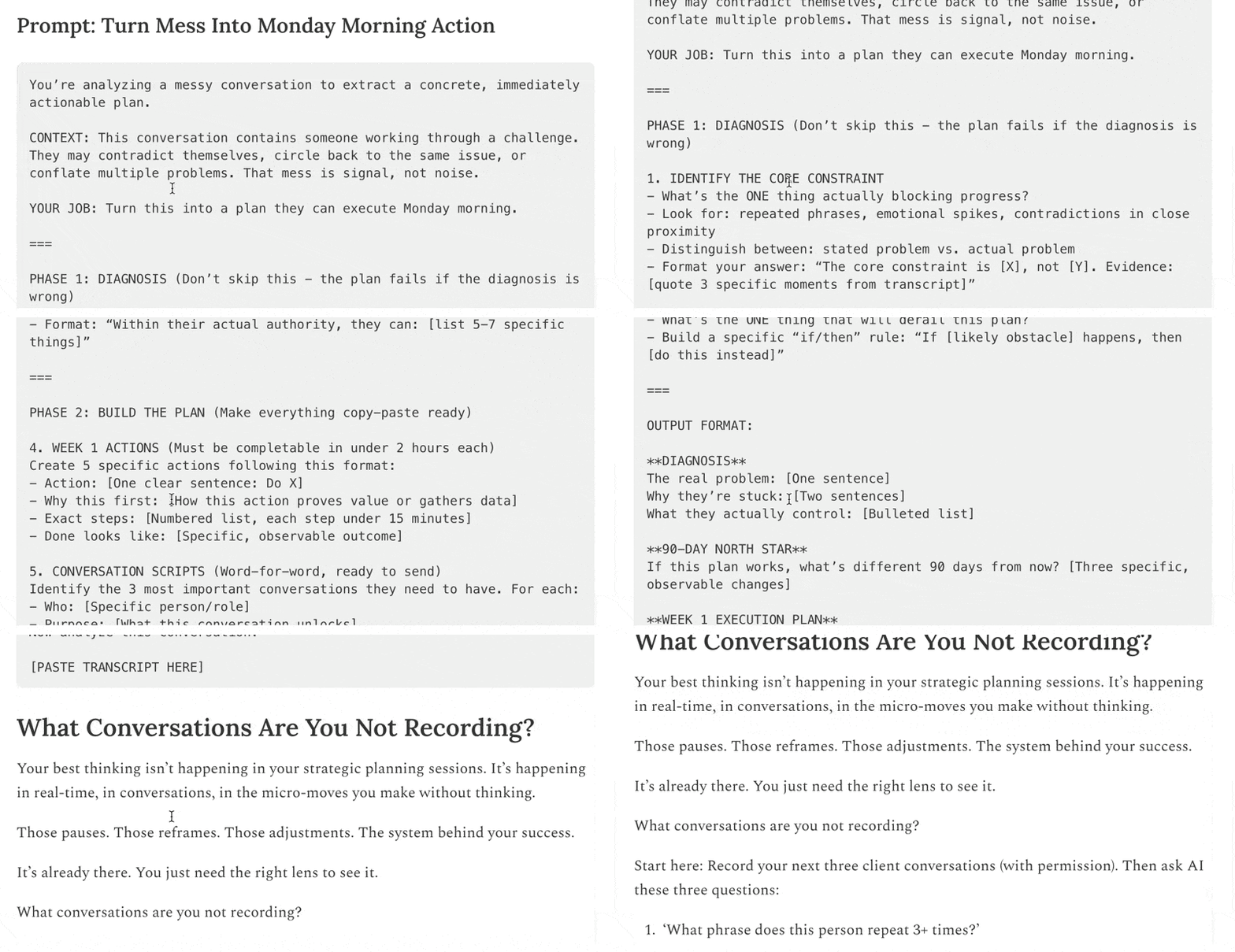
Prompt: Turn Mess Into Monday Morning Action
What it does:
Forces diagnosis before action. Most people jump to solutions while they’re still figuring out the problem. This prompt separates them:
Identify the core constraint
Spot the misdiagnosis
Map what they actually control
Build from there
It ignores what you can’t control: No fantasy planning. No “if we had budget” or “once leadership approves.” Only actions they can start this week with current authority.
Outputs copy-paste execution: Not “consider reaching out to stakeholders.” Actual scripts: “Email John Smith Tuesday at 9am with this exact message.”
What you get:
The real problem (one sentence diagnosis with evidence)
Week 1 actions (5 things, each under 2 hours, with exact steps)
Conversation scripts (word-for-word, ready to send)
Simple daily tracker (update in under 5 minutes)
Momentum protection (what will derail this + the specific response)
Feed it your messy transcript, get an implementation plan.
When and How to Use This Prompt
This prompt works on five types of conversations and the messier the transcript, the better it performs:
The Venting Session: Friend or colleague circles the same frustration for 15 minutes with no clear ask. The prompt finds the pattern in the repetition and the diagnosis in their contradictions.
The Strategy Meeting That Goes Nowhere: Good discussion, everyone agrees, nothing happens. The prompt forces the ONE constraint and builds Week 1 actions on what you actually control.
The “I Don’t Know Where To Start” Conversation: Someone’s paralyzed by a big challenge. The prompt separates what they’re treating as one problem that’s actually two, then identifies the smallest controllable variable.
The Brainstorm That Needs Direction: Lots of creative ideas, high energy, but no “do this first” clarity. The prompt adds constraint: what can we test this week with current resources?
The Post-Mortem/Debrief: Team reviews what happened but gets vague “do better next time” commitments. The prompt extracts the repeating failure mode and the ONE process change that prevents it.
Critical instruction: Don’t clean up your transcript before feeding it to the prompt. The contradictions, repetitions, and circular thinking aren’t bugs, they’re the diagnosis. The prompt needs the raw mess to find the real pattern.
To use: Record your conversation (with permission), get the transcript, and paste it at the bottom of this prompt. You’ll have a copy-paste action plan before your dinner gets cold.
Inside you’ll get the complete prompt that turns messy conversations into execution plans:
The full diagnostic framework - The 3-phase system that separates stated problems from actual problems, finds what people actually control, and builds Week 1 actions scaled to their real authority.
Copy-paste conversation scripts - Word-for-word opening lines, specific asks, and backup positions for the 3 critical conversations that unlock forward movement.
The momentum protection system - The “if/then” rules that anticipate what derails plans and pre-builds the response so nothing stalls.
This is the exact prompt I used to turn 15 minutes of venting into a 90-day implementation plan. It forces diagnosis before action, ignores what you can’t control, and outputs execution steps you can start Monday morning.
Access below 👇...
