

Before you start reading, let’s play a game. It will take ten seconds.
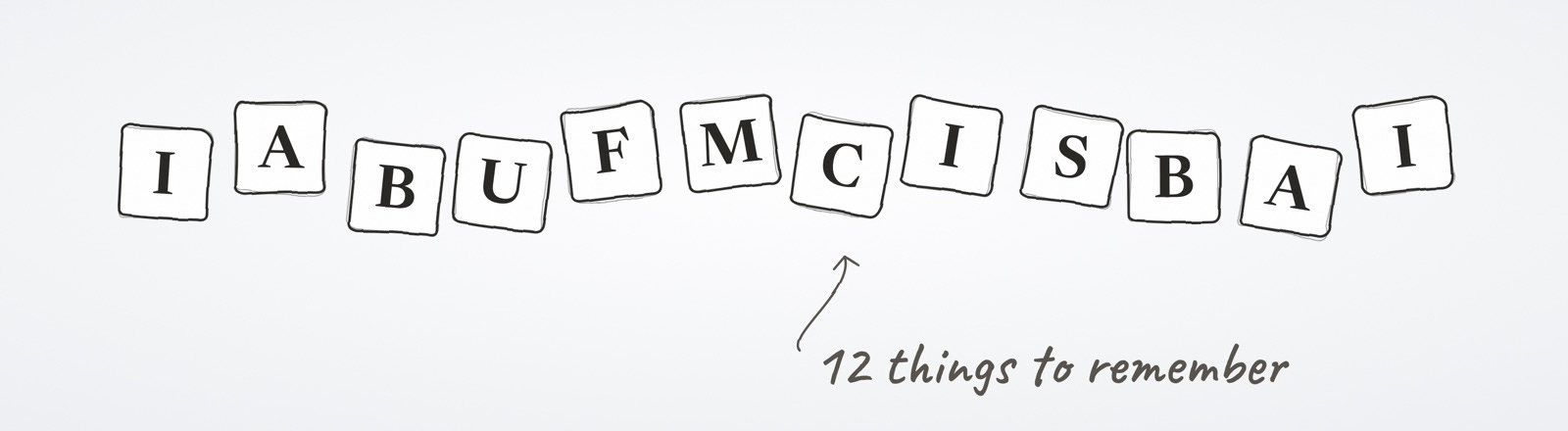
Read the following. After you’ve done that, cover the letters with your hand and say them out loud (or in your head) in the same order.
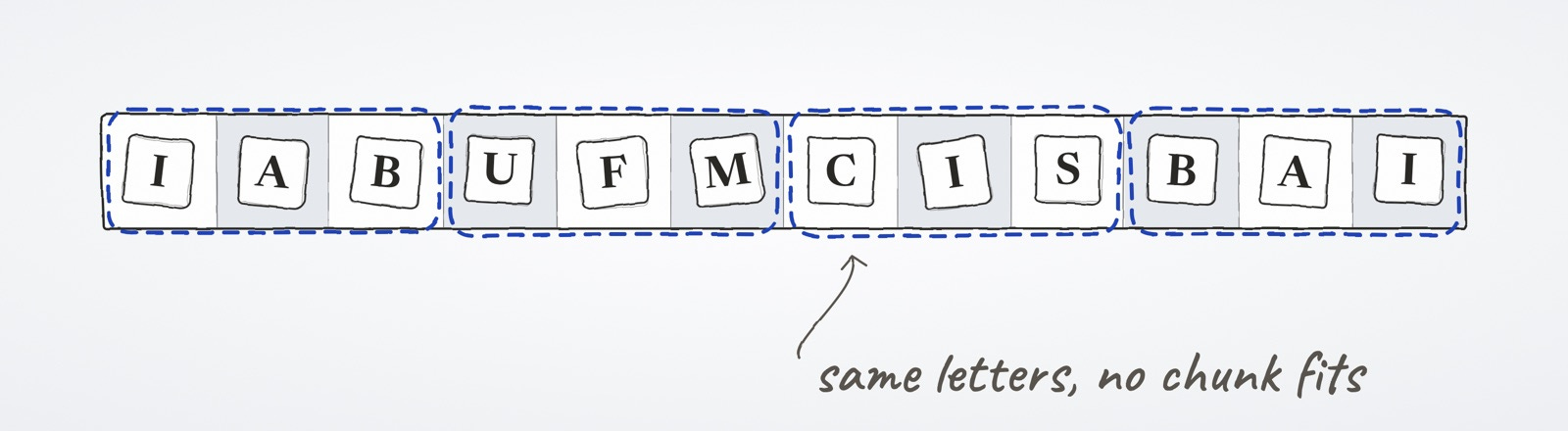
I A B U F M C I S B A I
Do it now.
How did you do? Most people can remember about four or five, but after that the letters are soup.
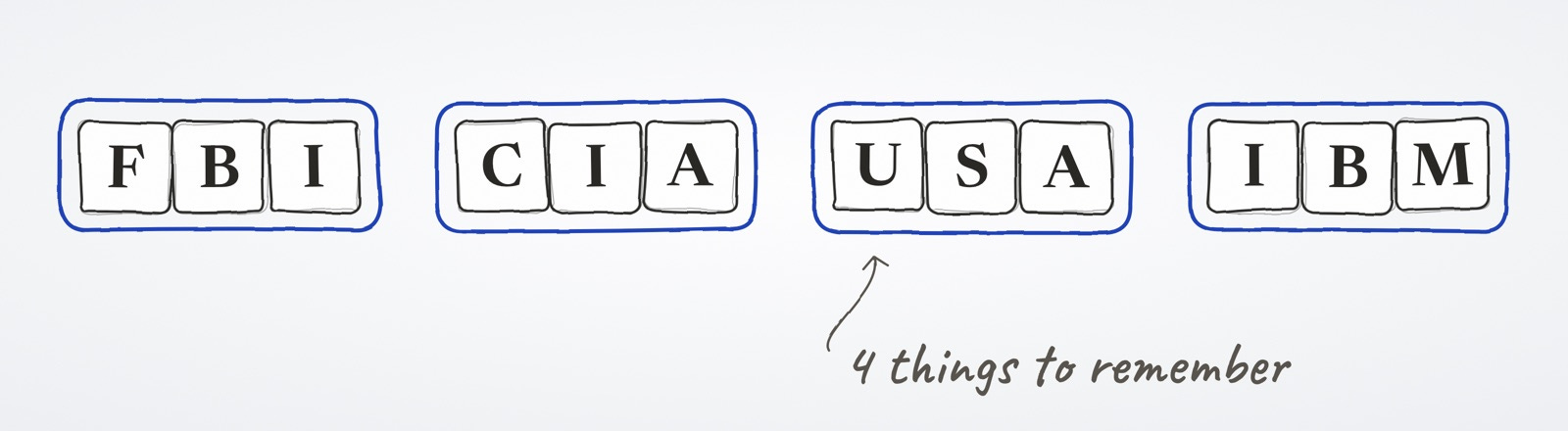
Now do the same with the following.
FBI CIA USA IBM
You probably could say them in reverse order.
The two patterns contain exactly the same letters: three I’s, two A’s, two B’s, and one C, one F, one M, one S, and one U.
The size of your memory didn't change between the two games. But the number of things you needed to remember did. In the first game it was twelve, and it's well-established that the number of things we can remember at once is relatively small (about 4-7). (Here’s the famous 1956 paper from George Miller.)
In the second game it was four. And you’ve already done all the work to glue FBI into a single item over the course of your life.
The term for this “gluing” is chunking.
Experts in every field have the same size working memory as novices. Chunking is what lets an expert see in the first five minutes of a discovery call what less experienced colleagues can't. No expert is born that way. They learned to do each part of it, one by one, over the course of many years. Then they glued all the parts into one big, "obvious" chunk.
Why Grandmasters Don’t Look Further Ahead
We tell ourselves a story about why experts are so much better than everyone…
That they just “think deeper” like a chess grandmaster who can look fifteen moves ahead while their opponent can only think three.
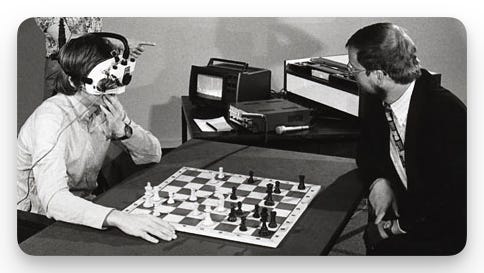
But in 1946, Adriaan de Groot, who was himself a Dutch chess master and a psychologist, decided to test this theory. He had grandmasters and experienced chess-club players solve the same problems by thinking out loud as they went. What he discovered, to many people’s surprise, was that the grandmasters didn’t search deeper, nor did they consider more moves. Instead, the grandmaster’s advantage appeared in the first five seconds after they saw the board.
In other words…
the difference wasn’t in how the two groups thought.
It was in what the two groups saw.
When you ask experts why they are so much better than the rest of us, the usual answer is, with a shrug of the shoulder, “experience.” In other words, “we think the same way you do, except more.” But de Groot’s research shows that experts literally see different things than less experienced colleagues do when looking at the exact same board.
What the Expert Sees
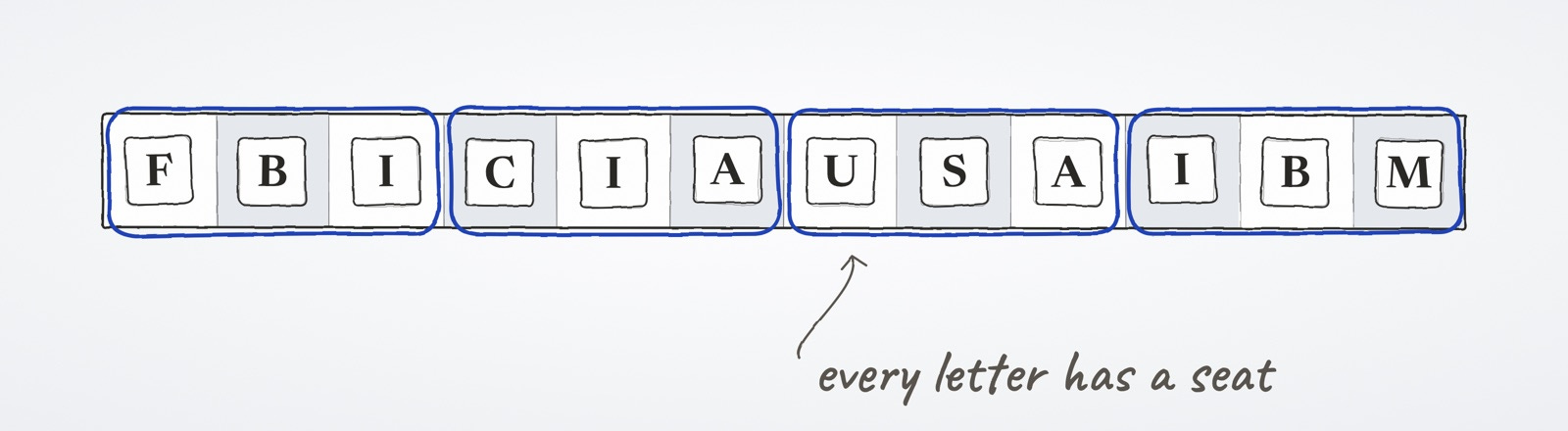
So what do experts see? To a novice, a problem looks like a pile of separate clues. To an expert, the same clues look like one familiar shape, the way F, B and I look like one thing to you when they sit together as FBI. That shape only forms when the clues are arranged the way they usually are in the expert’s world.
The Scrambled Board
In 1973, two researchers, William Chase and Herbert Simon, performed a famous experiment based on de Groot’s work. They showed a real-world chess position to players of all ranks for five seconds, then they covered the board and asked each player to rebuild it from memory. Consistent with the memory game at the top of this article, the number of pieces a master could remember was far greater than the number a beginner could.
But when Chase and Simon repeated the experiment with the same pieces placed at random, in positions no real game would ever produce, the master’s advantage almost entirely disappeared.
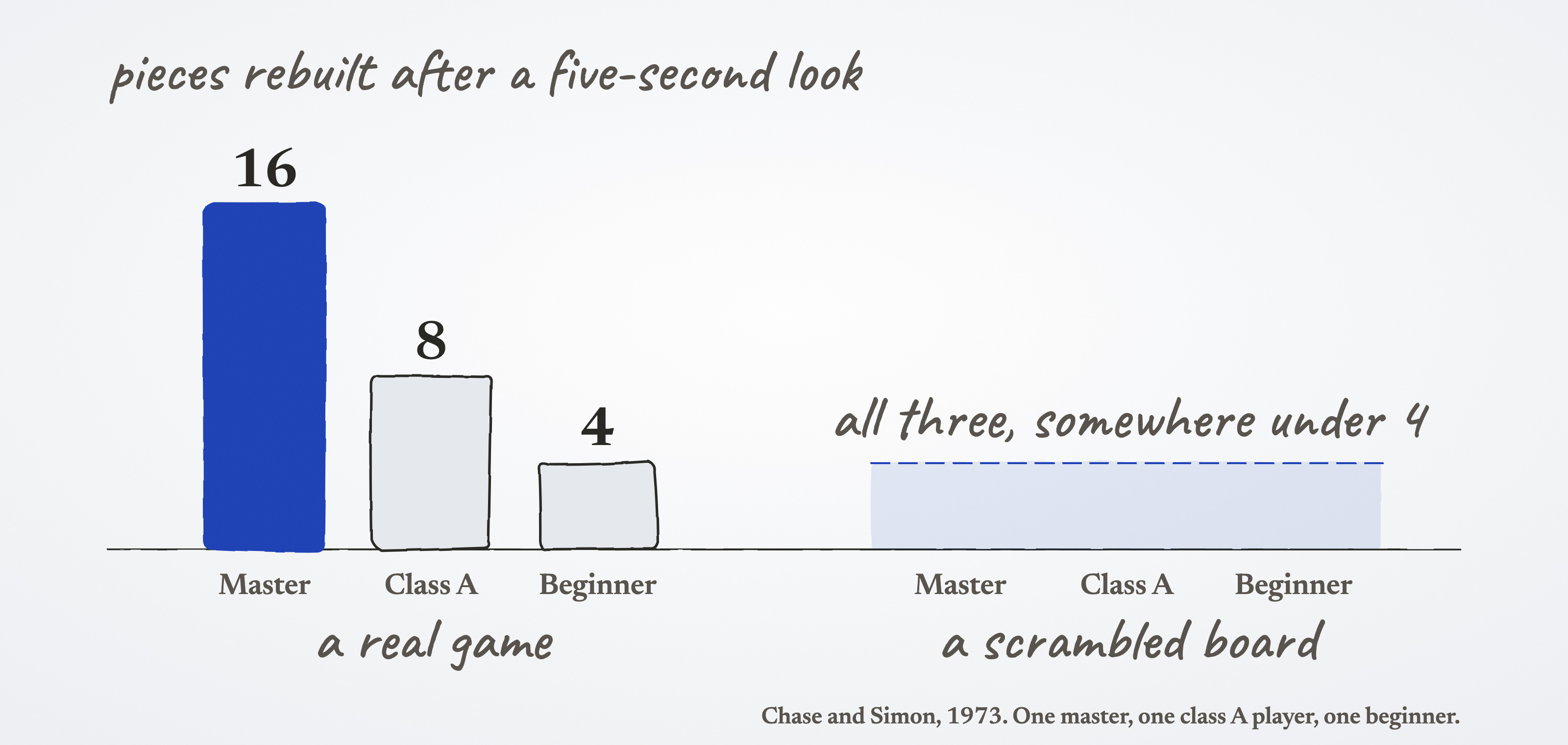
That random board is what I call a scrambled board. It has the same pieces as a real game, in an arrangement the expert has never seen in play.
The master’s memory was full of chunks the master had accumulated over the course of real-world games. Each chunk, like a king tucked in the corner behind a row of pawns, only made sense when the board was in a position that real games produce. On a scrambled board, none of the chunks the master had accumulated over the years fit.
In a related experiment a few years later, Chase and a young researcher named Anders Ericsson, who went on to become a famous researcher in his own right, trained an ordinary college student to remember a string of random digits. The student started off like the rest of us and could remember about seven. But after 230 hours of practice, he could remember 79.
The student did this by accumulating chunks from his own life. He was a runner, and he associated each chunk with a racing time. For example, he interpreted the sequence “3492” as 3:49.2, a time close to the world record for the mile. A mile time is easier to remember than four separate digits. It was also a chunk no one else in the lab would have come up with.
Have you ever taken a call with a client from a new industry? Did you, for the first few minutes of the call, ask the same questions a beginner would? Did it feel weird, since you’re not a beginner? The reason is that even though your skills are the same, the board is different. In a new industry, you’re the master looking at a scrambled board.
The Cost of Glue
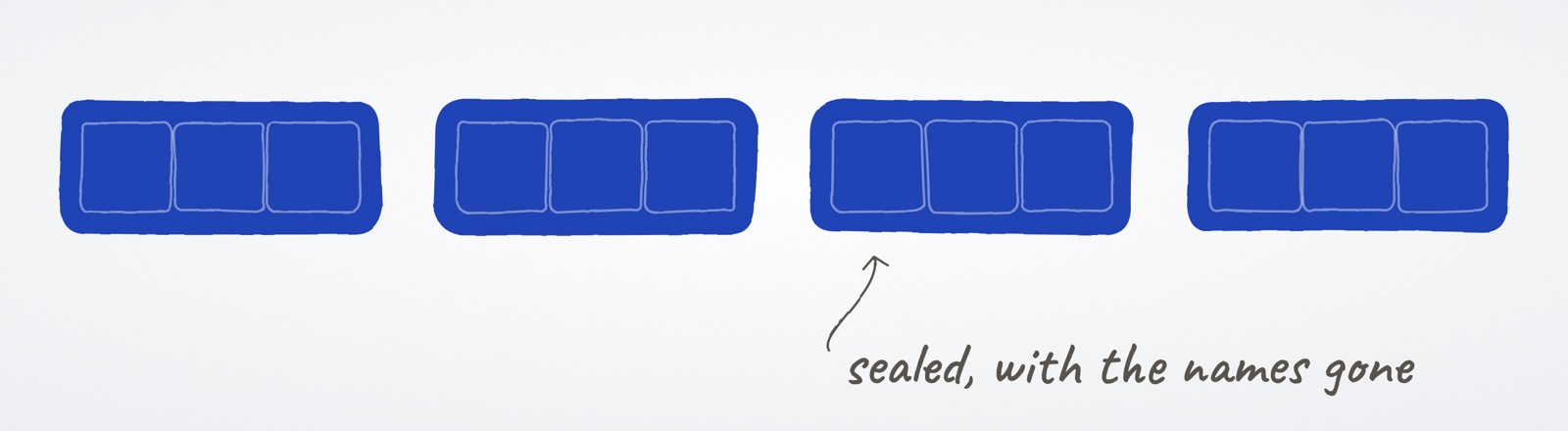
Once the pieces in a chunk are glued together, the chunk is sealed. It’s like a ZIP file that’s been compressed with the names of all the files removed.
That’s why, when you ask an expert how they do something, the best they can do is describe the few pieces they still remember from before the glue set…the first pieces they learned as a beginner. Those first pieces are the ones everyone in their field learns. So when you teach them to a junior colleague or an AI, the colleague or the AI ends up sounding like every other player in your field.
How to Break the Seal
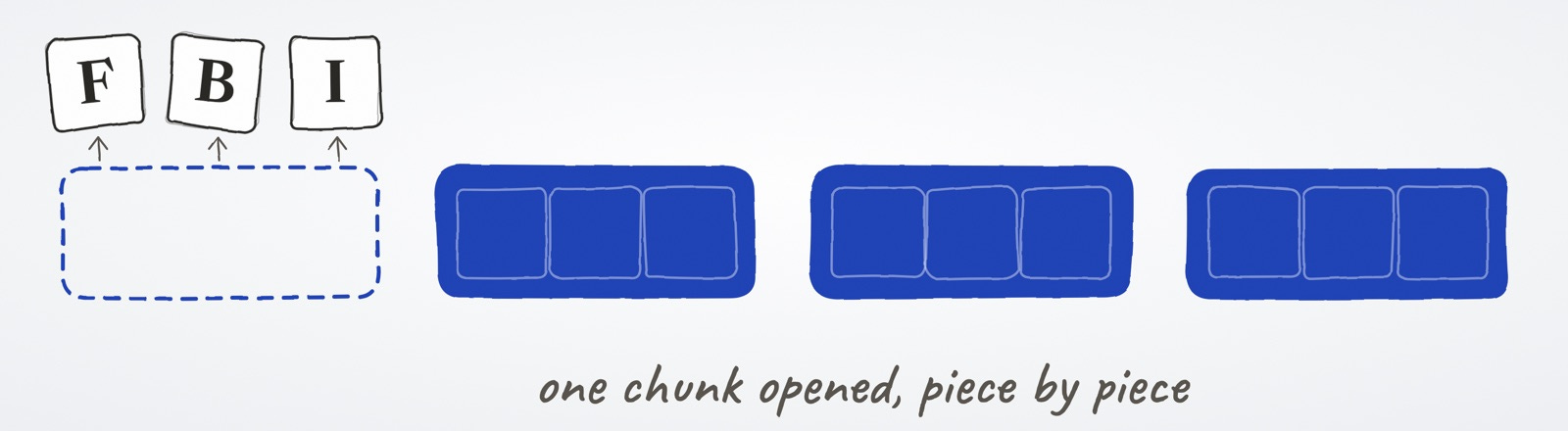
A chunk works differently during the call and after it.
When you’re working, you need the glue, because that’s what gives you your speed. You can’t take a chunk apart while you’re on the call, any more than you can look at FBI and see three unrelated letters.
But after the call, when you’re listening back to the recording, it’s a completely different story. You can take the chunks apart, name the pieces, teach them to a colleague, check if they were right, and store them in your AI.
You won’t always be able to take a chunk apart, of course. As Michael Polanyi famously said in 1966, “we know more than we can tell.” But a lot of the time, you will.
Find the Board Where You Slow Down
The scrambled board is how Chase and Simon showed the master’s edge was built from real games. It’s also the best way I know to get one of your own chunks open.
1. Find a fast judgment. Pull up a recording of yourself working, like a client call or a working session. Look for a moment where you went from question to answer in seconds, or named the problem before anyone else did. The words that give it away are small ones, like “just,” “obviously,” “I can tell” or “it depends.” Each one tends to skip over a decision you made too fast to notice.
2. Find where the same kind of judgment went slow. Now look for a moment, in that recording or another one, where you faced the same kind of situation and stalled. You hesitated, asked beginner questions, or got it wrong and had to walk it back. That’s your scrambled board.
3. List what was different. Put the two moments side by side. Look at what the other person said and did, and what they’d already been through before the call, in the fast moment. Then look for which of those was missing in the slow one. Each difference is a piece of the chunk.
What My Overwhelm Judgment Was Made Of
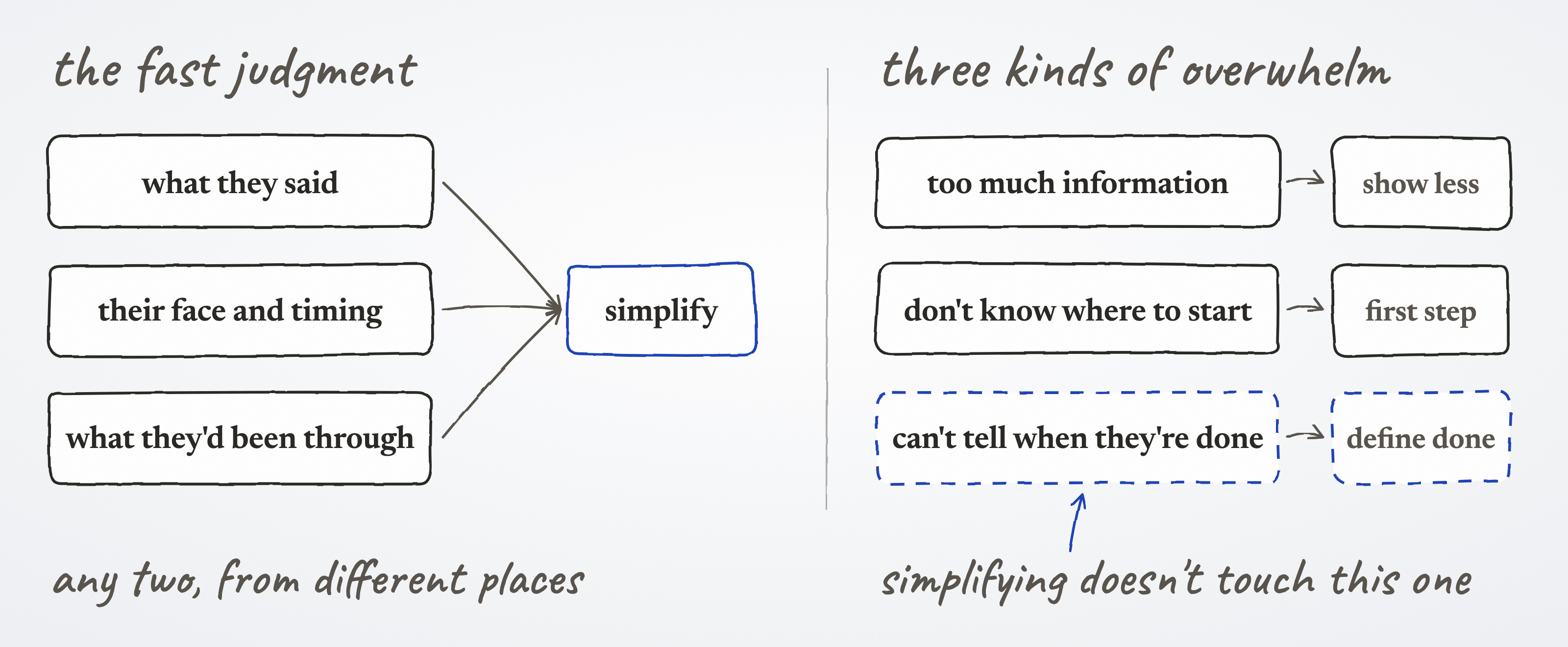
Here’s one of mine. When I first had AI go through my client transcripts, one of the things it found was that I was spotting overwhelm and simplifying the conversation before I’d recognized either as part of my process. In the moment, it was a single glance.
I had the AI take apart three client calls from March 23, and that single glance came out as several pieces.
The first was a cluster of signals arriving from three places at once. There was what the person said, lines like “nothing good about it” or “I’ll have to lean on you for that.” There was what their face and timing did, a blank look and no quick answers. And there was what they’d been through lately, which was usually several new ideas in a short stretch of time.
The second was a rule I run on. When two of those signals show up from different places, I trust it. I don’t wait for the person to tell me they’re overwhelmed.
The third was my scrambled board. Overwhelm comes in three kinds, and each one needs a different fix.
Too much information. Show them less, only what matters right now.
Not knowing where to start. Give them the first step.
Not being able to tell when they're done. Define done, so they can see it.
My usual fix is simplifying, and it doesn't touch that third kind. That's the board where my fast judgment stops working. Showing someone less doesn't help when the thing they can't see is the finish line. For one client, the fix was a checklist that reset every day.
Back to the Twelve Letters
FBI CIA USA IBM took you one glance because you’ve lived with those letters for years. The judgments you make fastest were built the same way, out of years of your own clients, which is why nobody else makes them the way you do. It’s also why you can’t see them.
TLDR:
You can hold about four to seven things in mind at once, and so can every expert in your field.
Experts get their speed from chunks, many small pieces glued into one, the way FBI is one item for you.
Chase and Simon showed the chunks come from real games. Scramble the board and the master’s edge almost disappears.
Once a chunk is glued, you can no longer name the pieces inside it. That’s why you can’t explain your fastest judgments, and why a colleague or AI you teach ends up sounding like everyone else in your field.
You can’t open a chunk during a call. Afterward, put a recording where you made a fast judgment next to one where the same situation went slow. Each difference is a piece of the chunk.
You now know what your fastest judgment is made of, and where to look to take it apart. Doing that on your own recordings is a different job. The hard part is finding a slow moment that matches the fast one, and keeping yourself from filling the gaps with the story you already tell about your work.
The Glance Map
Below is a prompt that does that digging with you. You paste in two or three of your transcripts. It finds your fastest judgments in your exact words, finds the moment where the same kind of judgment slowed down, and lists the pieces that were different, with a quote for each one. Then it writes the rule in one sentence you can check on your next call, plus a short block you can paste into your AI’s instructions.
