

A hush fell over the conference room. Rows of figures glowed across the projector screen: marketing data, growth forecasts, investor decks. The product team had spent weeks perfecting the pitch, triple-checking every assumption. They were ready.
Then, the industry veteran, a seasoned investor with decades of experience, broke the silence. After scanning the slides and asking three laser-focused questions, she spotted a critical flaw nobody else had considered. Instantly. Almost effortlessly.
People called it instinct. But it was more than that. It was something far more valuable: a hidden latticework of frameworks that made her expertise look like magic—yet anyone could learn, refine, and use it.
What if your biggest blind spot isn't in the data but in how you interpret it?
The Expert's Paradox
We think expertise is about accumulating more: more data, more reports, more time to analyze. In reality, the very best decision-makers skip the noise and pinpoint what matters because they see through multiple lenses at once.
Picture a doctor facing a baffling set of symptoms. A novice might check off a standard list of possibilities. However, the expert filters the problem through multiple frameworks - physiology, patient history, known risk factors, lifestyle influences - and lays them down quickly to form a precise diagnosis. The magic lies not just in having these frameworks but in stacking them seamlessly.
You already have glimpses of this capability:
You've walked into a meeting and immediately sensed something was "off."
You've heard a pitch and zeroed in on its gaping flaw in seconds.
You've spotted the hidden opportunity in a market others called "saturated."
Yet most of us leave these insights trapped in our gut instead of translating them into a repeatable system.
Where Most Expertise Gets Stuck
The issue isn't whether you have enough knowledge. You do. The real challenge is that your brilliance remains locked away—implicit, unstructured, and therefore almost impossible to share or refine.
Consider these common roadblocks:
Decades of pattern recognition buried in your subconscious.
Rapid-fire mental filters that react faster than you can articulate.
"Invisible" triggers you can't easily break down into steps.
As Charlie Munger puts it, "You must develop a mind that can jump the jurisdictional boundaries." Without frameworks that make our mental leaps clear, expertise remains a foggy personal advantage that evaporates the moment we stop using it.
Could documenting your 'gut' knowledge help your team level up rather than relying on you for every insight?
The Framework Advantage
This is where mental models and decision frameworks transform your practice. Instead of abstract theories, they are practical lenses that help you see what everyone else overlooks. A good framework captures knowledge you've proven to yourself again and again, then systematizes it so it's accessible when you need it most.
There are three reasons this approach multiplies your effectiveness:
Repeatability – You can revisit and refine each framework for consistent decision-making.
Scalability – Teams or peers can learn and apply your models, amplifying impact.
Depth – Layering frameworks reveal insights that a single perspective can miss.
The best part? You don't need to memorize dozens of these. Skillfully combined, three or four high-impact frameworks can revolutionize how you evaluate opportunities, mitigate risks, and create strategic advantage.
Building Your Decision Engine
Step 1: Pattern Mining
Start with those lightning-fast instincts that seem to come from nowhere. When you suspect something's off or sense hidden potential, pause to ask yourself:
Which signals triggered my reaction?
What questions did I automatically ask?
Where else have I seen this pattern?
This is your raw material. Capture it. Make it clear.
Step 2: System Building
Turn those signals into a mini-framework. If you notice suspiciously high projected website traffic from a new campaign, your framework might say:
"If projected website traffic from a new campaign exceeds historical benchmarks by >30% and the campaign relies heavily on a single, untested channel (e.g., a viral social media trend), then re-evaluate the traffic source's reliability and diversify the channel mix to mitigate risk."
Similarly, if you identify a marketing campaign with strong early organic reach and positive customer feedback, your framework could read:
"When a marketing campaign generates significant organic reach (e.g., high social media shares or backlinks) and early customer feedback indicates strong word-of-mouth potential, then implement a referral program or community-building strategy to amplify the network effect and ensure sustainable growth."
Break your gut instincts into if-then statements and key checklists.
Step 3: Framework Layering
Most marketers focus on isolated metrics: website traffic, conversion rates, or social media engagement. Experts, however, juggle multiple mental models, allowing them to see how these metrics interact and identify potential reliability issues. Here are some key frameworks relevant to marketing reliability (as examples):
Marketing Channel Analysis:
Reach and Frequency: Understanding the potential audience size and the number of times they are exposed to a message. Crucial for assessing the reliability of achieving the desired reach.
Channel Effectiveness: Measuring the performance of different marketing channels (e.g., organic search, paid advertising, social media) in terms of conversions, cost per acquisition, and return on investment. Helps determine which channels are most reliable for driving results.
Attribution Modeling: Determining how credit for conversions is assigned to different touchpoints in the customer journey. Essential for accurately measuring channel performance and ensuring reliable data for decision-making.
Customer Behavior:
Customer Segmentation: Grouping customers based on shared characteristics (demographics, psychographics, behavior). Allows for more targeted and reliable messaging.
Customer Journey Mapping: Visualizing the steps customers take when interacting with a brand. Helps identify potential friction points and optimize the customer experience for more reliable conversions.
A/B Testing and Experimentation: Systematically testing different marketing elements (e.g., headlines, calls to action, landing page designs) to determine which performs best. Essential for ensuring reliable improvements in key metrics.
Data Integrity and Measurement:
Data Validation: Ensuring the accuracy and consistency of marketing data. Crucial for reliable reporting and analysis.
Tracking and Analytics: Implement robust tracking mechanisms to collect and analyze marketing data. This is essential for measuring performance and identifying areas for improvement.
Statistical Significance: Understanding the statistical validity of marketing data and test results. Helps avoid drawing unreliable conclusions based on random fluctuations.
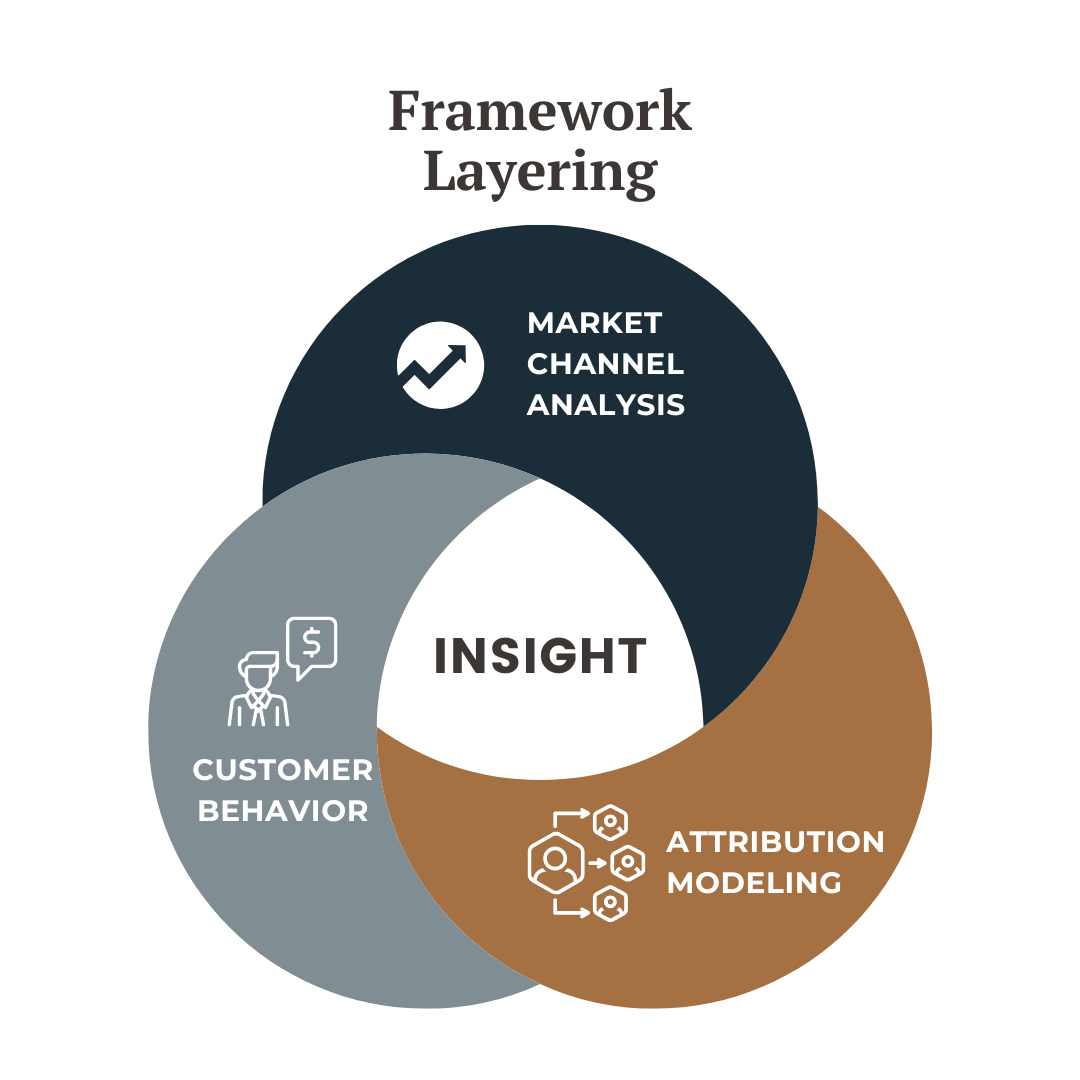
By layering these perspectives, you see how channel effectiveness impacts customer behavior, or how data integrity influences attribution modeling.
This is the compound advantage of frameworks: each perspective complements the others, exposing risks and hidden gems related to marketing reliability.
Let's illustrate with a concrete example: Imagine you are advising a client launching a new product targeting young adults through social media.
Marketing Channel Analysis (Reach & Frequency/Channel Effectiveness): Initial analysis might suggest focusing heavily on X (Twitter) due to its high reach among the target demographic. However, layering "Channel Effectiveness" might reveal that while X has a high reach, it has a lower conversion rate than LinkedIn for this specific product category.
Customer Behavior (Customer Segmentation/A/B Testing): Layering "Customer Behavior" and "A/B Testing" suggests segmenting the X audience based on interests and testing different ad creatives to improve conversion rates. For example, testing different calls to action or ad formats can reveal what resonates most reliably with different segments within the X audience.
Data Integrity and Measurement (Attribution Modeling/Data Validation): Finally, layering "Data Integrity" and "Attribution Modeling" would be crucial. If X's internal analytics are unreliable, relying solely on them would lead to flawed conclusions. Implementing cross-platform tracking and using multi-touch attribution models can provide a more reliable picture of campaign performance across different channels.
The Layered Insight: Combining these frameworks reveals a more nuanced strategy. While X might be a valuable channel for building brand awareness (reach), focusing solely on it could lead to suboptimal conversion rates. By layering in customer behavior and data integrity, you can optimize the campaign for more reliable results by segmenting the audience, A/B testing creatives, and implementing robust tracking to ensure accurate attribution and reliable data-driven decision-making.
Which frameworks do you already use unconsciously—and how could you sharpen them?
BONUS: Supercharge Your Frameworks with AI
When developing frameworks for complex problems, leveraging AI tools like ChatGPT, Claude, or Gemini can significantly accelerate the process. These tools can act as powerful thinking partners, helping you brainstorm, structure ideas, and even test the validity of your frameworks. Here's how:
Identifying Patterns in Data:
Imagine you have a large dataset of customer reviews, social media mentions, or website analytics. You can use one of these to analyze this data and identify recurring themes, pain points, and successful strategies. For example, you could provide the LLM with a CSV file of customer reviews and ask it:
PROMPT: "Analyze these customer reviews and identify the top three recurring complaints and the top two recurring positive comments. Group them by theme and provide a concise summary for each."The LLM can then provide a structured output that highlights key patterns, which can form the basis of a framework for improving customer satisfaction.
Generating Initial Drafts of Frameworks:
Instead of starting from scratch, you can use AI to generate an initial draft of a framework. For example, you could provide (pick your favorite LLM) with a description of a marketing challenge, such as:
PROMPT: "Developing a content marketing strategy for a new SaaS product andcreate a framework for developing a content marketing strategy for a new SaaS product, including key content pillars, target audience segments, and distribution channels."The LLM can then generate a structured outline that you can refine and customize.
Testing the Validity of Frameworks Against Real-World Data:
Once a framework is developed, you can use AI to test its validity against real-world data or case studies. For example, if you have a framework for evaluating the potential success of new product launches, you could provide the LLM with information about past product launches (market size, competitive landscape, marketing budget, etc.) and ask it to apply the framework to these historical cases. The LLM can then provide insights into how well the framework predicts success or failure and identify potential areas for improvement.
Using the Strategic Framework Architect Prompt:
One of my favorite ways to enhance this process is to use the following prompt, which positions the LLM as a strategic framework architect:
PROMPT:
You are a Strategic Framework Architect, specializing in creating practical and actionable frameworks for business challenges. Your goal is to help users develop clear, concise, and immediately applicable frameworks that drive tangible results.

Develop a [Specify the type of framework desired, e.g., checklist, decision tree, matrix, process flow] framework for addressing [Clearly define the topic/problem here] by exploring the following:

Problem Definition:

Clearly and concisely define the recurring challenge.

Who is most affected by this problem?

What are the specific limitations or shortcomings of current approaches to solving this problem (e.g., inefficiency, cost, lack of scalability, inconsistent results)?

Framework Components:

Identify 3-5 key components or steps that should be included in the framework.

Explain how these components/steps interact and contribute to solving the problem.

What makes this framework unique or more effective than existing approaches?

Implementation and Measurement:

Provide a step-by-step guide on how to implement this framework in practice.

Offer specific examples of how the framework can be applied in different scenarios.

What specific metrics or KPIs can be used to measure the success and effectiveness of the framework?
Example using the prompt:
Let's say the topic is "Improving Customer Retention for a Subscription Service," and let's say we want a checklist:
You are a Strategic Framework Architect, specializing in creating practical and actionable frameworks for business challenges. Your goal is to help users develop clear, concise, and immediately applicable frameworks that drive tangible results.
Develop a checklist framework for addressing Improving Customer Retention for a Subscription Service by exploring the following:
Problem Definition:
Clearly and concisely define the recurring challenge.
Who is most affected by this problem?
What are the specific limitations or shortcomings of current approaches to solving this problem (e.g., inefficiency, cost, lack of scalability, inconsistent results)?
Framework Components:
Identify 3-5 key components or steps that should be included in the framework.
Explain how these components/steps interact and contribute to solving the problem.
What makes this framework unique or more effective than existing approaches?
Implementation and Measurement:
Provide a step-by-step guide on how to implement this framework in practice.
Offer specific examples of how the framework can be applied in different scenarios.
What specific metrics or KPIs can be used to measure the success and effectiveness of the framework?
The LLM will then generate a structured response that you can use as a starting point for developing your customer retention framework. This approach encourages collaborative exploration, helping you extract practical insights and structure cohesive, actionable frameworks. Use it to shape your raw ideas into systems that bridge the gap between understanding and implementation.
Your Next Decision: Test, Layer, Refine
Next time you have a major marketing decision, be it a campaign launch, a new channel strategy, or even a content calendar, walk it through this multi-layered checklist:
Marketing Channel Analysis
Which channels offer the most reliable reach and frequency for my target audience?
How can I accurately attribute conversions across different touchpoints?
Customer Behavior
How can I segment my audience to deliver more relevant and reliable messaging?
What A/B tests can I run to optimize conversion rates and ensure reliable performance improvements?
Data Integrity and Measurement
How can I validate the accuracy of my marketing data?
Am I using statistically significant data to inform my decisions?
Document every "aha" you get from each layer.
Then, look at where they intersect. That's where your biggest strategic leap usually hides.
Final Word: Evolving Your Expertise
Your expertise is already there. The patterns are working quietly in the background. You gain a powerful decision engine that compounds over time by making them explicit, layering them systematically, and regularly refining them. This engine becomes more valuable as the world (and technology) grows more complex because it helps you see possibilities, risks, and hidden gems that others miss.
To your market leadership and beyond,
-Max
P.S. For the "there is no way I can actually do this" folks:
I know that you might have some reservations. You might be thinking:
"Developing frameworks sounds time-consuming."
While it requires an initial investment of time and effort, the long-term benefits far outweigh the costs.
Once you have a set of well-defined frameworks, you can apply them quickly and consistently, saving you time and improving your decision-making. Think of it as building a tool that you can use again and again.
"My marketing expertise is too nuanced to be captured in a system."
Some aspects of expertise are difficult to codify, many key patterns and decision-making processes can be captured in frameworks. The goal isn't to replace intuition entirely but to make your expertise more explicit, repeatable, and scalable. This also makes your expertise more defensible and valuable in the age of AI.