

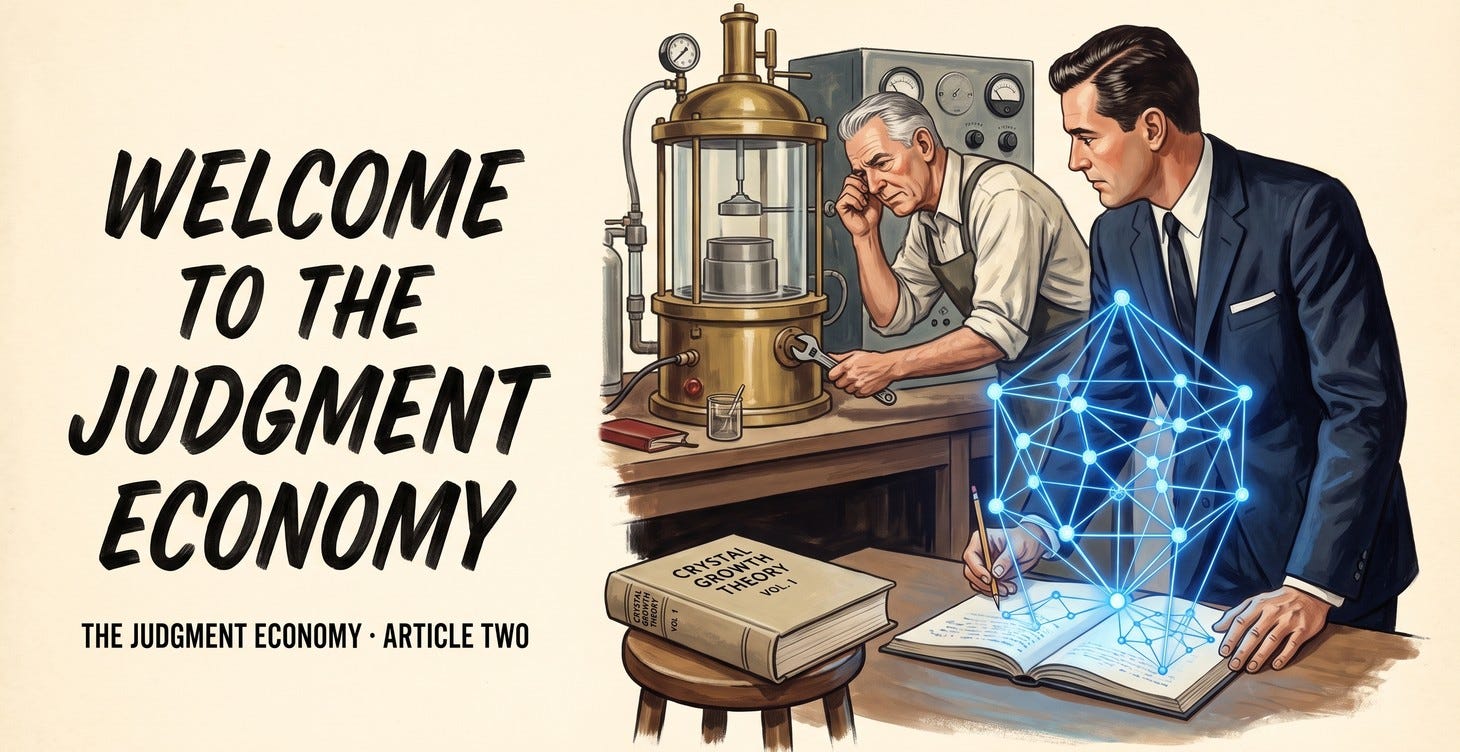
For about twenty years, scientists in the West couldn’t repeat a set of Soviet measurements.
The subject was a kind of high-quality sapphire crystal. The Soviet team had published their results. Western labs understood the theory behind it. They built or bought the same kind of equipment.
The results still wouldn’t match.
If you’re picturing a story about smart versus not-smart, that’s the wrong story. These were skilled scientists. They had the papers. They had the machines. They had everything that had ever been written down.
Progress came only when people showed up in person.
Researchers had to visit the Soviet labs. They had to watch the work happen with their own eyes. They had to see how the equipment behaved, which small adjustments the experienced technicians made, and what happened when the plan met the real material.
The missing piece wasn’t on paper. It lived inside the work itself.
What AI made cheap and easy
AI has made it much easier to produce a decent first draft of almost anything.
Working code
A readable article
A working spreadsheet
A research summary
A passable slide deck
A reasonable answer to a common question
A team of economists has been studying what happens when customer-support workers get AI help.. The biggest gains went to the least experienced workers. The tool spread out pieces of skilled performance that used to belong to only a few people.
That sounds like a productivity story but that’s the wrong headline.
When more people can produce work that’s good enough, “good enough” stops proving that someone knows what they’re doing.
The real story is about what gets scarce. Whenever something gets easy and cheap to make, value moves. It moves away from the thing that was hard to make, toward whatever decides if it’s worth making at all.
Making things is getting easy.
Deciding what’s worth making, and what’s actually right, is getting rare.
The Judgment Economy
We’re stepping into a world where information is everywhere, drafts are instant, and the thing that decides what happens next is judgment.
Judgment is noticing the one detail that changes everything.
It’s telling a real signal apart from normal noise.
It’s seeing the second problem before it shows up.
It’s knowing when the usual rule doesn’t fit this time.
It’s picking one answer out of several that all sound fine.
It’s deciding that a “good enough” draft still shouldn’t go out the door.
Rich Schefren calls this “The Judgment Age” and says judgment is the scarce resource in a world full of easy output. He’s right about what’s happening, and I’m borrowing his diagnosis.
An age names the period we’re living through.
An economy asks who owns the scarce thing, who can pass it on, and who gets paid for having it.
If judgment is the scarce resource, the people who can show their judgment, hand it off, and correct it are about to matter more than almost anyone else in the room. The people who can’t will watch their hard-earned skill get buried under a pile of decent AI drafts.
Where You Already Feel This
This isn't a guess about the future. You already feel it in four places.
1. AI hands you options. You supply the standard.
The model can hand back twenty headlines, three strategies, or six possible diagnoses.
Someone still has to pick which one to use.
A beginner usually picks whatever sounds the best (AI can make anything sound good).
Someone experienced spends their time cutting, rejecting, narrowing, and adding context instead.
The beginner assumes the right answer is buried somewhere in the pile.
The person with judgment knows the pile is only a starting point.
Those cuts and corrections are where the judgment lives. That’s the real gap between having a model and knowing how to use one well.
2. Teams run on process. Exceptions land back on the expert.
A written process, an SOP, works great for the cases you've seen before, the ones that happen all the time. Blair Enns has a line for this.
Low variation in process gives you low variation in outcomes.
There’s typically no SOPs for the outliers and edge cases.
They keep climbing until they reach whoever has seen enough strange cases to know what the pattern means, often the founder or the senior partner whose judgment never got written down anywhere.
This is why you can hire good people and still end up being the bottleneck. The process was built for the normal case, and the normal case never needed you in the first place.
3. More content ships. Trust follows whoever can tell the good from the average.
Publishing more doesn’t prove you have anything worth saying anymore.
Anyone can find information now. Readers stick with people who keep spotting the problems worth solving, drawing the distinctions that matter, and seeing what happens next before the rest of us do.
The signal was never in the volume. It’s in what someone chooses to say and what they leave out. Post without that filter, and you’re just adding to the pile everyone else is already making.
4. Services get easy to copy.
A competitor can copy what you deliver. They can study your proposal, borrow your process, buy the same software, and end up with something that looks close enough.
Their weakness shows up the moment something changes…when something happens that wasn’t on the YouTube tutorial. Someone with real judgment knows which parts of a plan can bend and which ones hold the whole thing up. The copycat only sees a template.
That difference is judgment.
And it’s the one part nobody ever bothers to write down. It’s also the real reason a client should pay you instead of the cheaper copy.
Judgment isn't just a fancy word for opinion
You might be thinking, isn’t “judgment” just a nicer word for having an opinion?
No, because real judgment gives you the same answer on the same kind of case, again and again.
James Shanteau spent his career studying what actually separates an expert from someone who’s just confident. He found that experts who tell similar cases apart, and land on similar answers when a similar case comes back around, are doing something real.
That consistency is the proof.
Gary Klein studied how people make decisions under pressure. Firefighters, military commanders, ER nurses. He found they almost never sit down and weigh their options. They recognize a pattern. They’ve seen enough cases to know what usually comes next, and the recognition happens fast because the experience runs deep.
Judgment gets built through years of seeing things happen, feeling the consequences, and getting corrected.
That’s what gives it weight. It also means judgment leaves tracks…
The decisions made, the corrections taken, the moments someone left the plan because something felt off, the cases they still remember years later, the distinctions they can’t stop noticing.
Judgment isn’t some mystery. Most of it just never got written down.
Can AI actually learn judgment?
Yes, from whatever’s already been made visible.
AI can learn from stated preferences, recorded decisions, corrections, results, and examples. It’ll keep getting better at applying the standards someone bothered to write down. It’ll keep getting better at spotting patterns that show up in the data.
But everything an expert never wrote down stays invisible to it.
A model can’t learn from a correction that only happened in someone’s head. It can’t study the option someone rejected before anyone else saw it. Or sit in on the conversation where an experienced person felt the ground shift and changed course. It can’t pick up a standard that got applied but never got named.
The space between what an expert knows and what they’ve ever put into words is the same space between a decent AI and a genuinely good one.
Writing judgment down gives AI something better to learn from. Skip that step, and the model learns from the average of what’s visible, while the best parts of someone’s expertise stay locked away.
Back to the sapphire labs.
The scientists had the paper. What they needed was access to everything happening around it. The visiting researchers never turned into copies of the original technicians. They just got close enough to reproduce the result.
AI has made the same problem bigger. It can soak up almost everything visible in the world. The best parts of someone’s expertise still live inside decisions nobody recorded, like the quiet correction, the option turned down before anyone saw it, or the standard that got applied without ever getting named.
The next question is how to get those decisions down on paper without sanding them into some fancy five-step framework.
That’s what the next piece is about. But first…
Try it on one of yours
Every time you reject an AI draft, correct a team member, or rewrite your own first attempt, you apply a standard you have probably never written down. The rejections are the evidence.
Pick one recent AI chat where you pushed back more than once, or one draft you rewrote where you still have both versions. Take out client names, but keep your own so the model knows which turns are yours. Paste the prompt below into Claude or ChatGPT, then paste the session or the two drafts underneath it.
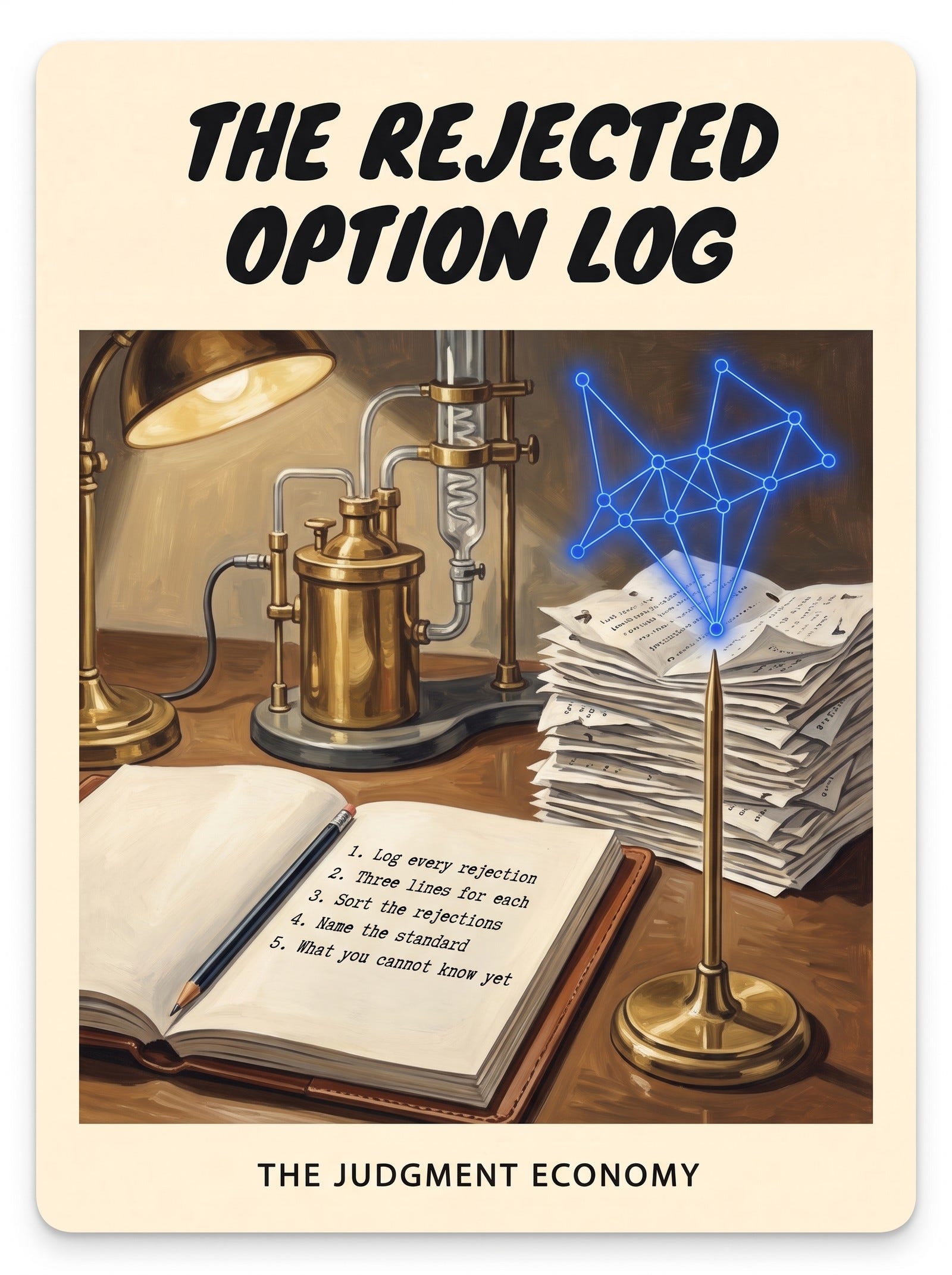
The Rejected Option Log
You are an outside observer reviewing a record of my work. I am an experienced [your role]. Below is either an AI chat session or a pair of drafts. In a chat, I am the human turns, labeled [your name as it appears]. In a draft pair, the first version is what I was given and the second is what I produced. The subject is what I rejected and why.
Rules:
Work only from what is on the page. Quote the option I rejected and quote my exact words or my exact change for every finding. If you cannot quote it, do not claim it.
Do not invent a framework, a name, or an acronym. Describe what I did in plain language.
Ignore any reasons I stated. Look at what I actually did: what I refused, what I narrowed, what I corrected, and what I moved past without using.
Do not flatter me. If a rejection was ordinary, say it was ordinary. If you find fewer than three rejections, say that too.
If you cannot tell which turns or which version are mine, stop and ask before you begin.
Steps:
Step 1. Log every rejection. Find each moment where I refused an option, corrected it, narrowed it, asked for something different, or moved on without using what I was given. Include silent rejections. List up to eight, in order. For each one, quote what was offered and quote what I said or did instead.
Step 2. For each rejection, write three lines.
What was wrong with the option, in plain words, judged from my reaction rather than your taste.
What I asked for or produced instead.
What a capable person with no standard of their own would have accepted at that moment.
Step 3. Sort the rejections. Group them by what they had in common: tone, accuracy, order, audience, length, missing context, or something else you can name plainly. Quote at least two rejections for every group. If a group holds only one, say so.
Step 4. Name the standard. From the groups, write one to three sentences describing a standard I appear to hold that I never said out loud. Quote the evidence for each sentence.
Step 5. Tell me what you cannot know yet. Everything above comes from one source, so each standard is a candidate, not a pattern. List the two or three most worth checking against my other sessions or drafts, and say what you would look for.
Format: short headers, quotes in italics, no summary at the end.
[PASTE YOUR AI SESSION OR YOUR TWO DRAFTS HERE]
Cognitive Fingerprint Lab is $20 a month right now. On Saturday, September 5th, new memberships move to $25. Anyone in before then keeps $20 for as long as their subscription stays active.
Part 2 of The Judgment Economy