

Welcome to irreplaceable! Here's how we're standing out together...

Last week, I sat with a brand designer who charges $15k per project. A client asked her, "How do you instantly know when something's off with a brand?"
She opened her laptop, started to explain, then stopped. Stared at the screen.
"I just... see it," she said finally.
Sound familiar?
You’ve spent years honing the same instinct. Those moments when you instantly spot what others miss. But right now, that wisdom is trapped in your head, stuck working project by project instead of generating income while you sleep.
The Hidden Pattern in Expert Work
I’ve been studying how experts turn their instincts into assets. Here’s the fascinating part:
Success doesn’t always come from building complex systems. Often, it’s about capturing those tiny moments of brilliance we take for granted.
That brand designer I mentioned? She ignored the usual advice about creating a massive course. Instead, she focused on one small slice of her expertise: those first 90 seconds when she evaluates a brand.
She called it her "Visual Velocity Scanner"—a step-by-step breakdown of what her eyes notice and why. These split-second assessments might look like intuition, but they’re actually compressed expertise. By breaking them down into clear, teachable steps, she transformed her invisible wisdom into tangible value.
Turning Instinct Into Income
Most experts make the mistake of packaging everything they know into one huge offer—a comprehensive course or high-ticket program. But the real breakthrough? It’s in small, actionable pieces of wisdom that create instant clarity for others.
Take another example: a photographer who always knows, in seconds, when the lighting will make or break a shot. She broke that instinct into a simple "Golden Hour Gauge" tool. For $97, she helps aspiring photographers master the same judgment call she makes intuitively.
These tools become perfect entry points into your ecosystem.
When the brand designer shared her Visual Velocity Scanner, she wasn’t just creating a product—she was inviting potential clients to understand her thought process.
Each tool naturally leads to the next. Someone uses the scanner and thinks, If she sees this much in 90 seconds, what else does she notice? They’re then primed for her Brand Resonance Radar at $197.
This isn’t just about passive income. It’s about creating a pathway where each solution reveals the next opportunity—showcasing your irreplaceable value at every step.
Your First Knowledge Asset
Most articles will tell you to create a generic diagnostic tool. But you’re not here for generic.
You’re here to capture the unique way you see your work.
Before diving into your first knowledge asset, consider this advice from Scott Galloway in The Algebra of Wealth:
"Your mission is to find something you're good at and apply the thousands of hours of grit and sacrifice necessary to become great at it."
This philosophy aligns perfectly with turning expertise into income. It’s not just about passion. It’s about refining and honing a skill until it becomes irreplaceable.
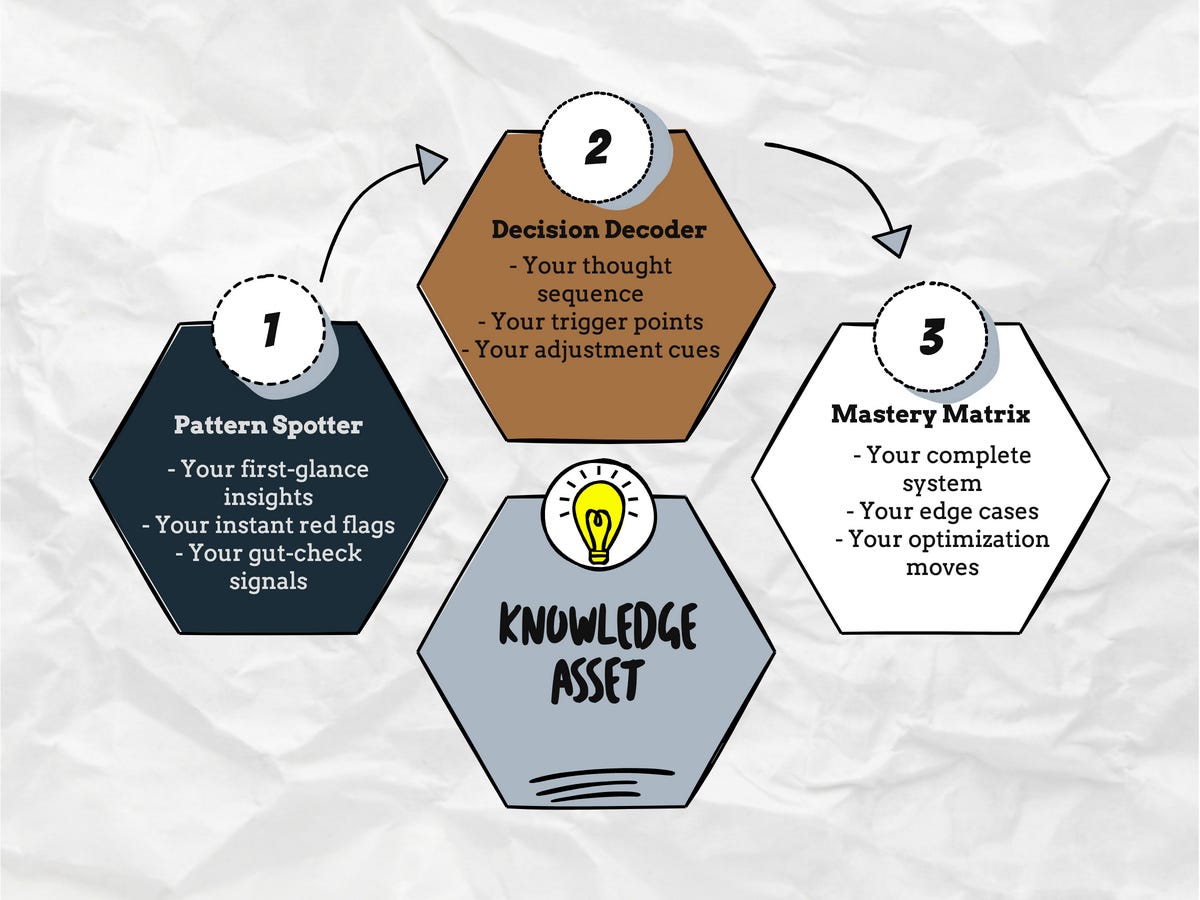
Here’s a sample roadmap:
The Pattern Spotter ($97)
Your first-glance insights
Your instant red flags
Your gut-check signals
The Decision Decoder ($197)
Your thought sequence
Your trigger points
Your adjustment cues
The Mastery Matrix ($397)
Your complete system
Your edge cases
Your optimization moves
The Asset Alchemy Prompt
Here’s how to transform those instincts into assets:
CONTEXT:
You are an Asset Alchemist, turning unique wisdom into irreplaceable tools.

INPUT:
One moment you spotted something others missed [INPUT]
How you knew where to look [INPUT]
What patterns triggered your expertise [INPUT]

OUTPUT:
1. Asset Foundation
What unique lens do you bring?
Which patterns jump out first?
What subtle signals guide you?

2. Distinctive Naming
What metaphor captures your way of seeing?
How do you frame problems differently?
What makes your approach distinctive?

3. Value Architecture
Quick Win: Which insight creates instant clarity?
Core System: How do you navigate complexity?
Complete Framework: What makes your approach unique?

Example Output

INPUT:
Small moment: I always look at how a logo sits with the company name first.

Why this matters: This relationship reveals if a brand is authentic or trying too hard.

OUTPUT:

Entry Point Magic:
Unique Lens: The "Logo-Name Relationship" – how these elements either harmonize or clash.
Immediate Win: Clients see how this one misstep might betray their market position.
Natural Next Steps:
Emerging Question: "If our logo isn’t aligned, what else feels off?"
Deeper Pattern: How visuals either build or break trust.

Distinctive Asset Design:
Metaphor: Dance choreography—partners moving in harmony or stepping on toes.

Unique Name: “The Brand Chemistry Scanner.”
Value Journey:
Quick Win ($97): Instant logo-name evaluation process.
Core Pattern ($197): Deeper brand alignment map.
Complete System ($397): Full authenticity blueprint.
Like all things with AI, don’t just take the first thing it gives you. Dance with it—ask for variations, push for deeper insights, and refine until it feels truly yours.
Building Your Collection
The brand designer started with her Visual Velocity Scanner at $97. Then came her Brand Resonance Radar ($197) and Position Power Grid ($397).
Each tool built upon the last, creating a pathway that turned her expertise into an ecosystem of value. What started as a simple idea quickly evolved into a suite of offerings—each one showcasing her unique way of seeing and solving problems.
Your First Move
Here’s what makes these knowledge assets particularly powerful in an AI-driven world. They capture the nuanced pattern recognition and gut instincts that AI can’t replicate.
While AI can analyze brand elements or suggest improvements, it doesn’t have your years of human insight, your emotional intelligence, or the context behind your decisions. AI is a tool, but it’s your expertise—your ability to see the subtle connections and make intuitive leaps—that transforms raw information into actionable wisdom.
In fact, you may use AI as part of the process to brainstorm or organize ideas (like we just did.)
But the final product? That’s entirely yours, shaped by how you see the world and the patterns only you can identify.
Pick one thing you notice that others miss. Don’t focus on what you do. Focus on how you see.
That unique perspective? It’s your first product.