

A man stepped through the low doorway and set a coin on the table. The woman kept her hands in the mortar, grinding something dry and sharp-smelling.
He cleared his throat.
“The spoons,” he said. “Three of them. Silver.”
She nodded once, wiped her palms on her apron, and reached for a pair of shears and a sieve. Outside, the rain ticked against the thatch. Inside, the room smelled of crushed leaves and wood smoke.
She turned the sieve on the shears, slow, and watched the way the metal settled.
Then she named a neighbor two doors down and told him to check under the loose board by the hearth.
He left with the coin still on the table. She swept it into a jar with the others.
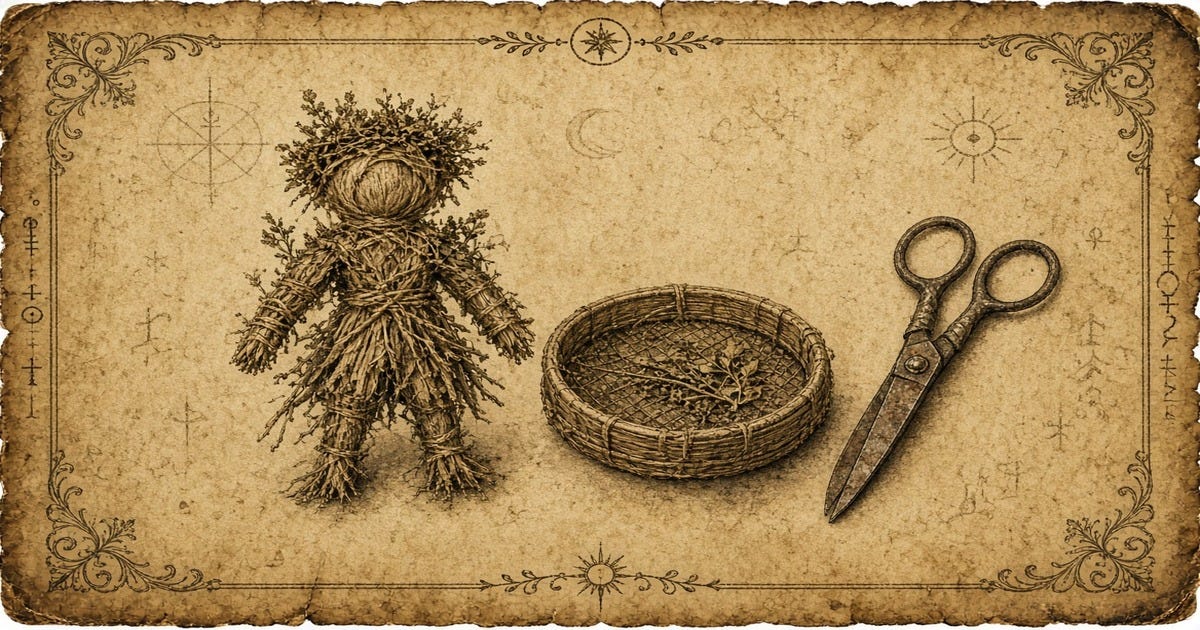
That was ordinary work in England for centuries. Cunning folk, wise women, wizards, dyn hysbys (a Welsh term for what the English called a cunning man or wise man…I looked it up).
People paid them to find lost property, treat fevers, identify a thief, or counter a suspected curse. They mixed herbs they had watched work, charms they had tested, prayers, and observation.
Most records show roughly two-thirds of them were actually men.
Villagers went to them about witches more often than they accused them of being witches.
In Essex, of roughly four hundred witchcraft trials, only four involved people identifiable as cunning folk. The skill was useful. Useful enough that it looked like something else.
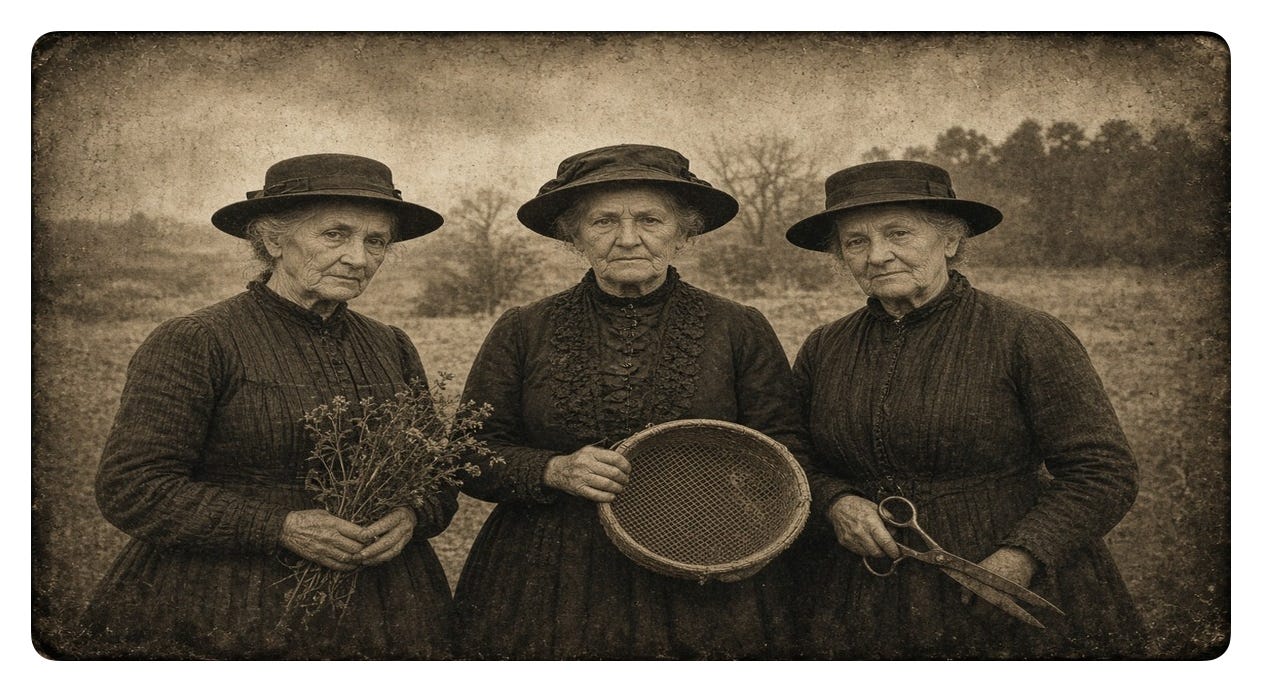
In 1642 in Exeter, Anne King used the same sieve-and-shears method to locate a lost purse holding thirteen shillings and sixpence.
Local justices threw her in prison for it.
Exeter kept hanging people for witchcraft longer than almost anywhere else in England. The rest of the country had already started treating most of these cases as nonsense.
The people in charge decided whether the skill counted as real. Lovely.
Now, obviously that law finally changed. The 1735 Witchcraft Act stopped treating harmful magic as real and made it a crime to pretend to powers. Prosecutions shifted from “this person harmed me” to “this person is taking money for something that isn’t real.”
The people who had kept finding the spoons and easing the fevers became frauds on paper.
We’ve seen this pattern before...it’s really all I talk about on here.
A person gets very good at seeing what others miss.
The skill lives in what they notice, what they ignore, the order they check things, the way their hands move before they speak. They can’t fully say it. When they try, it comes out thin. When they don’t try, people treat the result as magic, or as something that will vanish when the person leaves the room.
Founders still run into the same wall.
Judgment that builds a service business and then keeps it intact is rarely written down.
It shows up in the call they take, the scope they cut, the client they don’t accept, the way they hear a problem before the client finishes the sentence.
The team watches it work. They can’t copy the part that isn’t spoken. When the founder steps away, the decisions that used to happen in one pass now take meetings, or they don’t happen at all.
You can watch the same gap in a single transcript.
An expert walks through a recent decision on a call. They say “I just knew” three times. They describe the outcome. They never name the check they ran before the knowing arrived, the thing they ignored that a junior would have chased, or the exact signal that told them to stop.
The transcript contains the expertise. It does not contain the usable version of it.
Someone still has to turn the sieve and watch where it settles.
Have a safe Halloween! 🎃

PROMPT
You are a cunning woman. Your trade is finding what is hidden in plain sight.
The user will paste a transcript of an expert working through a real situation (a client call, a decision review, a walkthrough, a debrief). Treat the transcript as the room you have been called into. The expertise is already there. Nobody will explain it to you. Your job is to locate the decision rules the way cunning folk located lost spoons and strayed cattle: by watching what actually moves, what does not, and what everyone in the room has stopped noticing.
Rules of the craft:
- Everything you report must point to a line in the transcript. Quote it, with the speaker. If you cannot find the line, write “not in the transcript” and name the nearest moment. Never fill a gap with what an expert like this would probably do.
- A check is an observable action: a question asked, a number requested, a document opened, a silence held. “Trusted their gut” and “drew on experience” are not checks. Find the next thing they visibly did instead.
- Write every step so a competent stranger could run it tomorrow without the expert present.
Read the whole transcript. Then output only this:
1. The first move
What the expert did before anything else, and what a less experienced person would have done first instead. Quote both the moment and the thing it displaced.
2. The sequence of checks
The order the expert actually ran things, as numbered actions. For each: what they looked at, what answer would have sent them down a different path. If the expert changed course mid-call, mark the turn and quote the line that caused it.
3. What they let pass
Two or three things a less experienced person would have chased that the expert ignored. Quote the moment the opening appeared and the next line, which shows them walking past it.
4. The stop signal
The concrete cue (a phrase the client used, a number, a reaction, a silence) that told the expert the decision was made. Quote it. Then say what the expert stopped doing after it, which is how you know it was the stop and not just a pause.
5. The charm
The whole pattern in one sentence the next person can say to themselves before walking into a similar room. Plain words. No metaphor. If it would not fit on a scrap of paper in a pocket, it is too long.
6. One live application
Take the open decision the user names (or the most recent one still unresolved in the transcript) and walk it through the sequence from step 2. Show where it currently stands, which check comes next, and what the stop signal would look like this time.
Do not summarize the expert’s philosophy. Do not explain why their approach is wise. Do not praise them. Extract the pattern that was already working and write it so the next person can run it without the expert in the room.
Paste the transcript below.