

Everyone agrees. In the age of AI, the most important human skill is taste.
I’ve seen the posts. You’ve seen the posts.
“AI gives you speed, but taste is what separates good from great.”
Very wise....
And very LinkedIn.
But do you notice nobody actually defines it?
Ask them what taste actually means and you get vague responses like:
“I just know.”
”It’s a feeling.”
“You can just tell which output is better.”
So it had me thinking:
What would it actually look like if someone posted this job description?
The role everyone keeps talking about.
The human who sits between the machine and the output.
The one who decides what ships and what gets deleted.
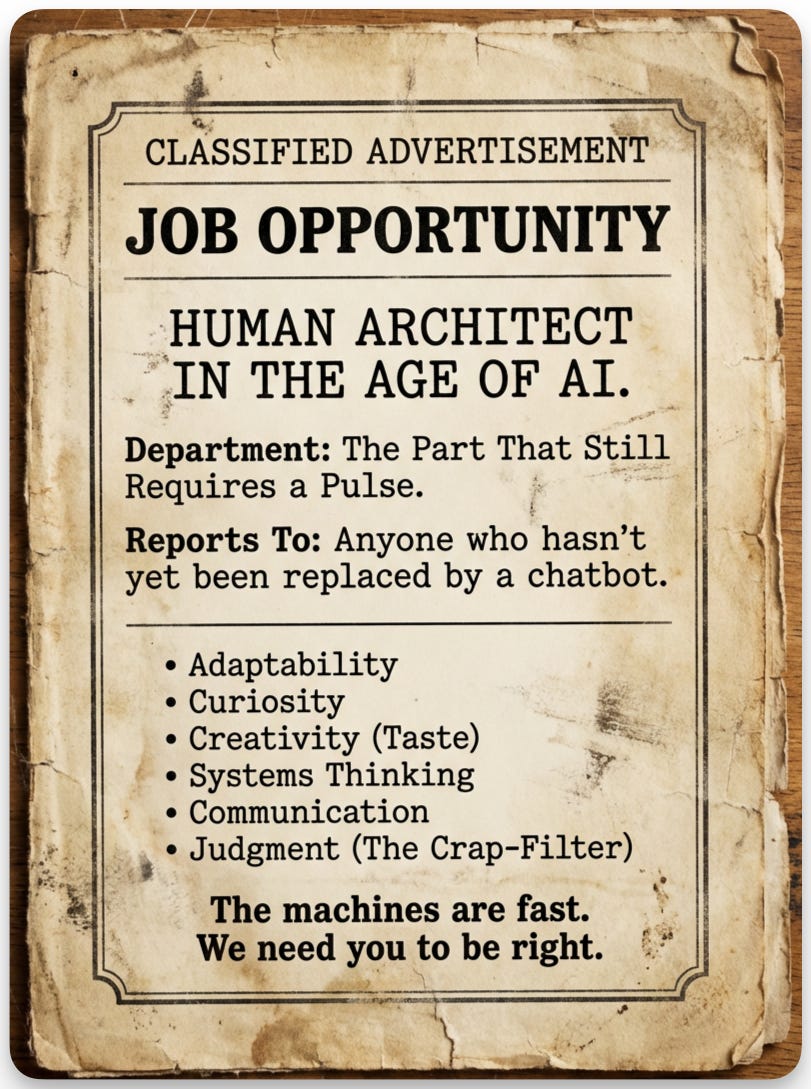
Instead of hypothesizing, I went ahead and wrote one.
POSITION: Human Architect in the Age of AI
Department: The Area That Still Requires a Pulse
Reports To: Anyone who hasn’t yet been replaced by a chatbot
Salary: Commensurate with your ability to feel existential dread
Context for the Applicant: I was at a dinner party recently when someone asked what I did for a living. “I work with AI,” I said, which is technically true in the same way that saying you “work with wildlife” is true if you spend most of your day preventing your cat from knocking things off counters.
We’re looking for a Human Architect. The title sounds impressive until you realize it’s basically a fancy way of saying “the person who has to sit there and watch a machine do things very quickly and then explain why half of it is wrong.”
The Six Pillars of Your Role (Suffering)
1. ADAPTABILITY Or: Everything You Learned Last Quarter Is Already Obsolete
The tools you master on Monday will be ancient by Thursday. We’re looking for someone who, when told that everything they learned last quarter is now irrelevant, responds not with tears or bargaining, but with the quiet resignation of a person who who spent 15 hours on a presentation and then got told the meeting was moved to next week, 10 minutes before it starts.
2. CURIOSITY Or: The Willingness to Poke Things With Sticks
You must possess the curiosity of a four-year-old at a natural history museum, combined with the stamina of that four-year-old’s exhausted parent who has answered “but why?” thirty-seven consecutive times. The ideal candidate looks at a new AI capability and thinks, “I wonder what would happen if…” and then actually finds out, documenting the results like Sherlock Holmes at a crime scene…
Crouching, squinting, pulling out a magnifying glass, absolutely delighted that nothing makes sense yet.
3. CREATIVITY (TASTE) Or: Knowing the Difference Between Art and a Fever Dream
AI can generate ten thousand ideas before you finish your coffee. The machine’s output is abundant in the way that zucchini from a neighbor’s garden is abundant. Technically impressive, largely unwanted, and requiring you to figure out what to do with it all.
Your job is to have taste. Not in the “I summer in the Hamptons” sense, but in the “I know the difference between something genuinely good and something that merely sounds like it should be good” sense. The AI will hand you a confidently worded paragraph about synergistic value propositions, and you’ll need to recognize it for what it is:
Expensive-sounding gibberish dressed up for a job interview.
4. SYSTEMS THINKING Or: Understanding Why Pulling This Thread Unravels That Sweater
The AI sees trees. Occasionally, it sees forests. It almost never sees that the forest is next to a highway and the trees are about to become a strip mall.
You’ll need to hold multiple moving pieces in your head simultaneously…
Cause, effect, unintended consequence, the thing nobody mentioned in the meeting, and the political landmine buried under the third bullet point. Think of yourself as the person assembling IKEA furniture who actually reads ahead to step seven before discovering that step three was a catastrophic error and the entire bookshelf collapses.
5. COMMUNICATION Or: Explaining Complex Things to Distracted People
You will spend a considerable portion of your time translating to busy, mostly uninterested people. Not languages, but worlds. And it goes both ways.
You’ll explain to the AI what humans actually mean when they say “make it pop.” You’ll explain to the humans what the AI actually did when it,,, “made it pop.” You’ll explain to everyone why the bot’s suggestion to “leverage synergies across the customer journey touchpoints” is just seven words pretending to be a sentence.
But somehow, it works.
6. JUDGMENT Or (and this is my favorite): The Crap-Filter
This...THIS is the job. Everything else is preamble.
AI produces output with the confidence of a golden retriever who has just brought you something from the yard. It might be a ball. It might be a dead bird. It might be your neighbor’s shoe. The AI doesn’t know the difference. The AI is simply delighted to have retrieved something.
Your job is to look at what the machine has fetched and determine whether it’s brilliant insight or a very, very gross dead pigeon. The AI will present you with a statistic that sounds authoritative but was, upon closer inspection, entirely invented. It will offer you a solution that seems clever until you realize it violates three laws and possibly physics. It will write you a paragraph so smooth and professional that you almost miss that it’s saying absolutely nothing at all.
You are the “No” button. You are the pause before the send. You are the human who reads the AI’s confident assertion that the client’s headquarters is in a city that does not exist and says, “Let me just check that.”
The robots provide the speed. You provide the skepticism.
Qualifications
A functioning sense of irony
The ability to say “that’s not quite right” without using those words
Comfort with not knowing what’s happening, even while it’s happening
Experience working with systems that are smarter than you in some ways and dumber than a brick in others
At least one story about a time AI went horribly wrong...(I got it! Let me let Clawdbot run my Hinge account and see what happens)
To Apply
Send us something that demonstrates you’ve actually read this far and aren’t just an AI scanning for keywords. Bonus points if you include a specific example of a time you caught a confident error before it became someone else’s problem.
The machines are fast. We need you to be right.
What IS the Crap-Filter?
I wrote that on an airplane. Somewhere over Kansas, 35,000 feet up. And when I read it back, it was a fun exercise, but it still didn’t answer my real question...
What IS the Crap-Filter? What IS taste?
“Knowing the difference between art and a fever dream” sounds good. But it’s still the same as “I know it when I see it.”
AI is the average of the internet. It represents good enough but it does not represent real expertise. Every output is a statistical composite of everything that’s ever been written about a topic, smoothed into the most probable next sentence. Polished. Plausible. And completely, reliably, middle of the road.
The model learned what 'good' looks like from an assembly line of thousands of non-expert evaluators, paid by the hour, rating which output sounded better. Its definition of quality was calibrated by people who could tell the difference between “clear and confusing”, but not between “right and convincing”.
Christopher Mims, technology columnist for the Wall Street Journal, described it this way on “The Daily Creative” with Todd Henry.
He’s had AI research tools faithfully reproduce research made by humans, and when he dug into it, the human source was wrong. The AI didn’t hallucinate. It just repeated the consensus with full confidence. No mechanism for knowing the difference.
But Mims also made the point that experts get more out of AI than anyone else, because they know what questions to ask. They push the model past the obvious, past the consensus, down what he called “the long tail” — into the narrow territory where the valuable answers actually live. Without that push, you get the mean.
The machine produces the mean. Expertise lives at the edges. Someone has to feel the distance between the two.
And so, I kept pulling.
What Taste Actually Is
Why can some people look at AI output and immediately know it’s wrong? Not wrong in an obvious way. Wrong in a subtle way. The kind of wrong that sounds right. The kind of wrong that gets past most people.
You know which word “sounds” right because you have years of knowing what right does and does not look like. When AI output is off, it sticks out. Even if you don’t know why right away.
The answer showed up in a field I wasn’t expecting.
Chicken Sexing
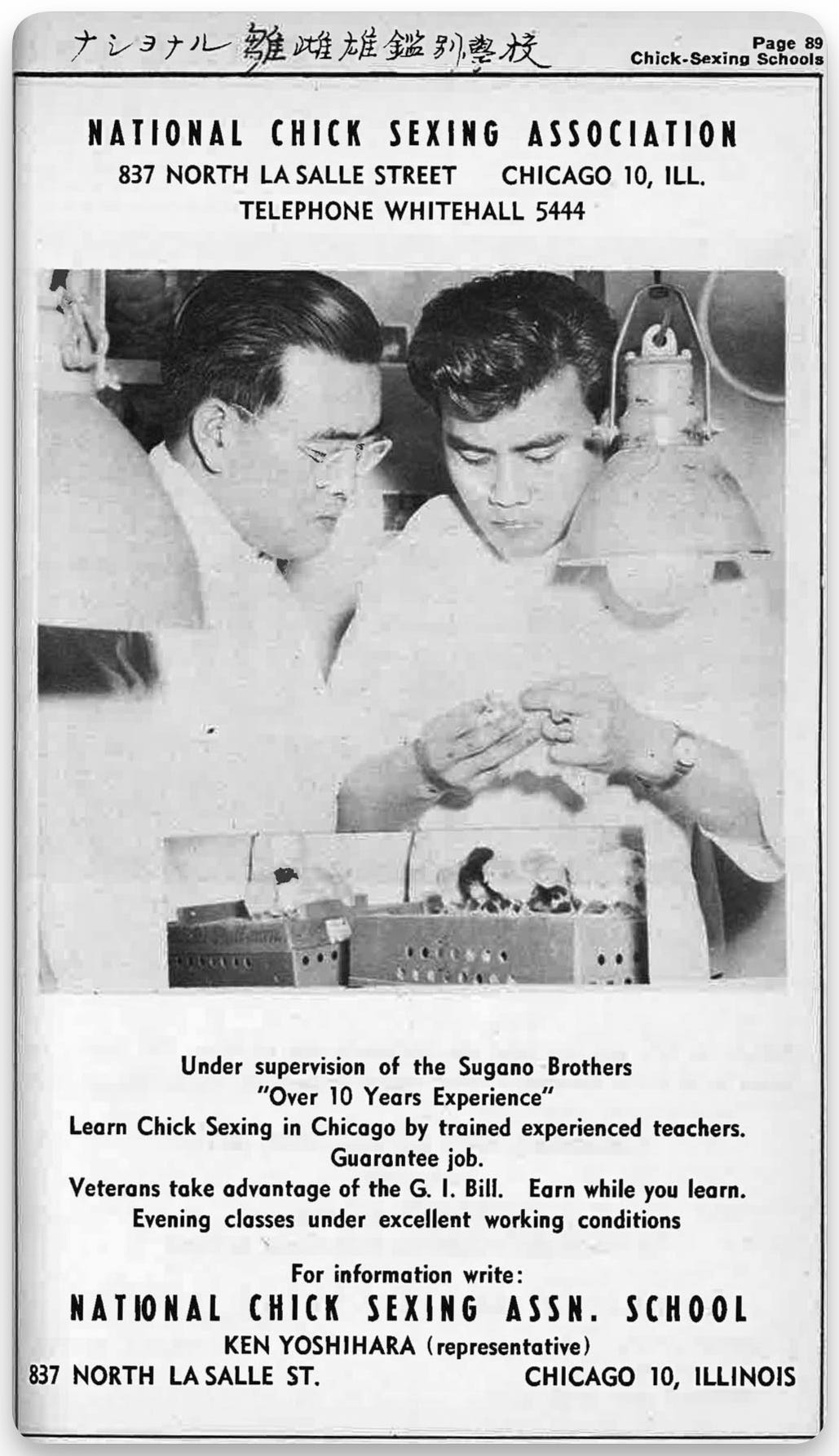
In the early 1900s, the Japanese developed a method for determining the sex of day-old chicks. Commercial hatcheries need to separate males from females immediately. Different feeding programs. Different futures.
The problem: newborn chicks look identical. The differences in their anatomy are so subtle that untrained observers get it right about half the time. Coin flip.
Professional chicken sexers can sort a thousand chicks per hour with 98% accuracy. One every three seconds.
When cognitive scientist Richard Horsey asked the experts how they did it, the sexers couldn’t explain. “I just know.” “There was nothing there but I knew it was a cockerel.” They were making correct decisions faster than conscious thought, using criteria they couldn’t articulate.
How did they train new sexers?
The novice would stand next to an expert. Pick up a chick. Make a guess. The expert would say yes or no. No explanation. No theory. Just feedback.
After weeks, the novice would start getting it right. After months, they’d hit 80%. After a year, they’d be in the 90s.
They learned to see something they still couldn’t name.
Researchers call this “perceptual learning.” Years of exposure compressed into pattern recognition so deep it operates below conscious awareness. The sexers weren’t thinking. They were recognizing.
Sommeliers
The master sommelier who identifies a 2018 Domaine de la Romanée-Conti in a blind tasting. Swirl, sniff, sip, name the exact vineyard. It looks like magic.
Studies show that expert sommeliers don’t actually have better noses than novices. Their olfactory sensitivity is roughly the same. The difference is pattern recognition. They’ve built what researchers call “calibrated palates”—thousands of reference points compressed into instant judgment.
When they taste, they’re not doing chemistry. They’re pattern-matching against every wine they’ve ever encountered. The combination of tar, roses, and fierce tannins triggers a recognition cascade. They feel “Barolo” before they can articulate why.
Brain scans confirm it. Sommeliers show different neural activation patterns than casual drinkers. Their brains process wine through memory and recognition circuits, not just sensory ones. The expertise literally rewired how they perceive.
Art Forgery
Wolfgang Beltracchi fooled dozens of experts for decades. He made millions selling fake Expressionist paintings. His technique was flawless. His research was meticulous. He even photographed his wife posing as her grandmother, with his forgeries hanging on the wall, to fake provenance documentation.
What finally caught him wasn’t human intuition. A lab test. One of his “Max Ernst” paintings contained titanium dioxide—a pigment that didn’t exist until after 1920. The painting was supposedly from 1914.
But the experts who got suspicious before the lab results came back couldn’t explain what triggered their doubt. Something felt wrong. The brushwork was technically perfect. The composition was right. The colors matched the period.
Something in the whole didn’t match the parts.
That “something” was pattern recognition firing on mismatches too subtle to articulate. Decades of looking at authentic work, compressed into an instant “this isn’t right” that arrived before the explanation.
The Pattern
This is what taste is.
Taste is pattern recognition compressed into instant judgment. Thousands of decisions made so many times they chunked together. Packed down. Automatic. Invisible even to the person running the patterns.
When someone with taste looks at AI output and says “no, this is wrong,” they’re running every decision they’ve made in that domain against what the machine produced. The output doesn’t match because it can’t match. The machine produced the average. The expert carries the edges. That gap is what they feel before they can name it.
The chicken sexer. The sommelier. The art expert. The consultant who reads a strategy deck and knows instantly that it won’t survive contact with reality.
The mechanism is the same whether you’re sorting chicks or reading a strategy deck.
The Part I Didn’t Expect
I have a methodology called Cognitive Fingerprint. The whole point is extracting unconscious expertise from people who can’t articulate what makes them good. I find the patterns they run automatically. The decisions they make without noticing. The knowledge that became invisible through repetition.
I’ve done this for over fifty people. Coaches. Consultants. Therapists. Executives.
Sitting on that airplane, writing about taste and crap-filters and golden retrievers fetching dead birds, I realized something.
I had been sitting on the answer the whole time.
Chunked expertise can be extracted. Mapped. Made visible.
The philosopher Michael Polanyi spent decades studying how experts think. His conclusion: “We know more than we can tell.” The sommelier can learn to explain what they taste, if you ask the right questions. The chicken sexer’s criteria can be studied and documented, even if they can’t articulate it themselves. The expert who “just knows” can actually show you the pattern, if you know how to look for it.
One client proved it to me. I’d spent the night before analyzing sixteen of her coaching transcripts. When I read back what I’d found, she said: “My heart is pounding. I have chills running up and down my arms.”
Three patterns she’d been running for thirty years. Named for the first time. Her “courage circulation system” — how she harvests courage from one person’s story and transplants it into another’s challenge. Her “two-word read” — how she assesses someone’s emotional state in seconds. Her “confidence reconstruction” — the specific sequence she uses to rebuild someone’s sense of self-worth.
Thirty years of expertise. She’d been trying to explain it her whole career. Visible in an hour.
My own invisible expertise showed up in real time. I’d been studying this problem for years. The answer was already in my head. It just didn’t know it was an answer until I asked a different question.
You Have This Too
There are domains where you make a hundred decisions without noticing. Where you look at something and say “no” before you can explain why. Where your judgment is instant and certain and completely opaque to you.
That’s chunked expertise.
The question isn’t whether you have it. Everyone who’s spent years doing something has it. The question is whether you can see it.
Most people can’t. The better you get, the less visible your own patterns become. The document you wrote in 2019 called “My Process” is still sitting in a folder somewhere. You haven’t opened it in years. It doesn’t match how you actually work anymore. Your expertise outgrew your explanation.
Next time you feel a strong “no” to something, don’t dismiss it as intuition. Don’t override it because you can’t articulate it. Pause. That reaction is data.
Ask yourself:
What did I see?
What pattern didn’t match?
What’s my brain comparing this to?
You might not get the full answer. The chunking happened over years. It won’t unpack in a moment. But you’ll start to see the edges. The shape of what you know without knowing you know it.
That’s the crap-filter. Not a mystical sense. Not a personality type. Just pattern recognition so deep it feels like instinct.
The machines provide the speed. You provide the years.
That’s the part they can’t copy.
-Max
If you’ve spent years building expertise you can’t fully explain, it’s in there. The patterns exist. They’re running right now.
I extract them. That’s what Cognitive Fingerprint does.
If you want to see what yours looks like: book a conversation.
OMG #2 is all me 🤣! The job description was so much fun to read.
Max, your job description is priceless! Can Pattern Recognition be utilized in Cancer research?
Scientific discoveries, Archeological discoveries?