

Between 1883 and 1929, Andrew Carnegie paid for 1,689 public libraries across the United States.
He’d grown up poor in Pittsburgh. As a teenager working as a messenger boy, he borrowed books from a private library a local colonel opened to working boys on Saturdays. Carnegie never forgot it. When he sold his steel company and became the richest man in the world, he decided to give towns the thing that had changed his life.
Then he attached a strange condition.
Carnegie would pay for the building. The bricks, the shelves, the reading room with the tall windows…
But he wouldn’t pay to run it.
Before he released a dollar, the town had to pass a resolution, a public and binding promise to fund the library every year afterward, usually at ten percent of what the building had cost. The staff, the heat, the new books. Forever.
Towns pushed back. They wanted the gift without the obligation. A library was a fine thing to have on the main street. But Carnegie had seen what happened to libraries a town owned and wouldn’t run. The doors stayed locked five days a week. The shelves thinned. The building turned into a monument to a thing the town didn’t actually use.
So he refused to fund those at all.
Carnegie had worked something out. The check buys a building. Only the town can buy a library. So he made them buy it first, in writing, before he spent a cent.
The Bike in the Corner
Getting a thing and running it…really committed to it…are different jobs.
Your friend buys a Peloton in January. The truck shows up Saturday. Two guys carry it up the stairs, plug it in, set up the screen. The Peloton has officially arrived. By June the bike is in the corner of the bedroom holding a sweatshirt and a phone charger. Your friend still owns a Peloton. Your friend is not a person who rides a Peloton.
Carnegie knew this. He’d seen the locked library. He understood that putting a thing within reach of people and getting those people to actually run it are two different projects, and the second one is the hard one.
The first is a check.
The second is a commitment, and nobody can write it on your behalf.
Everyone Got One
A few days ago, Google ran the largest distribution of AI agents in history.
At it’s I/O conference it announced that the agent is now the product.
Gemini rebuilt into the search box. Gemini Spark, an assistant that “Give it a task and it works in the background 24/7, even if your phone and laptop are turned off. It operates autonomously, but always under your direction. You choose to turn it on and it's designed to check with you before taking major actions.”. Agentic features reaching the 900 million people who open the Gemini app and the billion more who meet AI inside Search. The keynote framed it plainly.
You have an agent now. Everyone does.
Google built the building. It’s a very good building. I built a smaller one this week. A recap of every I/O announcement, a Omni prompting skill and a few other goodies.

But here’s the question Carnegie would ask before he believed any of the hype…
Who’s going to run it?
I am not talking about the skeptics. The skeptics were never the problem.
I am talking about what happens when everyone gets behind this agentic-wheel without really understanding what it can do?
This is no longer just an LLM chat. It can take actions “on your behalf.” But buyer beware because we are about to have a library with no librarian, and can’t quite tell.
Three Reasons You Can’t Tell
Having the building feels like running the library for three reasons, and each one is harder to see than the last.
The agent arrives friendly
It greets you by name. It offers example prompts. You try one and it does something impressive on the first attempt.
Feels like: It’s working.
The cost: Those example prompts came from Google
None of them came from you. Look at what people are actually sharing online two days after the launch. The clever Gemini Omni trick going around, the one that turns a butterfly into a swarm of fireflies, is Google’s own example, lifted straight from Google’s own prompt guide.
The crowd is copying the manual and posting the manual back at each other. You’re running the company’s demo and calling it your workflow.The agent is generic by default
It knows everything about the world and nothing about you. It can write an email. It can’t write the email you’d send to the client who went quiet last month, in the register you use with that account, about the thing only you know happened on the last call.Feels like: It’s capable
The cost: It can do anyone’s work. It can’t quite do yours
I watched this play out at a marketing agency. The founder couldn’t scope a new project without sitting in the room. Every statement of work and proposal needed his judgment. His team had the exact tools he had, the same subscription, the same models. The tools still couldn’t scope an SOW or a proposal, because scoping those were never generic tasks.
It was his specific patterns, built over years, living nowhere but his head. I pulled that pattern out of 7 of his past SOWs and proposals and built it into a system. Six hours of his time per project became 30 minutes. The team does this without him now. Nothing about their AI access changed. One task got installed and that was the whole difference.
You shrink to fit the tool
This is the one you can’t see without help. You adapt to the generic version. You learn which questions it answers well, and you quietly stop asking the ones it doesn’t.A tourist with a translation book can order coffee and find the station. She’s got a few hundred handed-down sentences. She’ll never have the conversation that actually mattered, and after a while she stops reaching for it, because it has trained her to only ask what it can answer.
Feels like: I’ve adopted AI
The cost: You adopted the demo. The work that needs you, that runs on your judgment and your context, never gets touched. And you stop noticing it’s missing
The three reasons have been here all along.
The Damage Used to Stay Inside
This used to be a smaller problem.
When AI was a chatbot in a separate tab, running the generic version cost you some speed and some polish. You got a mediocre draft. You fixed it. The damage stayed inside the document.
The agent changes that. Agents act. They send the email. They book the slot. They move the money. They make the call you’d have made, at whatever quality you set them to.
The mediocre version goes out under your name, gets read, gets remembered. By the time you notice the tone was off for that client, the position has already been taken in their head. You can apologize. They can’t unread. Distribution put that in 900 million hands this week. Installation (using the thing) is the only thing left standing between capability and consequence.
The Question Nobody’s Asking
I am the last thing from an AI doomer. If you follow me or have read any of my content you will know I love AI, I think the Gemini and Google updates are freakin awesome.
But the tech is moving SO much fast than most people’s “ai-literacy”. They are being handed a powerful set of tools and instructions, incentives and often work mandates to use it as fast as possible.
This sure doesn’t feel like it will end well…
Picture it inside a business.
A company that rolls the generic version out to 50 people has done something that looks decisive and isn’t. A license on every seat. A leadership team asks whether everyone has access and a training session forgotten in a week.
But here is the sneaky part.
It’s going to sound good. It’s going to look good. It’s going to create PowerPoints for you in minutes that used to take you hours and your leadership is practically begging you to do it.
Now, if that AI hasn’t been loaded and trained on you, your company, your situation, your thinking and your judgement it will give you the same answers it gives everyone else.
Answers that, on the surface, will make you think you will get that next promotion in no time.
Until you try to explain them.
When you have to get up in front of the team and present that fancy pants deck with all those animated charts and realize they are completely shallow.
28 slides that are directionally right but operationally useless (one of my favorites terms). Without the proper context and without people moving from knowing to understanding AI, this will happen over and over again.
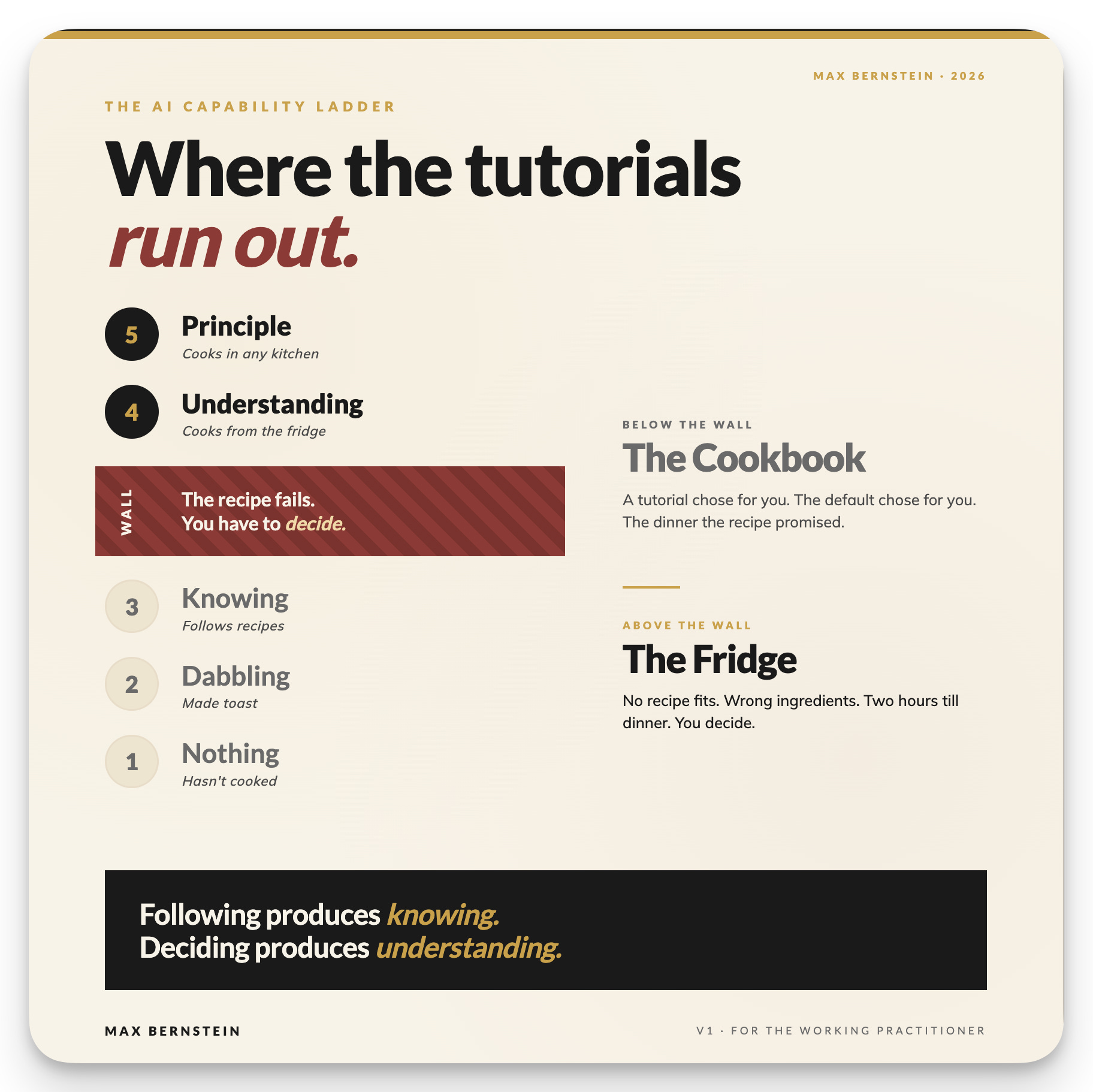
So here’s the question that hasn’t been answered.
What did AI do for me this week that it couldn’t have done for a stranger?
Sit with it. Write the answer down. Be strict.
If the honest answer is a faster email, a cleaner summary, a decent first draft, then the agent did for you the exact thing it did for 900 million strangers.
If the answer is specific, a draft only your agent could write because it knew your client, a risk it flagged because it had learned your blind spots, a call it got right because it caught what you would have caught, then something is installed. You’ll know, because a stranger couldn’t have gotten it.
Ask it this Friday. Then every Friday for a month. The weeks the answer comes back thin will teach you more than the weeks it’s good.
Twenty Years Across the Table
Financial advisor, 20 years in. Let’s call him Glenn. He had ChatGPT, he had Claude, he had every tool the headlines told him to own. He used them the way the tourist uses the translation book. Summarize this. Clean up that. Distribution, working exactly as distributed.
Then we installed one thing.
Glenn’s edge was never the financial knowledge. Every advisor has that. Glenn’s edge was reading a room. Twenty years across the table from couples had taught him to hear the thing under the thing, the hesitation a client would never say out loud. That skill lived only in Glenn. It had never been written down. It was the reason his clients trusted him, and the reason he couldn’t be in two meetings at once.
We extracted it. The patterns, the tells, the questions he asked himself in the car after a hard meeting. We built it into a system that reviews his call transcripts the way Glenn’s own instinct would.
He uploaded a transcript from a meeting he thought had gone fine.
The system flagged five signals he’d missed. A couple who’d said yes with their words and no with everything else. It told him the close he was planning, a gentle bit of pressure, would walk them straight out the door. It told him to do the opposite. Slow down. Name the hesitation out loud. Ask the question he’d have asked himself if he hadn’t been tired.
Glenn made one call. He followed the deeper read. The couple rescheduled within 20 minutes.
A generic agent could have summarized that transcript for anyone. It couldn’t have caught what Glenn would have caught, because catching it required being Glenn. For one afternoon, it was.
Why You Can’t Just Do This
That recap I created and linked above took an afternoon. It’s free because it should be free. A recap tells you what shipped and changes nothing about whether you can run it. The running was always the scarce part. The running is the only thing worth paying anyone for.
Carnegie wrote his clause into the contract because he knew the building would lie to the town. A library looks finished the day the roof goes on. It isn’t finished. It isn’t even started. It starts the first morning someone unlocks the door, and it has to start again every morning after that.
You understand the difference now.
Distribution is the building.
Installation is the librarian.
You can feel which one you’ve been running.
What you can’t do yet is the install itself. It’s genuinely hard, and not in the way you’d guess. Nothing about it is technical. The hard part is that installing your own expertise asks you to be your own interviewer, to pull a pattern out of your head while your head is busy being the expert. You can’t easily extract the thing you’re using to do the extracting.
That’s what The Personal Pattern Protocol is for.
It’s a three-part prompt sequence you run inside Claude, ChatGPT, or Gemini. It does what we did with Glenn, on your own expertise, with no consultant in the room. Glenn’s installation, above, is the worked example. The three prompts and the weekly audit are below.
The Personal Pattern Protocol
Three prompts. The first two are the setup. The third is what keeps the install alive.
The setup takes an afternoon. The audit takes ten minutes, every Friday, forever. Starting this one. The protocol has the same shape as the rest of the article. The setup builds the library. The Friday audit is the running.
Before You Start
Pick your tool. Use whichever AI you already pay for. The interview works the same in Claude, ChatGPT, and Gemini.
Pick your task. Three tests have to pass. Other people rely on you for it. You can describe a recent real instance of it from start to finish. Someone replacing you would do it noticeably worse. If several tasks qualify, pick the one where the “noticeably worse” is most obvious.
Prompt 1: Extract
This prompt interviews you. It will not help you with your work. Its only job is to pull one piece of your judgment out of your head and onto the page.
