

An old wizard named Gandalf shows up at Frodo Baggins’s door, and a quiet hobbit life of six meals a day in the Shire ends.
Frodo walks out past the last hedge he knows, carrying a ring that every evil thing in the world wants back.
A Black Rider stabs him in the shoulder.
A giant spider stings him stiff and wraps him in cords for later.
A creature named Gollum trails him the whole way, and inside a volcano called Mount Doom, bites off his finger.
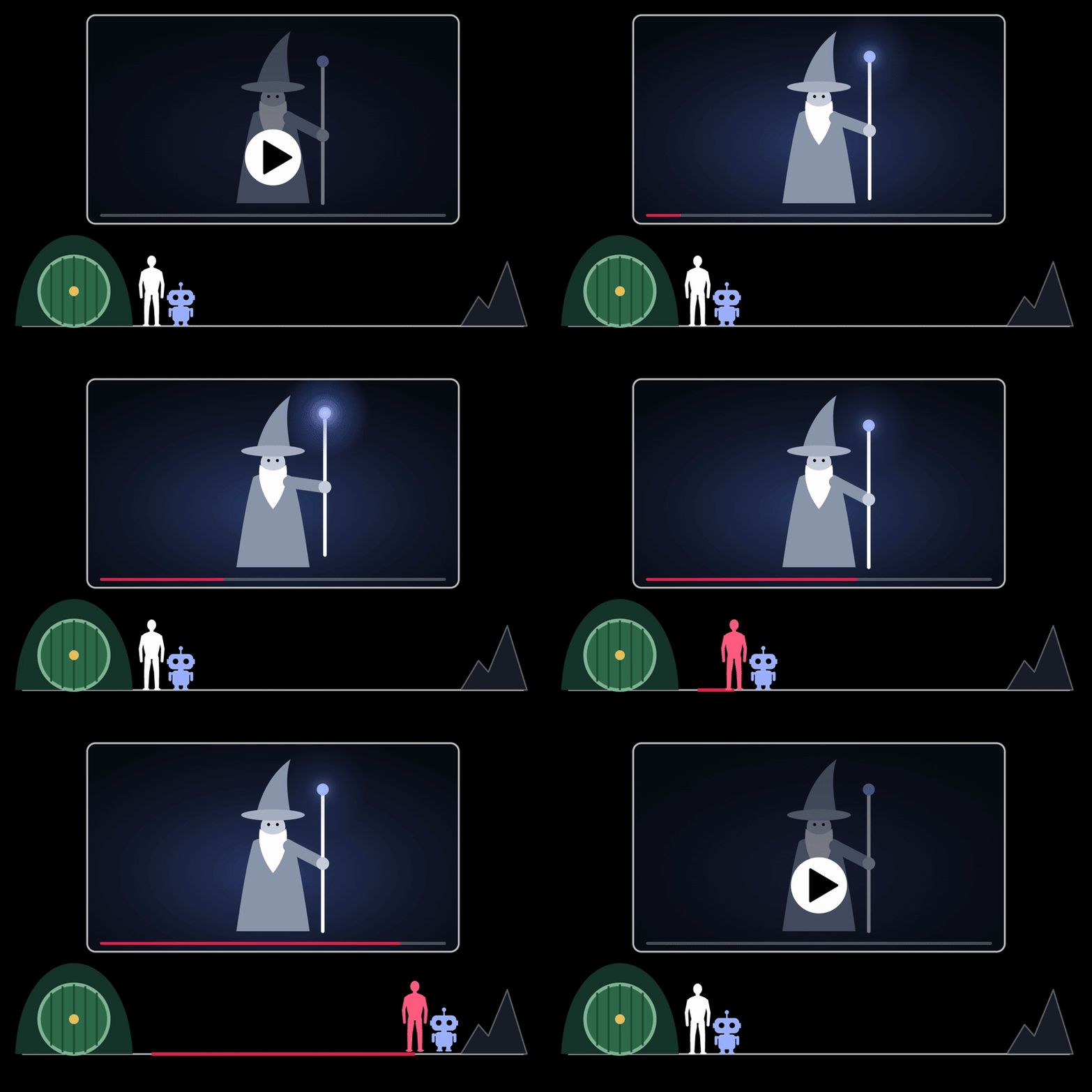
But everyone’s favorite little hobbit makes it home to the green hills of the Shire, sore, but forever transformed.
This is a classic story arc Joseph Campbell mapped in 1949 in The Hero with a Thousand Faces. He found the same journey in myths all over the world, and today it’s called the Hero’s Journey. A call pulls someone out of ordinary life, the road nearly kills them, and they come home changed.
Anybody who has started building with AI has probably gone on a version of this trip.
You leave the familiar ground of your expertise, build your way into a tangle you can barely maintain, and come back tokenless and tired with a more efficient tool and a different skill than you were expecting.
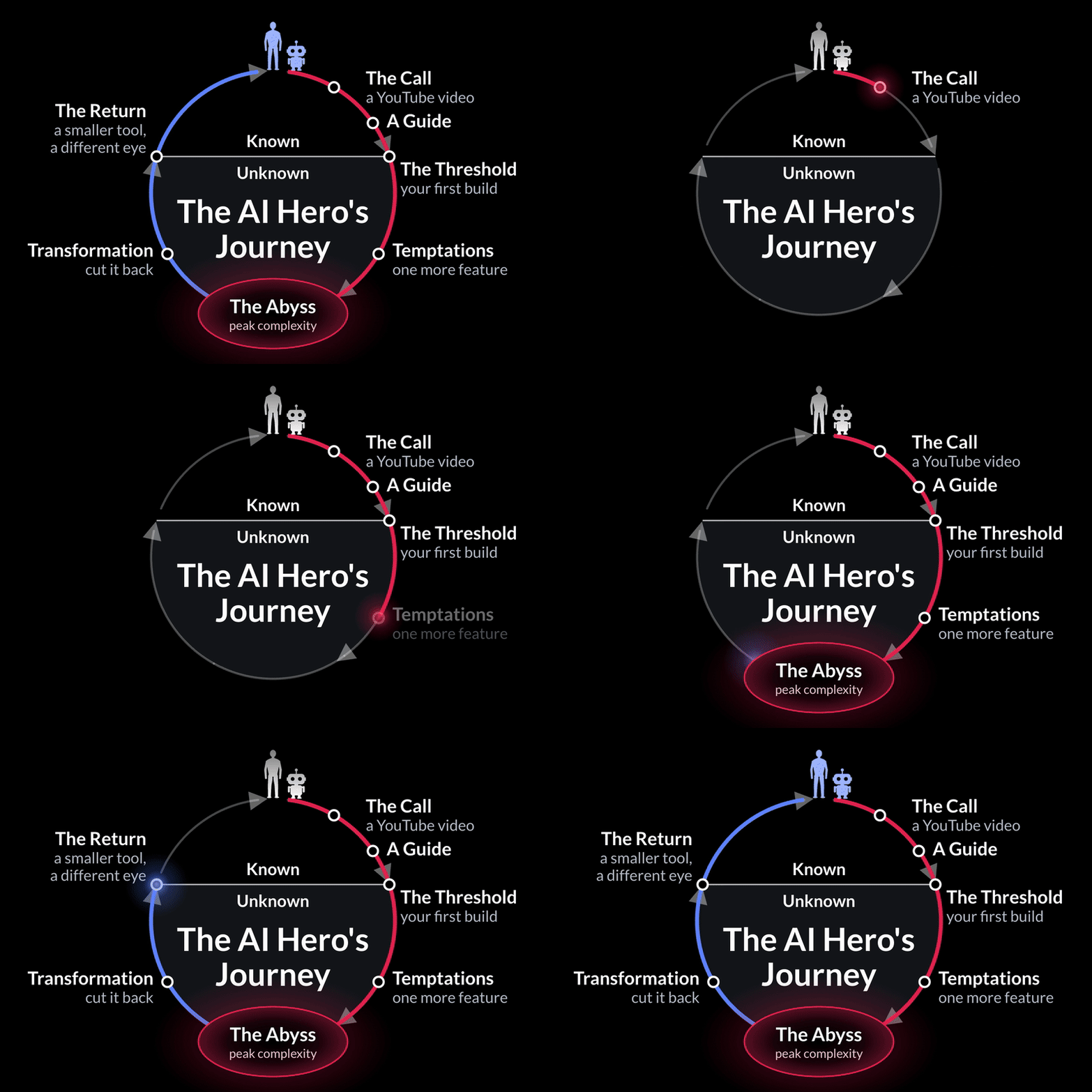
The Call
It starts when you get all jazzed up.
You watch a YouTube video, read a post on X, buy a workshop, or a friend mentions what they built. Something in it gets hold of you. You have spent fifteen or more years getting good at your craft, and until that moment, turning an idea into working software meant hiring a developer or waiting on a vendor. But now things feel different.
As you get some momentum you find a guide. Sometimes it's a friend who is three months ahead of you, and sometimes it's a course or a person on a screen you've never met.
They show you enough where it “actually doesn’t look that bad”. You follow along, copy the setup, and watch the pieces connect.
Then you cross over and build the first thing that works.
It sits on your screen, responds when you click it, and does a job you couldn't have built for yourself last month. That moment changes how you look at your calendar and your entire career! A problem that used to require a workaround now looks like your ticket to being the next Bill Gates.
In July 2025, I built a testimonial collection app called Story Bounty over a weekend. Afterward I thought I could build this stuff quickly, and I started looking at everything through "could this be an app?"
The Climb
After that first working build, you start climbing. You keep seeing what's possible, and every week a new capability opens up in front of you. One feature suggests the next one, so you add a dashboard, and then you add five more views to the dashboard, three more APIs and something called a “cron job.”
You spin up second and third apps for side problems in your business.
Every time a software subscription renews, the same thought crosses your mind... "I'm not paying for that, I'll build my own."
By August 2025, I was telling people Story Bounty was 88 to 90 percent complete. I already had plans for a website widget, an analytics dashboard, and nurture sequences.
The climb takes you straight to the peak. You look around at the architecture you've assembled, the tables, the settings pages, the automated handoffs, and you've got something super complex that sure feels like progress.
And this is the trap. It feels like you are headed in the right direction because the AI will keep building and telling you what you want to hear to stay vibin’.

But we all know that's not how the story ends...
In 1975, a pediatrician named John Gall wrote a book about how systems fail and later published it as Systemantics.
Gall’s Law says every complicated thing that works started out as a simple thing that worked.
The old ways of building software and apps forced you to start simple. When you wrote code by hand, that law stopped you early because you hit your own limits before the system did.
AI breaks the early warning system built into Gall’s Law. It makes building something complex from scratch feel not only possible but like it is our duty with these new superpowers.
So you skip the simple, working system…and pay for later picking up all the pieces.
My Story Bounty repository at its peak held 376 files and 83 database migrations. Along the way it had grown 3D components, gamified story scores, progress bars, and confetti. And my new buddy Claude called it world-class any time I asked.
(Note: It was not world-class)
The Ordeal
That’s when reality sets in. The thrill of adding features fades into the weight of keeping them all up.
You’ve built more software than one person can possible keep up with even if it was properly made.
Some of the tools sit underused because even YOU don’t want to click through all those screens.
Worse?
Inside a sprawling codebase, things break where you can’t see them.
You start to hate AI. No wayyyy this is super intelligence.
Every feature I added made the app home page promise something new. I’d rewrite the headline for the business owner collecting testimonials. Then build something for the client leaving one and rewrite it again until the page had no idea who it was anymore.
Behind the screen, my users could now set rewards for their clients paid out by how long a story ran and other numbers they picked.
Each reward pushed guests to keep talking.
Every new way to turn a story into marketing asked them one more question.
A voice testimonial that should take five minutes, took twenty. The people testing it kept telling me the same thing.
Dude, it’s too long.
Every feature I built to get my users better testimonials made a testimonial harder to leave.
After many months and even more declarations that you will never look at a prompt again, you wake up and do something completely novel to the AI space…
You subtract.
Slowly, you begin breaking your creations back down to what’s simple, clean, and necessary.
You cut the extra screens, drop the funny side animations, and try to get down to the one job the tool was supposed to do in the first place.
And yet the habit of building big doesn’t leave quietly. Halfway down the mountain, you feel the pull to climb again and fix the old monster with one more grand rebuild.
Then one day, another company’s voice interview tool interviewed me…
And I loved it.
In my own words, “bc it made me sound cool.”
So, I started fresh.
The Return
When you finally let the big system go, what replaces it is small enough to understand without 10 pages of documentation.
You build for the one problem that matters and leave the rest out.
Most of what I build now is simple but works. I am able to quickly see why every missing part is missing.
Looking back I wouldn’t change a thing.
The real transformation came from overbuilding and from learning through troubleshooting.
Running my head into the wall over and over again until I broke through and figured it out. I was building my own judgement through trial and error.
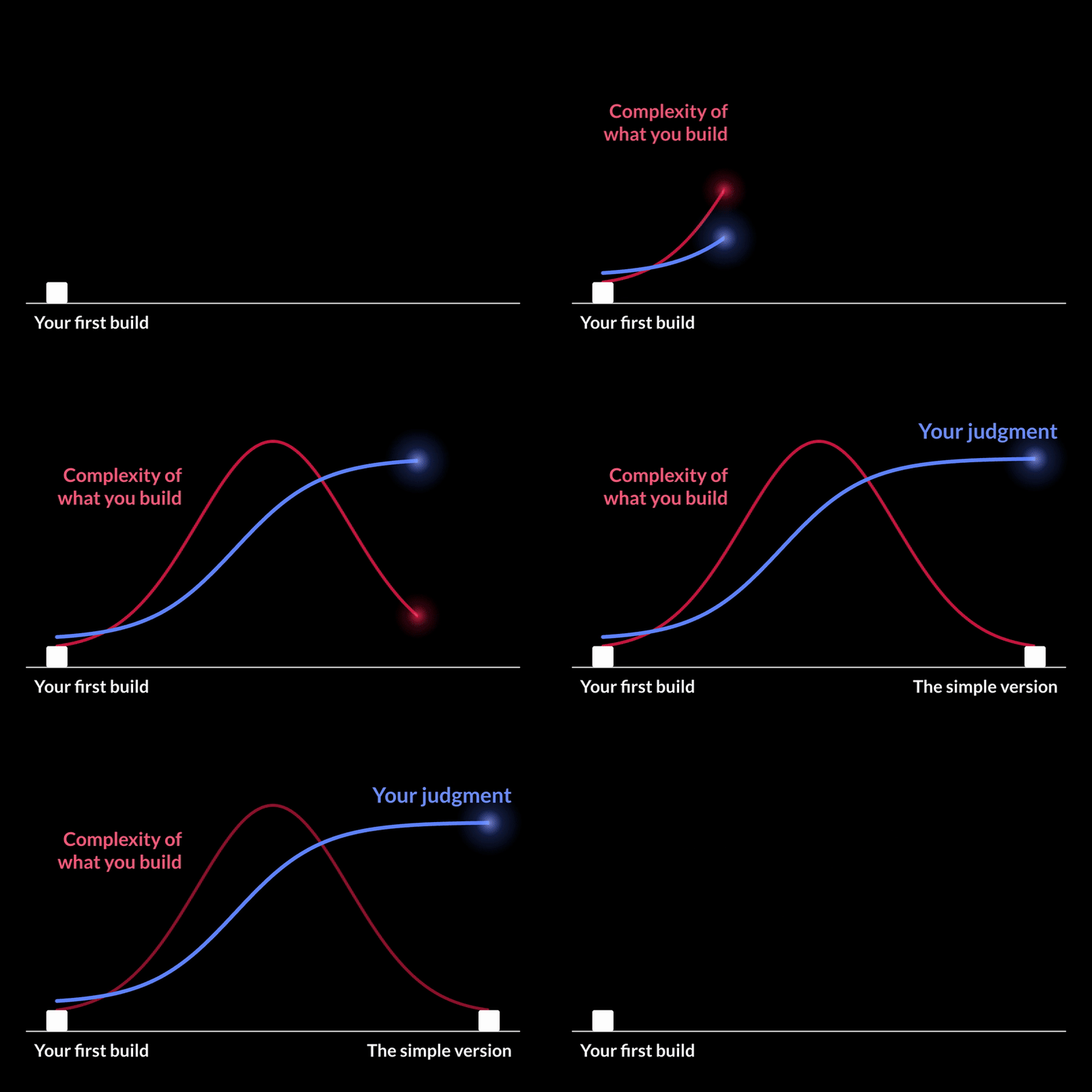
Even though I ended up not using anything I built on top of the mountain, I now know what’s possible.
And I realize the power of simplicity.
-Max