

In 1999, Pets.com spent $11.8 million on a Super Bowl ad featuring a sock puppet. Eighteen months later, they were bankrupt. The culprit wasn't bad technology. It was the exact same positioning mistake that's killing AI companies today.
Watch the infamous Pets.com Super Bowl commercial:
Pets.com thought technology differentiation was enough. They had the platform, the funding, the Super Bowl ad. What they didn't have was a reason for customers to choose them over walking to the corner pet store.
AI companies are at a critical inflection point. Those who pivot from hype to service excellence NOW will dominate their markets, while those who stay in "snake oil" mode will be left behind.
This isn't me being dramatic—it's pattern recognition. The exact same thing happened in the 1990s with service companies. Same promises, same positioning mistakes, same outcomes.
The companies that figured out service excellence early dominated for decades. IBM, Accenture, McKinsey, all made this pivot while their competitors were still promising magical transformations.
The companies that stayed focused on impressing people with their capabilities instead of solving specific problems don't exist anymore.
We're watching this movie again, just with AI instead of enterprise software. And most AI companies are still making the same mistakes that killed their predecessors.
If you recognize this pattern now, you can get ahead while everyone else is still promising magic.
Why This Article Includes 5 Strategic Positioning Prompts
Embedded throughout this article are 5 advanced positioning prompts that will push your thinking beyond obvious answers. Most AI positioning advice assumes you need to be told basic concepts like "focus on outcomes." These prompts assume you already know the fundamentals and need to think three moves ahead of competitors who are reading the same positioning playbooks.
What makes these prompts different:
They anticipate what happens when "good" positioning advice becomes commoditized
They force you to find differentiation beyond obvious metrics and outcomes
They're designed for sophisticated buyers who've heard every standard pitch
They help you position against competitors who are also pivoting to service excellence
How to use them: Copy any prompt into Claude, ChatGPT, or your preferred LLM. Fill in your specific details where indicated. The prompts are designed to push beyond obvious answers, so use the outputs as starting points for further refinement.
Think of them as strategic thinking accelerators, not final answer generators.
The 1990s Shakeout That Predicts AI's Future
When Everyone Promises Everything, No One Believes Anything
It's 1995, and every software company at every trade show is making the same promise. "Our revolutionary platform will eliminate all your business problems!" They'd demo impressive technology and talk about "leveraging synergistic solutions for optimal outcomes."
We're hearing the exact same language today, just with "AI" swapped in for "enterprise software."
The Inevitable Crash
Clients got excited, bought the software, and then... it didn't eliminate all their problems. Shocking, I know.
What happened next was entirely predictable. Clients got skeptical. Really skeptical. Trust eroded across entire industries. Companies that were once able to charge premium prices suddenly found themselves in price wars.
This pattern isn't unique to tech. Most businesses have been burned by service providers who sold the dream but didn't deliver the results—whether it was marketing agencies promising explosive growth, consultants promising transformation, or software companies promising to eliminate all problems.
The reasons vary (delegating work to junior staff, insufficient attention to client success, underestimating the complexity of crowded markets), but the result is the same: broken trust and damaged reputations for entire service categories.
The Smart Companies' Response
Some companies saw this coming and changed course. Instead of talking about their amazing technology, they started talking about specific problems they solved. Instead of promising to fix everything, they specialized in fixing particular things really well.
Take McKinsey. In the early '90s, they could have positioned themselves as "We use advanced analytical frameworks to optimize your complete business paradigm." Instead, they said things like "We help manufacturing companies reduce production costs by 15-20% in 6 months."
One approach sounds impressive. The other one gets you hired.
The companies that made this shift early didn't just survive—they captured the best clients, charged higher fees, and built reputations that lasted decades.
Why Every AI Conference Sounds Like 1995
Walk through any AI conference today and you'll hear the echoes:
"Our AI will revolutionize everything."
"Transform your entire business with machine learning."
"Eliminate manual work completely."
The Demo vs. Reality Gap
These promises sound impressive in a demo, but they create problems in the real world. When you promise to revolutionize everything, you set expectations you can't meet. When you claim to eliminate all manual work, you scare the people who actually have to implement your solution.
The disconnect between demos and reality is becoming obvious to buyers. They're seeing polished highlight reels and benchmark results that don't translate to their specific situations. What looks amazing in a controlled demonstration often falls short when applied to messy real-world business problems.
Smart Money Is Already Moving (Are You?)
Meanwhile, buyers are getting smarter and more skeptical. They're asking harder questions: "What specific problem does this solve?" and "Can you show me documented results from other clients?"
Most AI companies can't answer those questions because they've been too busy building impressive technology to actually solve business problems.
This creates an opening for AI companies that can pivot to service excellence while their competitors are still trying to impress people with their algorithms.
The Five Principles That Separate Winners from Casualties
The 1990s companies that survived and thrived followed five basic principles. They're not complicated, but they work.
1. Talk About Results, Not Capabilities
❌ Instead of: "Our AI uses advanced natural language processing"
✅ Try: "We reduce contract review time from 3 hours to 20 minutes"
People don't buy technology—they buy improvements to their business. When you lead with specific results, people can immediately picture the value.
I see this mistake constantly in the automation space. Companies say, "I'll help you automate your LinkedIn outreach" instead of, "I'll help you save 10 hours per week and generate 30% more qualified leads with my three-step system." One focuses on what the technology does, the other focuses on what the client gets.
If you were selling a car, you wouldn't start by explaining the engine specifications. You'd talk about how it gets you from point A to point B reliably and efficiently.
Pick 2-3 specific business metrics your AI improves. Use actual numbers from real clients. Lead every conversation with these results.
💡 Strategic Prompt: Capability-to-Outcome Reframe
My AI service: [describe your specific AI capabilities]
My current positioning: [how you currently describe it]

You're a positioning expert who knows that conventional wisdom says 'lead with outcomes not features,' but you also know most 'outcomes' are just features in disguise. The deepest insight: true differentiation comes from outcomes that were impossible before this specific technical approach.

Rewrite my positioning to show:

1) The specific business transformation only possible through my technical approach
2) Why this outcome was impossible before
3) Why competitors can't replicate it. Give me 3 versions that sophisticated buyers will recognize as genuinely differentiated.
Follow-up question to get more out of your response:
"Now take your strongest positioning option and help me create a 30-second elevator pitch that leads with this outcome. What's the opening line that would make a skeptical buyer stop and ask 'how is that possible?'"
2. Become the Expert at One Thing Instead of Good at Everything
❌ Instead of: "AI solution for all your business needs"
✅ Try: "The best AI for processing medical insurance claims"
This might seem limiting, but it's actually powerful. When someone has a specific problem, they want the expert who specializes in that problem, not the generalist who handles everything.
It's like choosing between a restaurant that serves "all cuisines" versus one that only makes ramen—but makes the best damn ramen you've ever had. Guess which one has a line out the door?
Pick one specific type of business problem where your AI creates dramatic results. Become known as the go-to solution for that problem.
💡 Strategic Prompt: Strategic Specialization Finder
My AI capabilities: [list what your AI can do]
Current target market: [who you're trying to serve]

You're a strategy consultant who's seen 200+ AI companies try obvious specializations (healthcare AI, legal AI, etc.). The smart play is finding non-obvious specializations that create unfair advantages.

Analyze my capabilities and suggest 3 specialization options that:

1) Cross industry boundaries
2) Target process specializations vs vertical markets
3) Could build a $100M+ business. Explain why each creates a defensive competitive position.
Follow-up question to get more out of your response: "For my top specialization choice, what are the 3 biggest objections prospects will have to this positioning, and how should I proactively address each one in my messaging?"
3. Show Your Work
❌ Instead of: "Proprietary algorithms deliver revolutionary results"
✅ Try: "Here's exactly how our AI makes decisions and when it needs human oversight"
Most AI companies think mystery makes them seem more impressive. Actually, it makes buyers nervous. When you show exactly how your AI works and honestly explain its limitations, people trust you more.
The problem is that most AI marketing still presents AI as an "easy button"—just plug it in and watch the magic happen. But getting great results from AI isn't that simple. It takes domain expertise, AI competence, and learning new skills like how to effectively communicate with AI systems. There's genuine nuance involved that many people will need to learn.
When you're honest about this complexity upfront, clients trust you more and have realistic expectations. When you pretend it's effortless, they get frustrated when reality hits.
Like a magician who explains how the trick works. You might think it would ruin the magic, but it makes you appreciate the skill more.
Create simple explanations of how your AI makes decisions. Be honest about where it works well and where it doesn't. Show confidence scores and explain when humans should double-check the AI's work.
💡 Strategic Prompt: Strategic Transparency
My AI solution: [describe what it does and how it works]
What I currently tell clients about limitations: [your current approach]

You've seen 100+ AI companies try transparency about limitations. Most just list what their AI can't do. The sophisticated approach: be transparent in ways that actually increase buyer confidence and position against competitors.

Help me communicate:

1) How my AI makes decisions
2) Where it needs human oversight
3) What skills users need to develop
4) Why these 'limitations' are actually strategic advantages.

Make it transparent but powerfully differentiated.
Follow-up question to get more out of your response: "Now help me turn this transparency into a competitive weapon. What specific questions should I ask prospects about their current AI solutions to highlight where my transparent approach is superior to 'black box' competitors?"
4. Make People Better at Their Jobs (Don't Replace Them)
❌ Instead of: "Our AI eliminates the need for manual work"
✅ Try: "Our AI handles the routine stuff so your team can focus on the strategic work"
When you tell people your AI will replace workers, you create fear and resistance. When you tell them it will make workers more effective, you create enthusiasm and advocacy.
Calculators didn't replace mathematicians—they made mathematicians more powerful by handling the tedious calculations so they could focus on solving interesting problems.
Design your AI to handle routine tasks while humans handle judgment calls. Train client teams to get maximum value from the AI. Position your technology as expanding what people can accomplish, not eliminating positions.
💡 Strategic Prompt: Next-Level Enhancement Positioning
My current positioning: [how you describe your AI's impact on human workers]

You know every AI company will start saying 'enhancement not replacement' after reading positioning advice. The next-level insight: positioning enhancement in a way that's defensible when this becomes commoditized.

Rewrite my positioning to show:
1) What humans can uniquely accomplish WITH my AI
2) Why this specific enhancement creates compound advantages
3) How this positioning remains strong when competitors copy the enhancement framing.
Follow-up question to get more out of your response: "Help me create a before/after story that shows the transformation in someone's daily work when they use my AI. Make it specific enough that prospects can visualize exactly how their job would change for the better."
5. Focus on Long-term Success, Not Quick Sales
❌ Instead of: Selling AI software as a one-time purchase
✅ Try: Building ongoing partnerships focused on continuous improvement
This is counterintuitive, but companies that tie their success to client success end up making more money, not less.
It's the difference between a car salesman who wants to sell you a car today versus a mechanic who wants to keep your car running well for years. Who do you trust more?
Tie some of your compensation to client results. Create ongoing optimization programs. Regular check-ins to identify new problems your AI could solve.
The Hype Cycle Reveals AI's Inflection Point
Gartner's famous Hype Cycle explains exactly why AI companies face this critical inflection point now. Every new technology follows a predictable pattern: initial excitement peaks, then crashes into disillusionment, before eventually climbing to actual productivity.
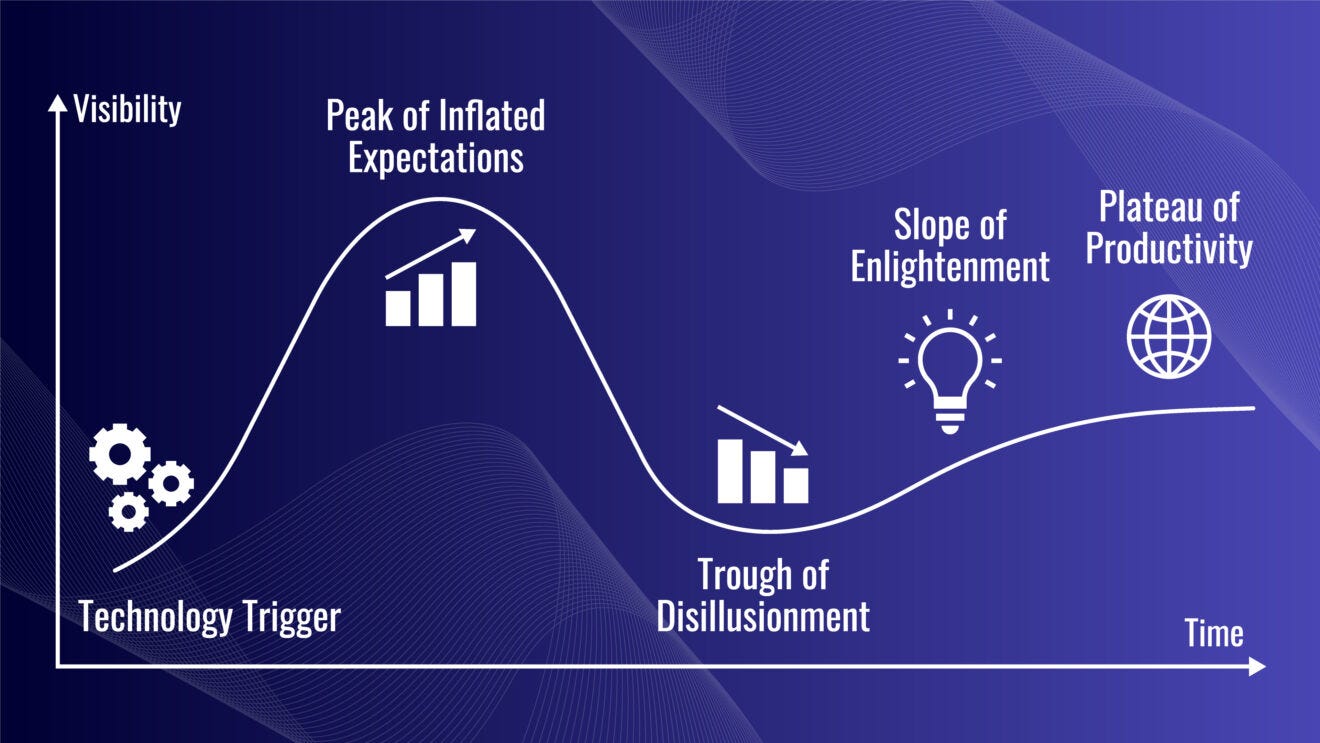
The Five Phases:
Technology Trigger - Initial breakthrough creates buzz
Peak of Inflated Expectations - Hype reaches maximum, unrealistic expectations set
Trough of Disillusionment - Reality fails to meet expectations, interest drops
Slope of Enlightenment - Practical applications emerge, real value becomes clear
Plateau of Productivity - Technology becomes mainstream and genuinely useful
AI Just Hit Peak Stupid
AI is clearly at the Peak of Inflated Expectations heading fast toward the Trough of Disillusionment. The same pattern happened with 1990s service technologies - initial excitement about "revolutionary capabilities" gave way to skepticism when results didn't match promises.
Early AI adopters are getting frustrated because the results don't match the promises. That frustration is spreading through professional networks. Within a year, companies will start requiring proof of results before they'll even take meetings.
This is the Trough approaching. Most AI companies will struggle here because they're still positioned for the Peak phase - all hype and promise.
If you think I'm being dramatic about the coming AI winter, remember that Gartner has accurately predicted this pattern for 30+ years.
The Trough always comes.
The only question is whether you'll be prepared for it or buried by it.
The Strategic Opportunity
Smart AI companies are preparing for the Slope of Enlightenment phase now. They're shifting from hype-driven positioning to service excellence because that's what survives the Trough and thrives on the Slope.
The companies that make this transition while their competitors are still promising magic will capture the mainstream market when practical adoption accelerates.
We're right in the middle of this transition. Companies that pivot to service excellence now will capture the sophisticated buyers while competitors are still trying to impress people with flashy demos.
Nobody wants to admit it, but most AI companies would be more valuable if they threw out their AI and just provided good old-fashioned consulting. At least then they'd be solving real problems instead of creating impressive demos that don't translate to business value.
The companies making this change now will dominate their markets. The companies that wait will find themselves competing on price in commoditized categories.
The Clock Is Ticking
The companies making this pivot right now are your future competitors. While you're still debating whether to change your positioning, they're already signing contracts with clients who used to be impressed by flashy demos.
The 1990s service company shakeout took 3 years. AI's will happen in 18 months because everything moves faster now.
By this time next year, "AI that actually works" will be table stakes. The companies still promising to "revolutionize everything" will be competing on price in a race to the bottom.
Your choice is simple: Make the service excellence pivot now while it's still a differentiator, or make it later when it's a desperate survival move.
Just don't be surprised when the companies that moved first are charging 3x your rates.
But There's a Bigger Problem Nobody's Talking About
While you're pivoting to service excellence, your clients are using AI to extract and replicate consultant expertise without paying for it. They're feeding your content into AI and asking it to "think like you" for their specific situations.
The consultants who survive won't just pivot to service excellence—they'll build frameworks so distinctive that AI can't replicate them.
Free Lightning Lesson: Transform Client Calls into $5K Offers
In 90 minutes, you'll discover the Mental Model Map Creator™ technique that extracts your hidden expertise from ordinary client conversations and transforms it into premium frameworks that sell for $5K+.
Because in the AI age, your unstructured expertise is increasingly vulnerable. The consultants commanding premium rates aren't smarter—they have systems for packaging their knowledge into frameworks clients gladly pay thousands to access.
The choice is yours: Let AI commoditize your expertise, or use it to build intellectual property that scales beyond your time.