

Rick Rubin cannot play an instrument.
Not “a little rusty” and didn’t “quit piano as a kid.” He has said, plainly, that he has no technical ability in music and knows less about the mechanics of recording than almost anyone who has ever done his job.
For long stretches of a session he looks like he’s snoozin’ on a couch with his eyes closed.
But this is the man who co-founded Def Jam out of his NYU dorm room and then spent four decades producing records that don’t feel like they should even be on the same shelf.
Run-DMC and Slayer
Red Hot Chili Peppers and Adele
The Beastie Boys and Johnny Cash
Genres that basically hate each other, all routed through the same guy on the same couch.
Musicians who work with him for the first time tend to ask a version of the same question…
What, exactly, do you do here?
The honest answer doesn’t make them feel any better. He listens, and he tells them the truth about whether it’s any good.
That’s the whole job. He cannot make the sound. He can only tell you, with a confidence that has been right for forty years, when the sound is true and when it’s filler pretending to be a song. The artists can all play. Some of them are the best in the world at it but what they hired was that magic ear.
We treat that as an exception. The genius who “can’t work the gear.”
But there have always been two different roles hiding inside the word “skill,” and we spent about a century thinking they were one.
One job is operating the tool. Fingers on the keys, hands on the board, the craft of making the thing come out.
The second job is knowing what the thing should be. Whether it’s any good. Whether it moves. Whether to keep it or kill it.
Almost everywhere, we bundled those two jobs into one person and called the bundle “skill.” You earned the right to judge the work by first proving you could do the work. The ear came after the hands.
But our guy Rubin skipped the hands. He went straight to the ear. And it turned out the ear was the rare part all along.
Rubin will tell you music is almost incidental to what he actually does. He happens to work in it. Knowing what’s good is the same in any room.
I know, I know. This is kind of an AI newsletter so you can probably guess where this is going.
For most of your life, one sentence kept you out of an entire category of work.
“I can’t code.”
One, maybe two years ago, that sentence meant software was a thing other people made, and you described what you wanted to them, badly, in a doc that cost you thousands.
That barrier has been moved by millions of tiny robots, pre-trained on the best coding practices on the internet.
The operating layer, the syntax, the part where you translate an intention into something a machine will actually run, is the part the robots do now.
You say what you want in plain English and it builds. Not perfectly and not always right on the first try. But it builds, and it never once needs you to know what JSON is.
What it cannot do is the second job.
It cannot tell when its own work has no pulse. It hands you something that it is VERY proud of and…average. And then it waits. It waits for someone to look at the output and say “this is fine!” and fine is the problem.
Rubin puts it better, with guitars. A lot of records get built by stacking the same part over itself, double it, triple it, until you’ve got a “wall of guitars”. And when there’s a wall of guitars, you hear guitar. You don’t hear a person playing guitar. It goes generic.
The personality in the one take where you can hear the fingers catch the strings.
The machine(AI) hands you the wall of guitars. Every time. Full, competent, and nobody in the room.
That someone is you. The job that’s open is the ear.
And the people least likely to notice the job is open are the ones who spent ten years building the exact ear it needs.
Watch how “code is the skill” quietly stopped being true.
The first thing you notice is the swap. You used to need a translator, someone who could take “make it feel premium but not stiff” and turn it into the thing that runs. Now you type “make it feel premium but not stiff” and the translator is built in.
This feels like the technical person still has the edge. They speak the machine’s language natively and you’re working from a phrasebook. So you defer. You keep treating the person who can operate the tool as more valuable than the person who knows what good looks like. That deference is the first cost, and it’s already out of date.
Go one level down. The hard part of building anything was never the typing. I learned this the slow way. The hard part was deciding, precisely enough that the result could be judged, what you actually wanted.
I watched a strategist with no technical background pull better work out of Claude than a developer sitting two seats away. The difference was simple. She could say exactly what “good” meant for an ad in her category, and he couldn’t. He could build whatever she specified. He just had no specification of his own.
When that happens to you, you’ll blame the prompt. You’ll go rewrite it a sixth time. The prompt was never the thing in the way. You hadn’t decided what good was, and no amount of rephrasing decides that for you.
None of this is new. Rubin proved it at eighteen. When he started, the only hip-hop records out were made by studio pros who built other kinds of music for a living. They had all the craft. They didn’t know the club. So they made a clean, polished version of a thing they didn’t understand, and it came out fake.
Rubin could barely record. But he’d stood in that club every week and knew exactly what it was supposed to feel like, so he made the real one. The craft was all on the wrong side of the glass. The scarce thing was knowing what good was.
Now the bottom level, the one that's harder to look at directly. Specifying what to build was the floor above. This is the floor beneath it.
Whether what came back is any good, and the nerve to say so when it isn't. When the machine can build anything you describe, that judgment is the only scarce thing left in the room.
Rubin has a word for his actual work.
Reduction.
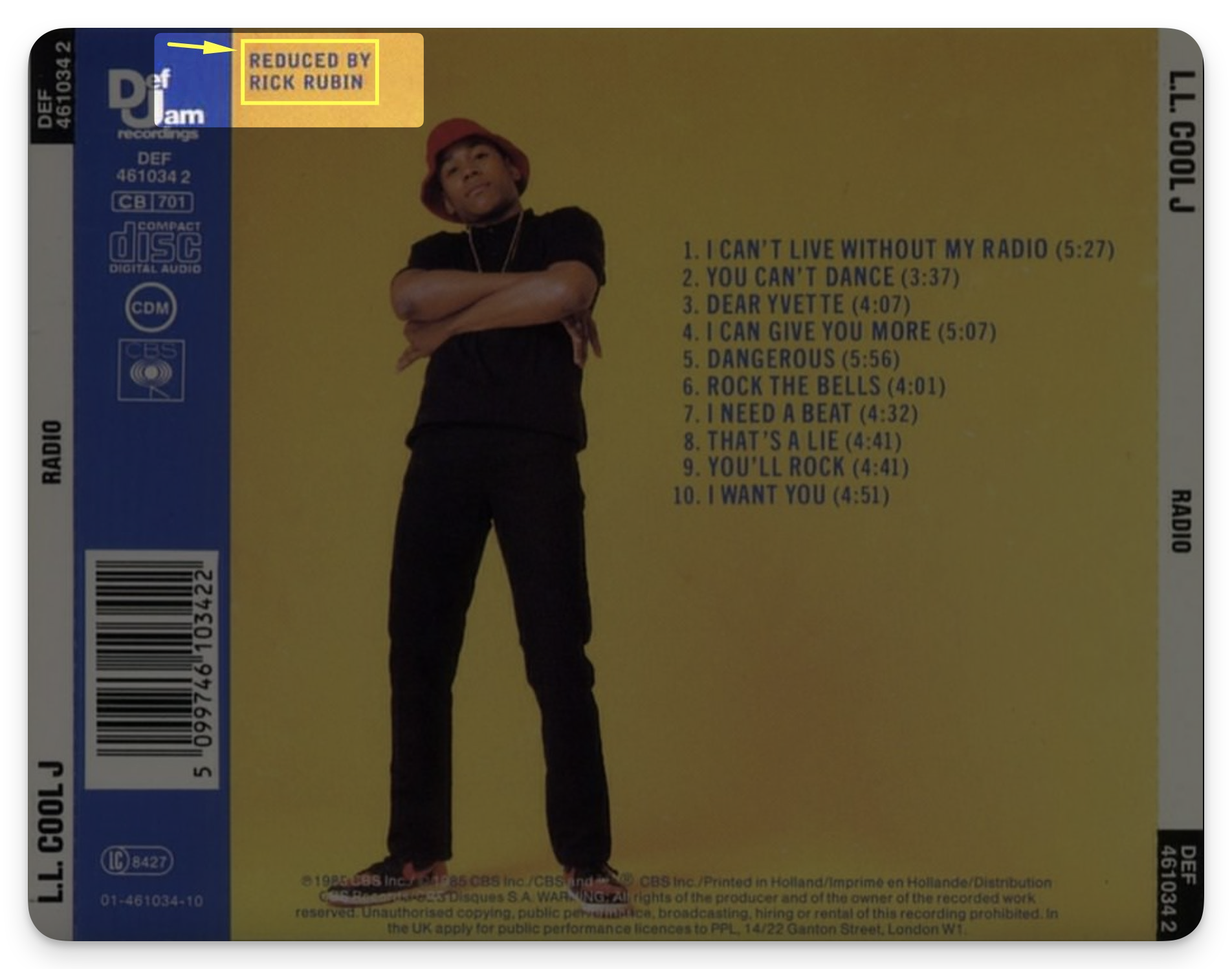
He coined it at nineteen, on an early LL Cool J record, where he printed “Reduced by Rick Rubin” instead of “Produced by.” Production meant building up. What he was doing was the opposite. Stripping a thing down until only what matters is left, and knowing, in your body, where that line sits. That knowing is the real work. It is the instruction set now. Your taste is the thing that tells the AI what to make, and then tells you whether it made it.
This feels like you’re “just giving feedback.” Like the build is the work and your notes are commentary on the work. It goes the other way now.
The notes are the work. The build is the commodity.
For a hundred years, taste sat on top of craft like a penthouse. You took the elevator up through technique to reach it. That’s why it felt like a luxury, the finishing layer you added once the real skills were in place.
The elevator is free now. Anyone can be at the top floor by the afternoon.
So the penthouse isn’t a luxury anymore. It’s the whole building. We are watching the floor and the ceiling swap places in real time, and the people most exposed are not the ones who never learned to code. They’re the ones whose only edge was that they could.
You can see the same confusion at the company level. Every job post wants someone “proficient with AI tools.” They’re screening for operators, people who can drive the machine.
The thing they actually need is harder to test for and worth far more. Someone who can look at what the machine produced and know, fast and correctly, that it’s wrong.
What matters is whether you can tell when it’s lying to you. Using it is the easy part.
Something to try this week. It takes about ten seconds and it works on any AI output you touch.
The next time AI hands you something and you feel the little reflex to fix it, stop your hands. Don’t fix it yet. Ask yourself one thing.
Could I write down the rule I’m using right now?
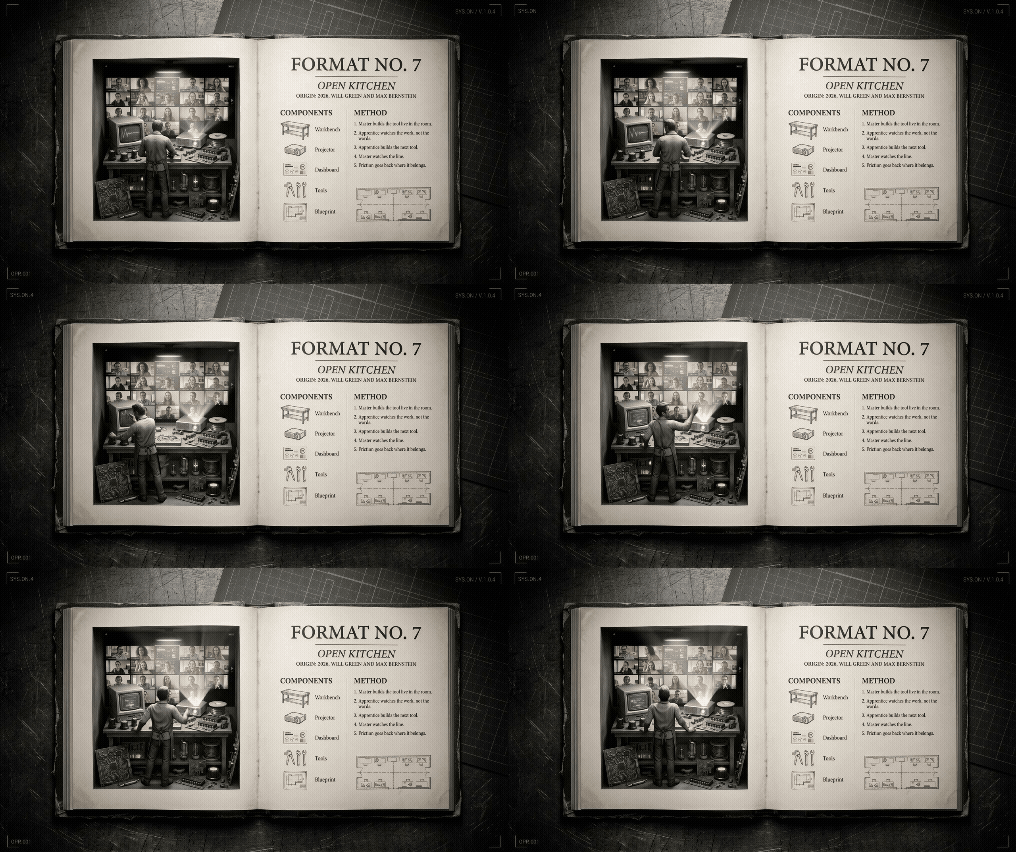
You felt the thing was off. That feeling is a rule you already hold, sitting just under language.
“The opening is too eager.”
“It’s explaining the joke.”
“Real people don’t talk in lists.”
When you reach in and pull that rule up into a sentence, you’ve made a piece of your taste visible that was invisible a second ago.
Do that for a week, every time you correct an output, and you’ll notice something uncomfortable and good. You have hundreds of these rules. You’ve had them for years. They’ve just been trapped in your head, leaking out one correction at a time, teaching no one and saving you nothing.
Your taste is reading this right now. It’s the thing that has been deciding, paragraph by paragraph, whether this was worth your time.
You’ve been treating that faculty as the cheap part of your work. The part you’d happily hand off so you could get to the “real” output.
It will feel like the soft skill.
It will feel like the thing you can’t put on an invoice.
It will feel like the part that doesn’t count, because you didn’t sweat for it the way you sweat for the technical stuff.
Rubin lay on that couch for forty years being the most valuable person in rooms full of virtuosos, because he understood the thing they kept forgetting. Anyone in that room could play. He was the only one who could hear.
The machine can play now. All of it. Every instrument, every genre, on demand, for nearly nothing.
The hearing is still yours.
It might be the only part that was ever really yours.
-Max
P.S. Putting that hearing somewhere it can actually work, instead of leaving it trapped in your head leaking out one note at a time, is the thing I built an entire workshop around.
Claude Code Accelerator starts Wednesday. I built it with Luke and Mario, two of the sharpest copywriters and creative strategists I know. Which is to say, two people who already do the thing this whole piece is about for a living.
If you already know what good looks like and you’ve been waiting for permission to build, this is it.
Max,
Thank you for another "Red Hot" newsletter issue. I really enjoy how you always provide pure-genius extraction of different artists, creatives, and those with a golden ear.
Rick Rubin had that unique ability to spot the next big thing in the music industry.
Clive Davis and Barry Gordy Jr. had very similar genius traits.
Steven Cox