

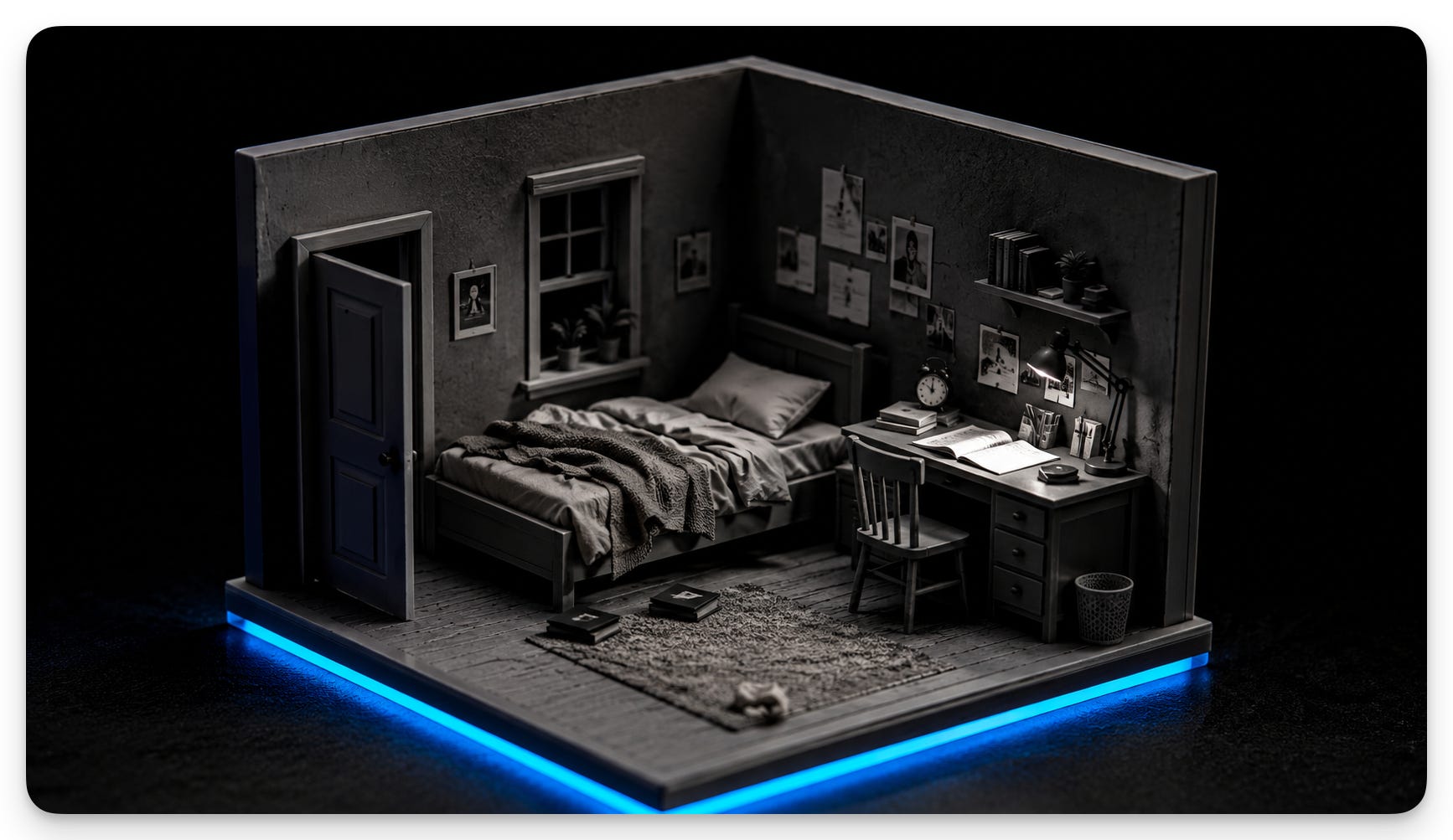
You are looking into a room that fits on a table.
The bed is made wrong. A calendar on the wall is frozen on the month of the incident. The later pages are still attached. Lee knew good detectives clock time clues like that, including what is not advancing.
A window opens. The fabric on a chair is worn the way fabric gets worn when a real person sat there for years. The scale is one inch to one foot.
Everything is tiny and nothing is typical dollhouse-cute.
If you stood over this table in the 1940s, someone would start a stopwatch at ninety minutes and tell you to study the whole room. Start in one corner. Work every wall, every object, every surface. Then do it again through the middle. Not a circle.
Just watch the room and notice what “feels” off.
The woman who built these rooms was Frances Glessner Lee.
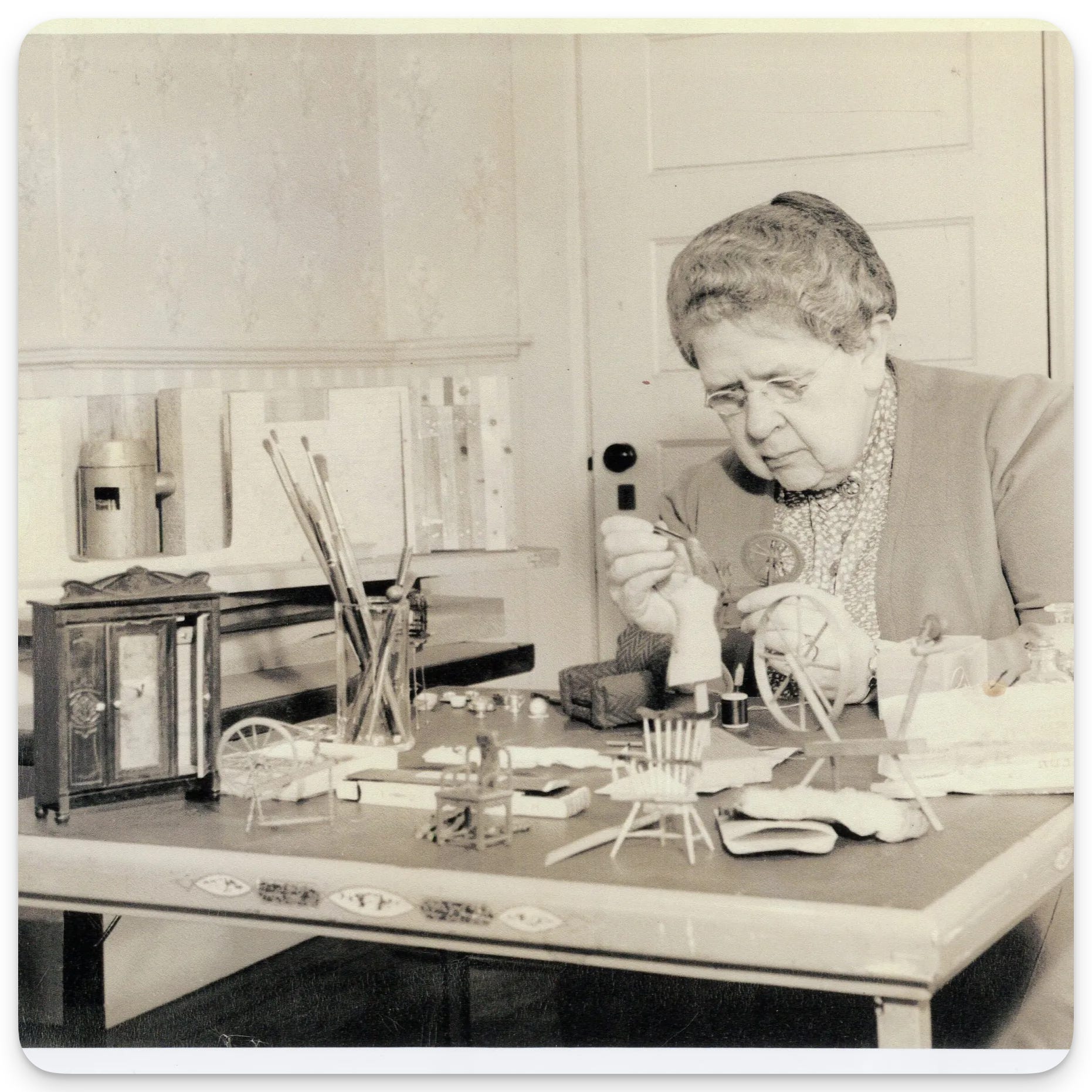
She was a Chicago heiress, born in 1878, denied from the medical path she dreamed of. Instead, she used her inheritance to fund a department of legal medicine at Harvard Medical School in 1936. Then she did something stranger than putting her name on a building.
She built dollhouse dioramas of death.
She called them the “Nutshell Studies of Unexplained Death”, after an old police line about finding the truth in a nutshell. There were about twenty of them. Built with a carpenter over years, in wartime material shortages, some running what would be six figures in today’s money. She even went to autopsies so the bodies would look right.
She wore out-of-date clothes herself so the fabric would age the way old clothes age. She knitted tiny victim clothes under a magnifying glass, a few minutes at a time before her eyes quit.
🪑 One Story From The Workshop:
A real rocking chair rocked seventeen times after a shove. The miniature had to match. Fifteen on the first try was not good enough so she would rebuild it.
The rooms were composites of real cases, not fantasy.
Sex workers
Messy kitchens
Domestic violence
Spaces nothing like the houses she grew up in (I hope).
In 1946 she started handing them to investigators for training, as part of a larger system.
Seminars that put cops and medical people in the same room, week after week. Harvard later dissolved the department for internal political reasons and the dioramas went to the Maryland medical examiner’s office in Baltimore. Today, they are still used in forensic seminars.
And in all the weirdness of dollhouse murder scenes and heiress forensics, that last part is the piece that actually matters for this article.
Optional Watch: The Full Frances Glessner Lee Story
If you want the full Frances Glessner Lee story (the Harvard seminars, the wartime workshop, the rocking chair that had to rock the same number of times as the real one), this documentary is worth the watch:
These nutshells were a training environment for judgment, built so carefully that detectives would trust them, and kept alive by a teaching system that outlasted any single institution.
Why a manual still fails (and a “room” works)
Lee could have written a manual.
She had the money, the access, the medical connections, and the time. Best practices would have told her a manual would have scaled on paper.
But it also would have sat on shelves. It would have been photocopied into oblivion and ignored by every new detective who still walked into a real room and missed all the important clues.
So, she built rooms instead because she knew a manual transfers vocabulary. A room transfers seeing.
The point of the Nutshells was not to “solve” the little dollhouse crime and high-five. It was to force investigators to process evidence so they did not make a hasty call. Officers later said they got better at real scenes because they had been forced to think their way through these ones (a novel idea, I know).
You can memorize the chapter on blood spatter and still miss the calendar pages missing.
You can pass the quiz and still walk past the worn chair.
The full-room-focus forces you to stay in the environment long enough for your judgment to wake up. The ninety minutes are a container for attention.
I watch something similar in businesses every week.
Someone on the team tries to make a decision that only the founder could make.
So they write the SOP with clear steps, share it in Slack. Maybe a Loom. For a day or so, it feels like progress and then a real situation shows up, and the team pings the founder again because they just don’t feel confident in their answer.
The document exists. The judgment does not.
Or the more common, 2026 version. The company buys AI tools where everyone has an overly eager digital assistant and a chat window. But when the employees screen share for five minutes, you see people open a blank conversation and start from zero.
To make matters worse, you see them quickly take AI’s first response as gospel and move on with their day.
That’s a modern “Nutshell Study of Unexplained Context”. The scene is missing and the assistant is guessing.
Two Failures Modes That Stack
Time and time again, when the team’s are producing slop, these are the two biggest culprits:
Culprit 1: People take the first answer from AI. They skip the sit. Lee forced ninety minutes of looking before anyone got to declare a theory. While it may look like busywork, it’s actually building the muscle of thinking the problem through.
Culprit 2: Even a careful sit fails if the room is empty. No transcripts, no judgment file and no instructions that say “run the pass before you publish.” So you get a clever rewrite of the wrong problem.
One of Lee’s teaching points, still used in Baltimore, is:
Don’t let what you already “know” keep you from what you should know.
What a business nutshell looks like in real life
Here is what I mean by a nutshell in a business, without the blood and the doll furniture.
Last week I sat with a founder who wanted his team to own their numbers. Not “know the KPI.” Own it. Know what to do when they were behind. Know when to escalate and when to solve it themselves.
He had folders
He had projects
He had AI access
On paper he had already built the house (hell, it was a freakin mansion).
When we looked at how people actually worked, almost nobody was living in the house. They were standing on the porch every morning with a new blank chat, inventing the day from scratch. The knowledge never compounded because there was no scene. There was only a tool and some hope.
So we did one small experiment. We took a single recurring decision, the kind that always bounced back to him, and we built a Nutshell for it.
The decision was ordinary. When is a client proposal “ready enough” to send, versus still living in founder polish mode.
If you write that as an SOP, you get something like:
Check pricing
Check scope
Have sales review
Send
Directionally right but operationally…generic.
A new hire can follow every step and still ship something that fails the founder’s real test, because the real test is not on the list.
The real test is a feeling in the stomach when a paragraph is still performing instead of promising
The real test is knowing which missing line item will explode in week three
The real test is a pattern the founder can spot in eight seconds and cannot yet put in a bullet
So we built a scene instead.
🕵🏻♂️ The Scene: One Proposal, Client Eagerly Waiting
This is the “room” for that decision. Imagine you are looking over the founder’s shoulder.
What is on the desk / screen:
Google Doc open: Proposal_v4_FINAL_use-this-one
Three browser tabs (client site, competitor PDF, HubSpot)
Slack open: client message says “any update?”
Printed competitor one-pager on the desk
Sticky note on the monitor: “don’t underprice again”.
That is all surface inventory. Next is what a careful look finds.
🔎 Clues A Smart Person Walks Past
Same objects with a deeper read. This is what the SOP never captures:
The doc title says FINAL. Version history says otherwise: the “why us” paragraph was rewritten four times. A smart person polishes the adjectives. The clue is that the proof is still weak.
The competitor page is only marked on the results section. Not the services list. A smart person copies more bullets. The clue is buyers are buying certainty, not scope.
Slack is polite. “Any update?” A smart person rushes the send. The real heat is in an email from two days earlier that is not even on this screen.
The sticky note looks like a pricing reminder. It is not. It is about a discount pattern that taught the wrong lesson last quarter. A smart person lowers the price. The clue is a different kind of fear.
You can follow a checklist and still miss every one of those.
🤖 Where AI Typically Goes Wrong
It rewrites the proposal to sound sharper. It adds buzzwords and “improves clarity.” It does not notice the founder is stuck on proof because the last three deals died when buyers could not see themselves in the case study.
📑 The Full Room Pass (How To Study The Scene)
This is Culprit 1 in practice: Sit before you decide. Do not take the first theory. Do not take the first AI paragraph.
Historians and trainers often describe Lee’s eye-path as a spiral. Think of it as a full room pass.
Start top-left. Sweep the walls, the furniture, the floor, the open door. Hit every surface. Then come through the middle again. Stay in the room until you stop inventing a theory and start noticing what is actually there. Up to ninety minutes. No jumping to “I already know what this is.” No opening Claude until the pass is written down.
In the business version, the pass is the same job with different furniture. Before anyone opens a tool or types a prompt, they walk the scene in a fixed order for about twenty minutes:
What is this clients history?
What was the last communication?
What are the second-order effects of this decision?
Where are my blindspots? Where are theirs?
What is the first question they will ask when they read this and can we answer it in advance?
Write what you see before you write what you would do.
I ran one employee through that scene without giving the “right” answer. Their first instinct was to polish the language. After the pass, they asked a different question.
“Do we have one proof story that matches this buyer’s exact fear, or are we still selling services?”
That is the sentence the founder usually has to produce alone.
One scene. One decision. One person who got a little closer to seeing what he sees.
When this works with AI, it is not because the model got a clever one-off prompt. It is because the context was already connected.
Past transcripts in the same place
Knowledge files actually current
Custom instructions written so the model can catch the nuance in the situation and answer strategically, instead of sounding good while missing the real problem
That is lesson 1 and lesson 2 working together.
You sit with the scene first (human or AI, same rule: no first-draft answer as final). And the system is already loaded so the sit has something real to stand on. The room is not only for the human. The room is what you install so the right context shows up at the right moment.
Half-built context fails the same way a sloppy Nutshell would have failed. If the details are wrong or thin, people (and models) stop trusting the room and go back to guessing.
The Prompt: You Understand It, It’s Time To Install It
Two lessons:
Do not take the first answer.
Install the context and system that support the sit.
Do not take the first answer. Sit with the problem. Build the muscle of thinking it through while the scene is still in front of you. Lee’s ninety minutes were that muscle. Your full room pass is that muscle. Hitting enter on Claude’s first draft is the opposite.
Have the context and the system that support that sit. Transcripts, judgment files, custom instructions, triggers that surface the right room at the right moment. Without that, you are either guessing alone or polishing the wrong problem with a smart model.
Frances Glessner Lee built dollhouses so people could practice lesson 1 inside a trustworthy room. She ran seminars so the room lived in a system, not a drawer. Your SOPs fail because they skip both.
The Context Nutshell is the productized prompt that turns one recurring decision into a scene, a clue inventory, the traps a novice (or a blank chat) will fall into, and install instructions so the context can live in files, custom instructions, and the moments that should trigger it.
If you already have an SOP, you can attach it. The prompt will use it as the old manual and build the room and install pack around what the SOP misses.
The point is to make the missing scene legible, and to wire it where people and AI actually work.
Below is the full prompt. Build the Nutshell. Install the context. Then the next time the same problem shows up, force the sit before the first answer.
🥜 The Context Nutshell
Copy everything below into a fresh chat with your AI of choice. Replace the bracketed sections with your real situation.
Optional but powerful: Attach or paste your current SOP (or checklist / Loom transcript) in the SOP block.
The tool works with a blank start or with an existing manual. Do not paste your “correct answer” or the founder’s preferred choice into the prompt. If you do, you are writing a manual again.
