

Your Best Work Feels Suspiciously Easy. That’s The Problem.
A client of mine had 35 years of experience. She thought her session she recorded was “pretty boring.”
Then I showed her what actually came out of it.
Multiple content assets. Recurring patterns she’d been using for decades without naming them.
Judgment calls that took her two seconds, but would’ve taken someone else two years to develop.
She stared at the screen for a second, then said something that made me smile:
“This is 35 years of thinking from me.”
Thirty-five years of thinking...
Had become a boring afternoon. And this is not uncommon:
A founder reviews an AI draft. The information is correct. But something feels... wrong. She rewrites half of it. Can’t explain why. It just was.
A consultant joins a call after the team spent HOURS debating a solution. Two questions and only four minutes. He immediately knows what the problem is.
A creative director rejects seven concepts in immediately. Points to details that weren’t in the original brief. Details no one else even noticed.
You’ve done this too. You’ve looked at something and instantly KNEW it was off.
But when someone asked you WHY, you had no sentence to explain it.
Here’s what’s happening. You’re not hiding some secret method. Your brain has compressed YEARS of experience into split-second pattern recognition. The answers feel suspiciously easy.
And when something feels easy, it’s hard to believe it’s worth much. So I started digging into why this happens.
Turns out... there’s a name for it.
The Expertise Paradox
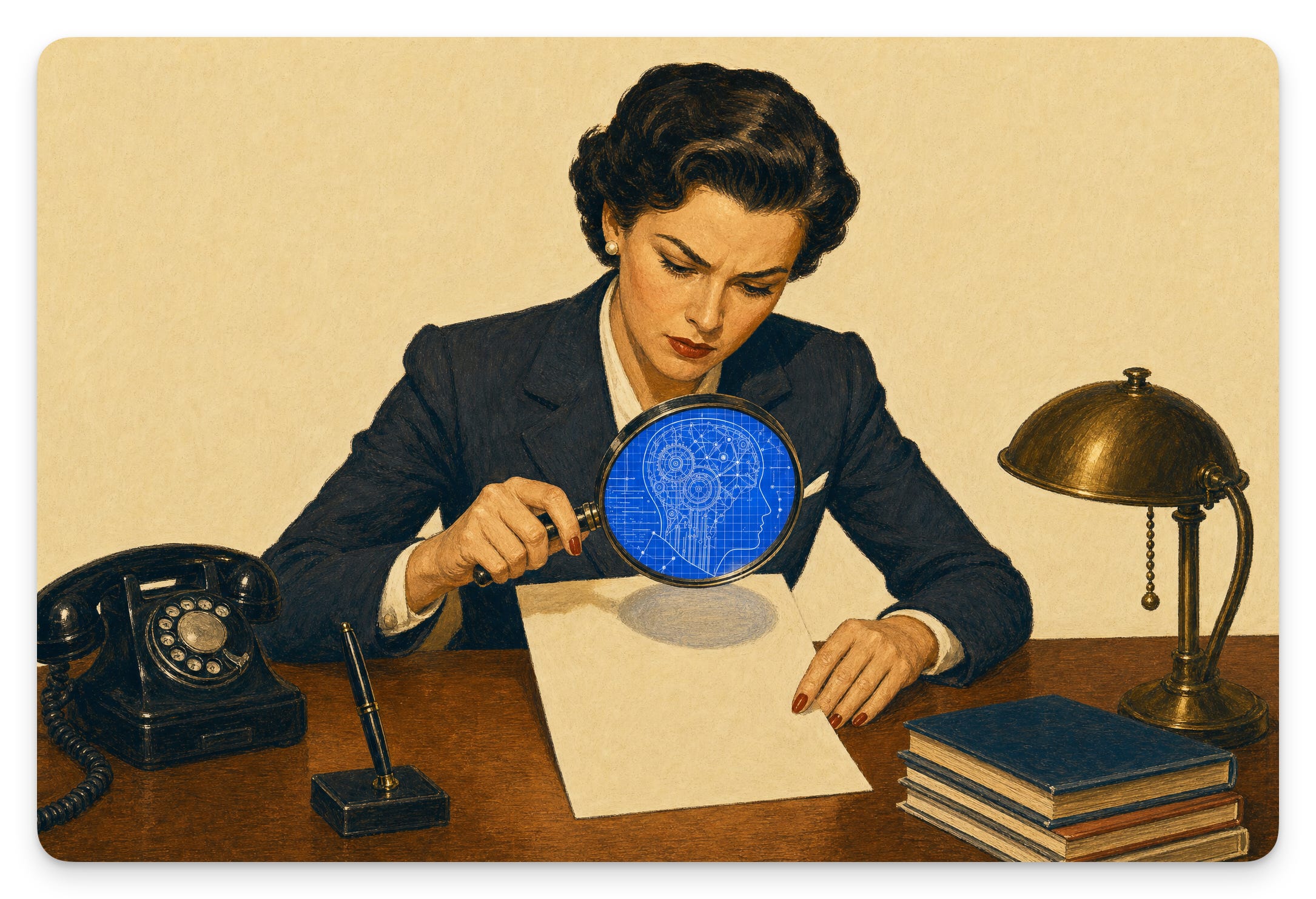
There’s a name for what’s happening here. As you gain experience something weird happens in your brain. You stop consciously walking through every step.
You start recognizing patterns. Grouping details together. Responding to situations as a WHOLE instead of individual pieces.
A beginner sees fifteen separate clues
The expert sees one familiar shape
This is evolutionary, it’s your brain’s way of conserving energy. Of not burning through mental calories analyzing shit you’ve already figured out. But it creates a strange side effect.
The expert loses conscious access to the reasoning that produced the answer.
Read that again.
The BETTER you get, the more automatic your judgment becomes. The more automatic it becomes, the harder it is to explain.
The harder it is to explain, the less valuable it FEELS.
Even though it’s actually MORE valuable than ever.
This is the Expertise Paradox.
🧠 The Expertise Paradox: The better your judgment gets, the less you can explain it, and the less explainable it looks, the less it seems worth paying for.
Why It Matters Now
AI can produce a very good, confident-sounding first draft of damn near anything.
A article
A spreadsheet
A presentation
A piece of code
A research summary
A reasonable answer to most questions
These are things people built entire careers on. Things that used to separate the experts from the amateurs.
And now?
They’re commodities on a digital assembly line. Don’t believe me?
Try this...
Put out a feeler on LinkedIn asking if anyone can build you a new website. Watch what happens to your DMs. That site that used to cost 10K?
Now it’s $200.
Now ask all those people to show you PROOF their websites convert. Real numbers with actual results.
I’d be SHOCKED if 1 out of 20 can give you anything beyond vibes and Lovable heart bubbles. Here’s what’s happening.
Execution is becoming a commodity
Judgment is becoming scarce
And the economic pressure on that gap? About to get intense. When more people can produce “acceptable” work, the person who can tell you what quality actually looks like becomes the most valuable person in the room.
But here’s the problem…
Most experts can’t explain HOW they know. Their judgment has become invisible. even to themselves. And when you can’t articulate how you know something, it’s pretty tough to promote it.
Market it. Or sell it. But here’s the good news...
The same AI that commoditized execution?
It holds the key to unlocking the very thing that makes you irreplaceable.
What’s Coming
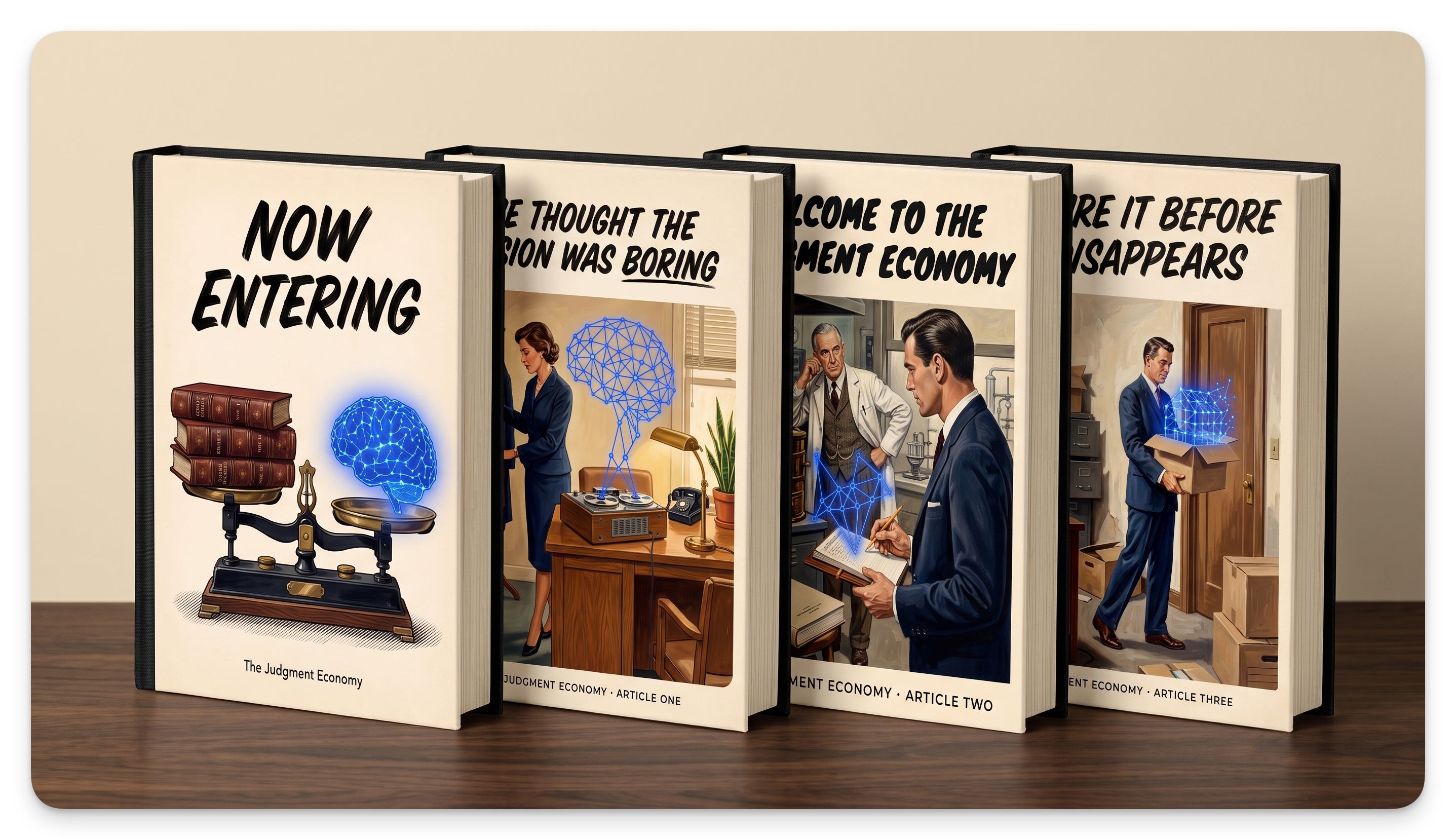
I’m publishing three articles on this. They’re designed to be read in order, but each one works on its own.
“She Thought the Session Was Boring”
Opens inside the session my client dismissed. Explains why expertise becomes invisible to the person who has it. You’ll finish this one replaying moments when your own best work felt ordinary.“Welcome to the Judgment Economy”
Opens with a case where published information wasn’t enough. Scientists had the papers. They had the equipment. They still couldn’t reproduce the result until they SAW the work performed. Explains why AI makes invisible expertise economically urgent.“Capture It Before It Disappears”
Opens with a waste-management owner who could see a business inside a dumpster. Explains where judgment leaves evidence and what to do before it disappears.
The Judgment Economy
These articles are the start of something bigger. A change to what this newsletter is.
Since March of 2025, I’ve been building a methodology called Cognitive Fingerprint™.
The premise is simple.
Your best judgment leaves evidence in your recorded work.
Your patterns
Your blind spots
Your mental models
Your frameworks
(We all have them even if we’ve never named them.)
Your decision DNA.
How, when, and WHY you make the calls you make. Basically, how you think.
🚀 Being able to understand AND articulate this is your unfair advantage in the new economy.
The articles explore what that looks like from the inside.
Where judgment leaves evidence
How to capture it without inventing some polished fiction
Why expertise becomes invisible to the person who developed it
What captured judgment can become across AI, content, teams, and succession planning
Here’s the thing. What I’ve built over the past two years is too big to live in a newsletter. A newsletter can show you the territory.
I send once a week. You read it over coffee, maybe you nod along.
But the actual method. The thing that requires practice, distillation, and careful thought. That needs a place where you can bring your calls, your transcripts and run the tools against them.
Then you build your own intellectual property.
On Friday, September 4th, I’m opening Cognitive Fingerprint™ Lab.
A Skool community built around this method. Loaded with courses, prompts, installable Claude skills, recorded classes.
And a few surprises.
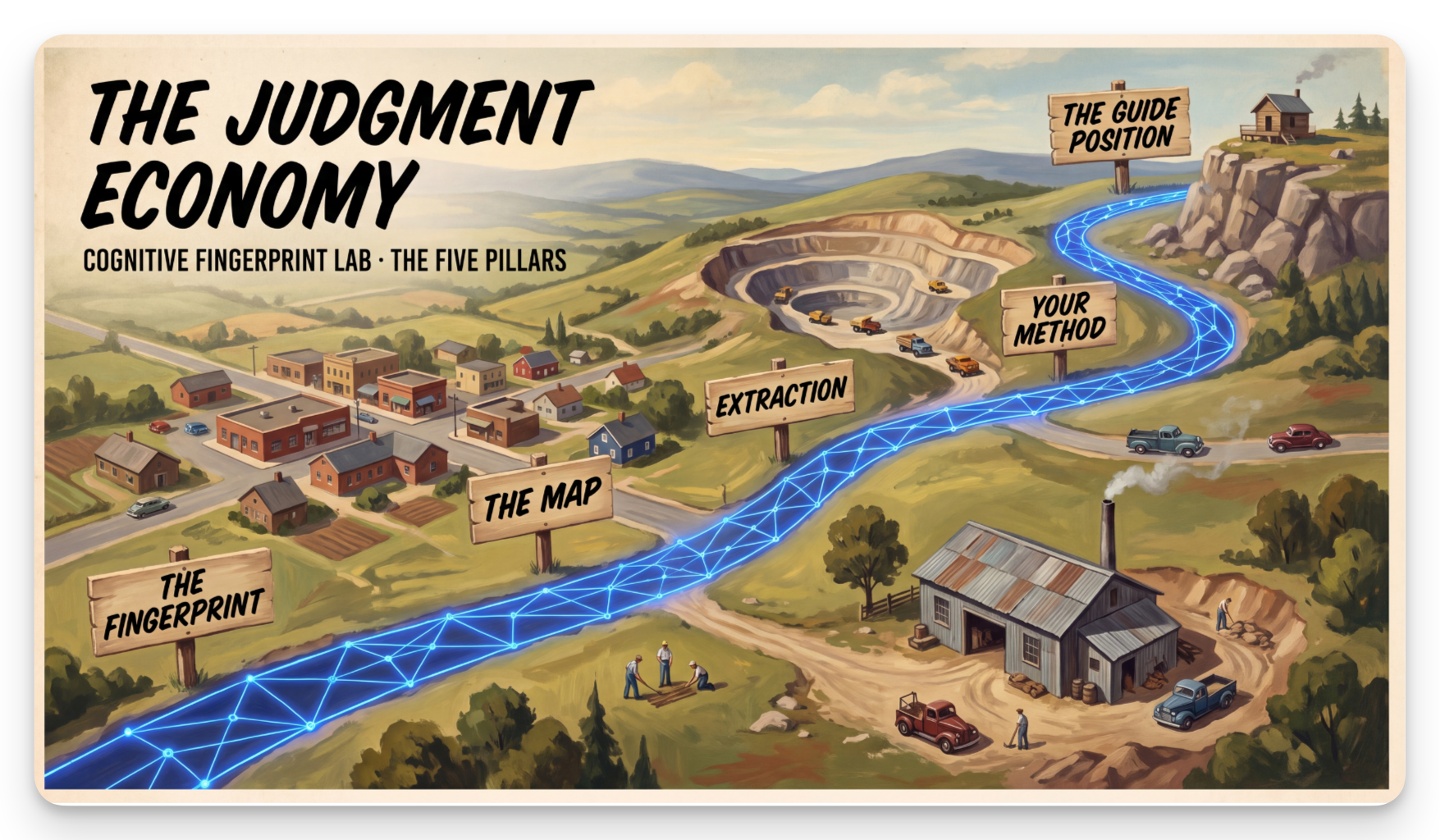
Inside, there are five pillars:
The Fingerprint. Why you can’t see your own expertise. And the science underneath it
The Map. The full territory sitting in one recorded conversation, charted. Most people run one extraction, get one result, and stop. We’re going deeper
Extraction. The prompts, workflows, and tools you run against your own calls
Your Method. Turning repeated patterns into a named method. A diagnostic. An SOP your team can run without you
The Guide Position. Pricing, positioning, and content built on what you found
Membership includes BOTH this newsletter and the Lab., no matter what door you come in through.
It’s currently $20 per month. On Saturday September 5th, new memberships move to $25 per month.
Current members and anyone who joins before the deadline keep the $20 rate as long as their subscription stays active.
Read the articles first.
If the series changes how you see your work, the CF Lab will be here. The first article publishes Wednesday.
My client thought her session was boring. Thirty-five years of thinking had become an ordinary afternoon. The articles that follow are an attempt to understand why that happens.
And what to do about it.
-Max