

This article first appeared in the “Beware the Default” newsletter but I really enjoyed writing it and I think there are some good reframes in here that you will enjoy reading.
In 1925, the average American woman spent five and a half hours a week on laundry. She was scrubbing on a washboard. Wringing by hand and hanging everything on a line and praying it didn’t rain.
By the 1950s, the automatic washing machine had reached most American homes. The promise seemed obvious: all that scrubbing and wringing, gone. Free time would appear.
But Ruth Schwartz Cowan studied what actually happened, drawing on time-use research by sociologist Joann Vanek. The finding was not what anyone expected.
By the 1970s, women were spending more time on laundry than before the machines arrived.
Total housework had gone up, not down.
The machines made laundry easier, so people washed clothes more often.
Sheets that used to last a week now lasted three days. Standards for what counted as “clean” quietly recalibrated upward. The stain your grandmother would’ve ignored became the stain your mother couldn’t tolerate.
Cowan called it the “great irony of household technology”. The machines didn’t free anyone.
They moved the bar.
I know, I know…You already see where this is going.
The AI productivity story runs on the same assumption the washing machine did.
Do the same work faster, get the leftover time back. That’s the pitch. That’s the implicit promise every time someone posts a “saved me 4 hours” screenshot.
But the time doesn’t come back. It gets absorbed.
How the Bar Moves Without You Noticing
Aruna Ranganathan and Xingqi Maggie Ye spent eight months inside a 200-person tech company watching this happen. Their study, published in Harvard Business Review this February, tracked 40 workers who adopted AI tools.
The findings should’ve been a celebration. Workers got faster. WAY faster.
Then three things happened, in order:
First, scope expanded. Workers who finished tasks faster didn’t log off early. They took on more work. The freed-up time just... filled. The same way a new lane on a highway fills with traffic within months like the extra space never even existed.
The capacity didn’t create slack. It created demand.
Nobody sent a memo. The work just appeared. And because it appeared at the exact moment they felt productive, they called it ambition.
It was absorption.
Second, hours extended. Workers started sending prompts and requests after hours. The tool was always available, so the work became always available. The boundary between “work time” and “free time” didn’t blur. It dissolved. Email did this exact thing 20 years ago. Office workers now spend 28% of their week managing email... a technology that was supposed to make communication faster.
But, as you can see (and probably know), the pattern is the same. Lower the friction of doing a thing, and people do more of the thing. Not less. The bar was moving. Everyone called it dedication.
Third, quality dropped. The cognitive load of broader scope plus longer hours plus constant output evaluation added up. The researchers’ conclusion: AI didn’t reduce work. It intensified it. It felt like a mystery. It was the bill coming due.
The gain was the story people told on the way in. What they found was a trap.
Speed up the work -> Absorb the speed into expectations -> Extend the hours to meet the new expectations -> Burn out under the weight of a bar that moved while nobody was watching.
We are watching the washing machine cycle get compressed from decades into months.
The Part That Actually Costs You Something
There’s a layer underneath the burnout that’s harder to measure but worse to lose.
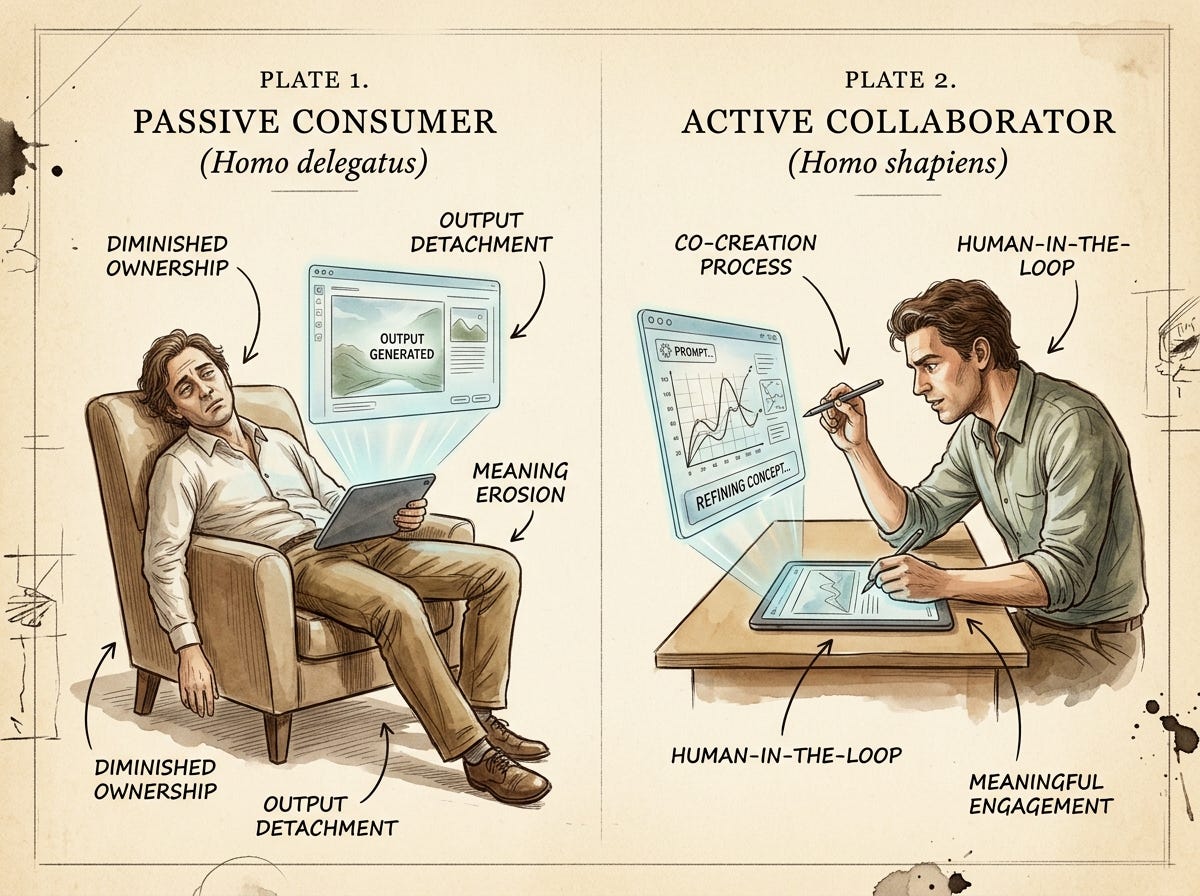
A team led by Elena Hayoung Lee published a study in Nature this March. They gave 269 people tasks to complete with AI assistance. The variable was:
One group received AI outputs passively (the AI did the work, they reviewed it).
The other group collaborated actively (working with the AI, shaping the output together).
The passive group finished faster. They also reported lower self-efficacy, lower sense of ownership, and less meaning from the work.
Sit with that for a second. The people who let AI handle it... felt less capable afterward. Not because the AI failed. Because they succeeded without being involved.
The washing machine took away the physical labor of scrubbing. It also took away the thing that made a clean shirt feel earned. The same exchange is happening in your work right now.
You used to write the first draft. Now you edit the AI’s first draft. The output might be better. The feeling of authorship is different. And that difference goes deeper than feeling. It shows up in how you talk about the work, how much you’ll fight for it in a meeting, how deeply you understand what you shipped.
Ownership is a signal of understanding. When it fades, the understanding goes with it.
And honestly, it’s something you have to experience firsthand to really get it. One AI-generated article is easy to dismiss. One delegated task, one social post you didn’t really write. That’s nothing.
The feeling comes later. When it becomes a habit. When you look up one day and realize you feel disconnected from your own work. Not tired. Disconnected. Like the thing you’re producing stopped being yours and just became more noise.
Until I wrote this, I could feel that. I just couldn’t name it.
Dario Amodei, CEO of Anthropic, raised the same question on the Lex Fridman podcast. In a world of increasingly powerful AI, where does meaning come from? His answer wasn’t complicated. Work is a source of deep meaning for most of us, he said, and that won’t change no matter how capable the tools get. The need for meaning doesn’t get automated away.
The Lee study already told you the answer. The people who felt less capable afterward handed the work over and reviewed the output. The ones who kept their sense of ownership stayed inside the thinking as it happened. Shaping it. Treating the AI as a collaborator.
That’s the variable. Stay inside the work or step outside it.
Use AI to move faster through the parts that don’t require you. Stay inside the parts that do.
Why This Time Is Faster
The washing machine took 50 years to fully recalibrate expectations around cleanliness. Email took about 15 to become the thing it was supposed to replace (meetings, memos, phone calls) plus a dozen things it was never meant to be.
AI is doing it in months.
The cycle is the same. The clock is faster. Your organization adopted AI tools sometime in the last year. The expectations have already moved. The “normal output” for a Tuesday has already been redefined by whoever on your team figured out Claude first. And once one person’s output resets the benchmark, everyone else is running to match a bar they didn’t see move.
The Question Worth Sitting With
Before you fill the time AI freed up, ask who decided it needed filling.
Not “how do I use this time productively.” That question has already been colonized by the same expectation inflation that turned the washing machine into more laundry.
Just: who decided?
If the answer is “my calendar filled itself” or “there was more work so I took it” or “I guess I just... did”... you’re living the washing machine paradox. The time was never yours. The bar moved, and you moved with it, and the gap between where you were and where you are now has been papered over by the feeling of being productive.
Productivity is the feeling. Leverage is the question.
The difference between the two is whether you chose what to do with the hour you got back, or whether the hour got taken before you noticed it existed.
Your Organization (Or Client) Is Reading This Too
Your ego will tell you this is a personal discipline problem. That you just need better boundaries, better time management, a system.
But Cowan’s research showed something the self-help version misses. The washing machine didn’t just change individual behavior. It changed what society expected of a household. The standard shifted, and every individual decision happened inside that shifted standard. You couldn’t opt out of “clean” being redefined.
You could only decide how to respond.
The AI version of this is already in motion. The company that saw one team ship 3x faster with AI didn’t celebrate and go home. It asked why the other teams weren’t doing the same. The bar moved for everyone because it moved for someone.
You’re not going to solve this with a morning routine.
The Oldest Trick in the Technology Book
In 1983, when Cowan published her research, the response was predictable. People said it didn’t apply to them. Their washing machine really did save time. They really were spending less effort on laundry than their mothers.
They were wrong, and they were wrong in the exact way that made the data invisible.
The standard moved slowly enough that each incremental shift felt like a personal choice rather than a structural one.
The AI bar is moving faster. Which means you’ll notice it sooner...if you’re looking.
But most people aren’t looking. They’re too busy filling the time they saved.
-Max
This is what we talk about inside Beware the Default. Not productivity tips. The invisible assumptions underneath them. If that’s your kind of room, we’d like to have you.
Sources
Cowan, R.S. (1983). More Work for Mother: The Ironies of Household Technology from the Open Hearth to the Microwave. Basic Books.
Ranganathan, A. & Ye, X.M. (2026). “AI Doesn’t Reduce Work—It Intensifies It.” Harvard Business Review, Feb 9, 2026.
Lee, E.H., Yin, Y., Jia, N., & Wakslak, C.J. (2026). “Relying on AI at work reduces self-efficacy, ownership, and meaning while active collaboration mitigates the effects.” Scientific Reports (Nature), March 15, 2026.
Oh I noticed! I noticed that I start getting slightly grumpy because I need to review so many lines of AI code when I only send couple to ask it to generate a plan then execute it. There are too many lines to review after I returned from a coffee break. And reviewing sometimes is not fun because you don't understand what it is doing, and you need to first learn what it is doing, googling concepts, patterns of algorithms. Some of it I can't care enough and honestly would prefer someone else make the call.
I never understood how the market sometimes think that "1-person unicorn" company could ever existed. When someone in you human-filled company make a mistake, sometimes you can fire them or you can make sure to warn them and have them own the mistakes. But with AI, you can't, all burden is on you. That cognitive load is simply too much: reviewing in detail and owning the responsibility completely in every aspect of a business.
Parkinson's Law FTW. 🥳
Of course work will expand and quality will decrease because the media that holds everything else in suspension around people hasn't changed, ie. the prevailing ways and means of leading and managing. It has an overwhelming effect on the culture and signals sent to staff.
Change the system of management and suddenly AI gains look very different...