

Imagine a smoke-filled boardroom in the 1960s. The air is thick with tension. Tobacco executives, their faces etched with worry, focus intently on Don Draper. Their biggest account, Lucky Strike, is in trouble.
Mounting public concern about the health risks of smoking threatens their entire industry. Everything is at stake. In this pressure-cooker environment, Don delivers a seemingly simple, yet utterly transformative idea: "Toasted!"
This iconic scene from Mad Men isn't just great television, it's a powerful illustration of a crucial marketing principle: Market Sophistication, a concept first articulated by marketing legend Eugene Schwartz in his groundbreaking book, Breakthrough Advertising.
Go to the 3:20 minute mark
Many marketers struggle to connect with their target audience, often because they're speaking the wrong language. The secret to cutting through the noise lies in understanding this concept.
Before crafting any marketing message, Schwartz argues you must answer three critical questions:
What is the mass desire that motivates your market? (See our previous article, "Mass Desire—How AI Helps You Harness What Your Market Already Craves.")
How much does your market know about your product (their State of Awareness)?
How many similar products have they been told about before? (Their State of Sophistication?)
It's this third question – Market Sophistication – that we'll explore today, revealing how it can transform your marketing effectiveness.
What is Market Sophistication? (And Why "New" is King)
Market Sophistication isn't simply about how aware your market is of your product. It's about their awareness of all similar products and the promises made about them—the competitive landscape and how previous marketing has shaped their perception.
In saturated markets, simply reiterating benefits falls flat. The audience has heard it all before. This is where the power of "new" becomes paramount.
Why? Because novelty triggers a powerful response in the brain. As Evaldo Albuquerque explains in The 16-Word Sales Letter™, a lack of uniqueness means your message "will not activate dopamine pathways in your prospect’s brains. Without the release of dopamine, your customer will just ignore your message."

This is because our brains are wired to prioritize novelty. Cognitive neuroscientists have shown that a specific brain region, the substantia nigra, lights up when we encounter something new, releasing dopamine and creating a sense of anticipation. This evolved response motivates us to explore and learn.
In marketing, this means that presenting your product or service as "new"—whether through a genuinely innovative feature, a unique mechanism, or a fresh perspective—is crucial for capturing attention and driving engagement.
Schwartz's Five Stages of Sophistication (and the Diminishing Returns of Claims)
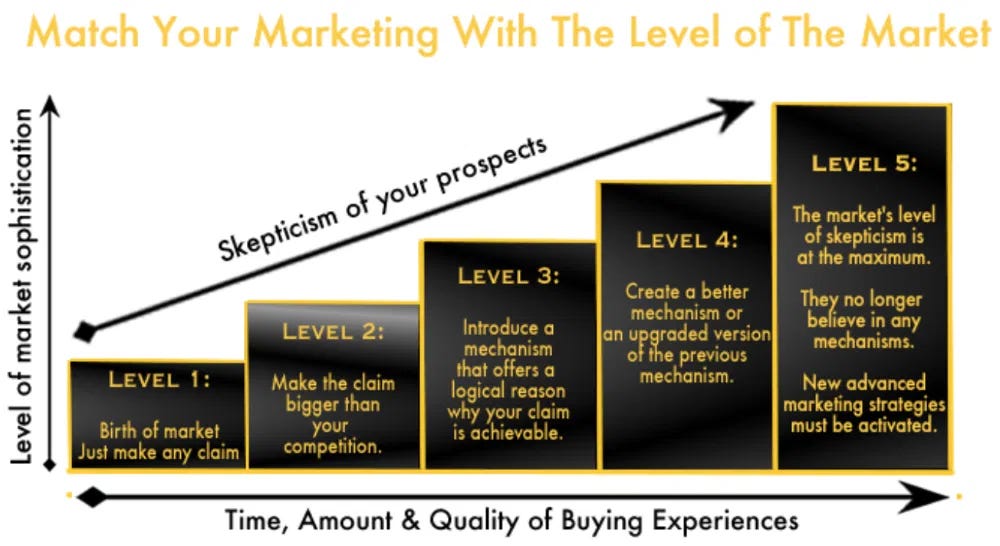
Schwartz identified five distinct stages, each demanding a unique messaging approach:
Stage 1: Unaware (The "Dream" Scenario)
The prospect doesn't even know they have a problem, let alone a solution. This is the marketer's dream – a blank slate.
“To be first. And it happens quite often today. Sometimes because of a technological breakthrough—creating a new product...or a radically better product...or a familiar product at an explosively low price.”
At this stage, you are introducing a new way of thinking."
Focus: Tap into their deepest desires and needs. Introduce the core concept itself. Paint a picture of a better world. Be simple and direct.
Example (Modern): Imagine the early days of smartphones. A Stage 1 message might have been: "Imagine having all the world's information, communication, and entertainment in the palm of your hand."
Key Insight: At this stage, you are introducing a new way of thinking.
Stage 2: Problem Aware (The "Enlarged Claim" Trap)
The prospect feels the pain but hasn't connected it to a specific solution. Competitors begin to emerge, and the race to make the boldest claim begins.
'If you're second, and the direct claim is still working—then copy that successful claim—but enlarge on it. Drive it to the absolute limit. Outbid your competition.'
This strategy is unsustainable. Claims lose credibility as they become more outlandish.
Focus: Agitate the problem. Make them feel the pain more acutely. Then, introduce the idea of a solution, often with increasingly exaggerated claims.
Example (Schwartz): "LOSE UP TO 47 POUNDS IN 4 WEEKS OR RECEIVE $40 BACK!"
Key Insight: This strategy is unsustainable. Claims lose credibility as they become more outlandish.
Stage 3: Solution Aware (The "Mechanism" as the New Benefit)
They know the solution exists but haven't found your specific offering. This is where the magic happens. The focus shifts from what the product does to how it works—the mechanism. The mechanism becomes the new benefit.
What this market needs now is a new device to make all these old claims become fresh and believable to them again. In other words, A NEW MECHANISM—a new way to making the old promise work.'
Focus: Highlight the mechanism by which your product delivers the solution. Introduce your unique approach. This is your "new chance for success" in a crowded market.
Example (Schwartz): "FLOATS FAT RIGHT OUT OF YOUR BODY!" (This headline focuses on the how – the mechanism – rather than just the weight loss claim.)
Key Insight: The headline now prioritizes the mechanism, making the old claim feel fresh and believable again.
Stage 4: Product Aware (Mechanism Elaboration)
They know about your product and its basic benefits, but they're also bombarded with similar products from competitors. Now, competitors begin to elaborate on the successful mechanisms introduced in Stage 3.
Focus: Emphasize the superiority of your mechanism through further elaboration and added benefits.
Example (Schwartz): "FIRST NO-DIET REDUCING WONDER DRUG!" (This expands on the "wonder drug" mechanism.)
Key Insight: Like Stage 2, this stage eventually reaches a point of diminishing returns.
Stage 5: Most Aware (Identification and the "Dead" Market)
They know everything about your product, they want it, but they need a final push. The market is saturated, and claims and mechanisms have lost their power. The focus shifts to identification.
"In this Final Stage of Sophistication...the emphasis shifts from the promise and the mechanism which accomplishes it, to identification with the prospect himself."
Focus: Connect with the prospect on an emotional level. Use imagery, storytelling, and lifestyle associations to create a sense of belonging.
Example (Schwartz & Modern): The Marlboro Man campaign, associating smoking with rugged masculinity. A modern example might be Apple's "Think Different" campaign, appealing to creative individuals.
Key Insight: In this stage, you're not selling a product; you're selling an identity.
The Cigarette Industry: A Classic Example
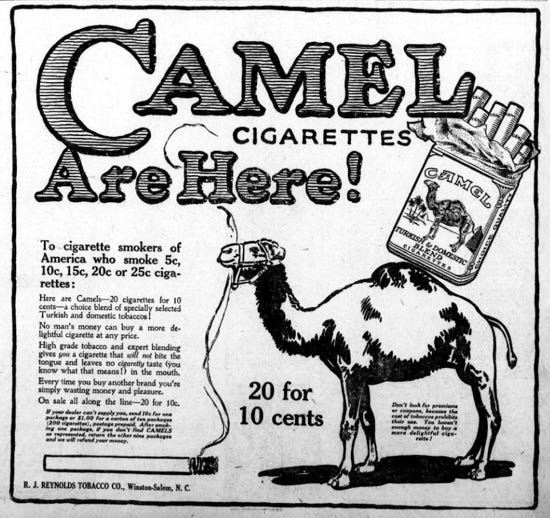
“The history of cigarette advertising is a continuous battle against competition, against physical and social taboos, even against the very success of its own current advertising, which saturates and exhausts the market..."
Early 1900s - Stage 1: The Promise of Pleasure
"I'd walk a mile for a Camel!"
Focus: Simple, direct claims about taste and satisfaction.
1920s-1930s - Stage 2: The Battle of Bigger Claims
"Light up a Lucky, and you won't miss the sweets that make you fat!"
Focus: Exaggerated comparisons and promises.
1930s-1950s - Stage 3: The Rise of the Mechanism
"Luckies – They're Toasted!"
"Pall Mall's greater length filters the smoke further!"
"Camels – Protect your T-Zone!"
Focus: Introducing specific features and processes as differentiators.
1950s-1960s - Stage 4: Mechanism Elaboration
"Philip Morris – All the harshness baked out!"
Focus: Expanding on existing mechanisms and adding more benefits.
1960s-Present - Stage 5: The Power of Identification
The Marlboro Man campaign
Focus: Associating smoking with lifestyle, image, and identity.
Connecting to Modern Marketing
Understanding Market Sophistication is crucial for modern marketing. Whether you're creating content, crafting ad copy, or developing a brand strategy, knowing where your market stands is essential for effective communication.
Stop Wasting Money: Take Action Now
Don't let your marketing messages get lost in the noise. Use the principles of Market Sophistication to craft messaging that resonates, captivates, and converts. Start by asking yourself the three crucial questions:
What is the mass desire?
What is the level of awareness?
And most importantly, what is the level of sophistication?
Then, use the Breakthrough Marketing GPT to help you analyze your competitive landscape and develop a winning strategy. [Link to GPT]
Enjoyed this article? This is just part of our series on applying Breakthrough Advertising with AI. Subscribe to our newsletter to be notified when new articles are released, including:
Article 1: Why Breakthrough Advertising Is the Timeless Playbook for Winning Markets](Link to Article 1)
Article 2: Mass Desire—How AI Helps You Harness What Your Market Already Craves (Link to Article 2)
Article 4: Write Headlines That Convert (coming soon)