Inside This Issue:
The One-Day Transformation - How Matt went from “I just do my job” to a complete portfolio of frameworks using only his resume, LinkedIn, and 20 minutes of voice memos
The Three Extraction Triggers - Why most resume analyses miss invisible expertise, and the specific prompts that catch environmental patterns, unconscious language, and differential approaches others overlook
The Resume Extraction Protocol (Paid subscribers) - Three complete prompts engineered to extract frameworks from career documents in under 3 hours, including the validation criteria that ensure you’re finding real IP, not just skills summaries
Let’s go…
I’ve been extracting frameworks from interview transcripts for 10 months.
Since early January, I’ve analyzed hundreds of hours of recorded conversations, catching the invisible patterns in how experts think, synthesizing them into frameworks, and multiplying them into content ecosystems.
I call this process extracting your Cognitive Fingerprint™.
The idea: Your best expertise operates below conscious awareness.
The questions you ask automatically
The approaches you take without thinking
The systems you use but can’t name
I typically work with coaches and consultants, but the pattern holds across every domain.
Deep expertise creates unconscious competence.
Unconscious competence hides what you know.
But that last night of vacation, my friend Matt didn’t have months for the usual process.
His LinkedIn had been open on his laptop for three days straight. I could smell the Sunday Scaries coming out of his pores when he turned to me:
“I have all this experience but I have no idea what makes me different. I know I want to stand out to attract future employers and also appear as a thought leader inside my current job. Can you help?”
Matt has been a Senior Learning Designer for 12 years. His resume listed impressive companies: a major airline, a cryptocurrency exchange, a delivery app unicorn, a CRM platform. 150+ training modules created. 20,000+ employees trained.
On paper, incredibly accomplished.
But when I asked him what made him different from other instructional designers, he said:
“I don’t know. I just... do my job?”
That phrase—”I just do my job”—has cost more consulting revenue than bad websites, unclear positioning, and missed networking combined.
He’d been applying to roles and getting nowhere. His social media sat quiet. His portfolio showed his work but didn’t explain his approach. To hiring managers, he looked like every other experienced learning designer with a solid track record.
Listening to him, I had a thought: What if I didn’t need extensive setup and hours of transcripts this time?
In the age of AI, everything is data. Your resume contains more than job listings. Years of unconscious patterns. Hidden in bullet points. Waiting for extraction. Your LinkedIn reveals more than professional highlights. Expertise you can’t articulate sits in every “Responsible for...” line.
I’d never tried extracting frameworks from just documents before. No transcript. No deep interview. Just resume + LinkedIn + Claude.
“Send them over when we get back,” I said. “Let’s see what we find.”
This is the story of how we extracted a complete portfolio of frameworks from 2,000 words of resume text, five AI-generated questions, and twenty minutes of voice memos.
More importantly: the process you can use to do the same.
The Resume Extraction Experiment: Your Documents Contain More Than You Think
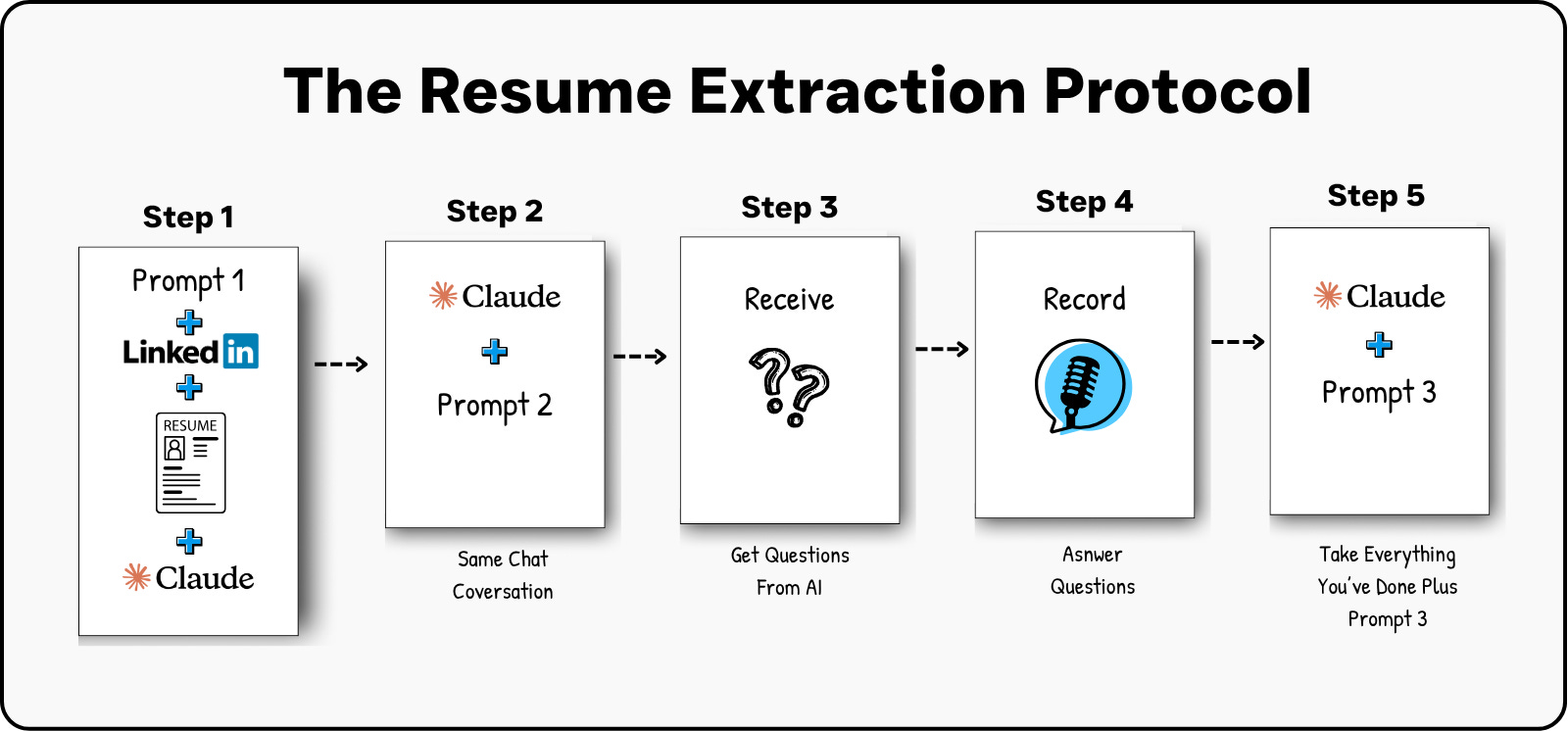
I took Matt’s resume and LinkedIn profile (maybe 2,000 words total) and fed them into Claude with a specialized extraction prompt.
STEP 1: THE INITIAL EXTRACTION - Partial Preview
Analyze this resume and LinkedIn profile for invisible expertise patterns.

Look for:
1. Recurring problems this person solves across different roles
2. Patterns in company types/environments they choose
3. Language they use repeatedly that others might not
4. Implicit questions they likely ask that aren’t stated
5. Specializations they’ve developed but might not recognize
...

[Full prompt available to paid subscribers below]
Thirty seconds later, Claude delivered the pattern:
Pattern Detected: “Matt has worked at 6 consecutive tech companies in rapid-change environments (cryptocurrency, delivery apps, AI implementation). Repeated language: ‘rapid iteration,’ ‘product evolution,’ ‘feature changes,’ ‘training sustainability.’ This person likely approaches training differently than traditional LDs because traditional comprehensive training fails in these environments.”
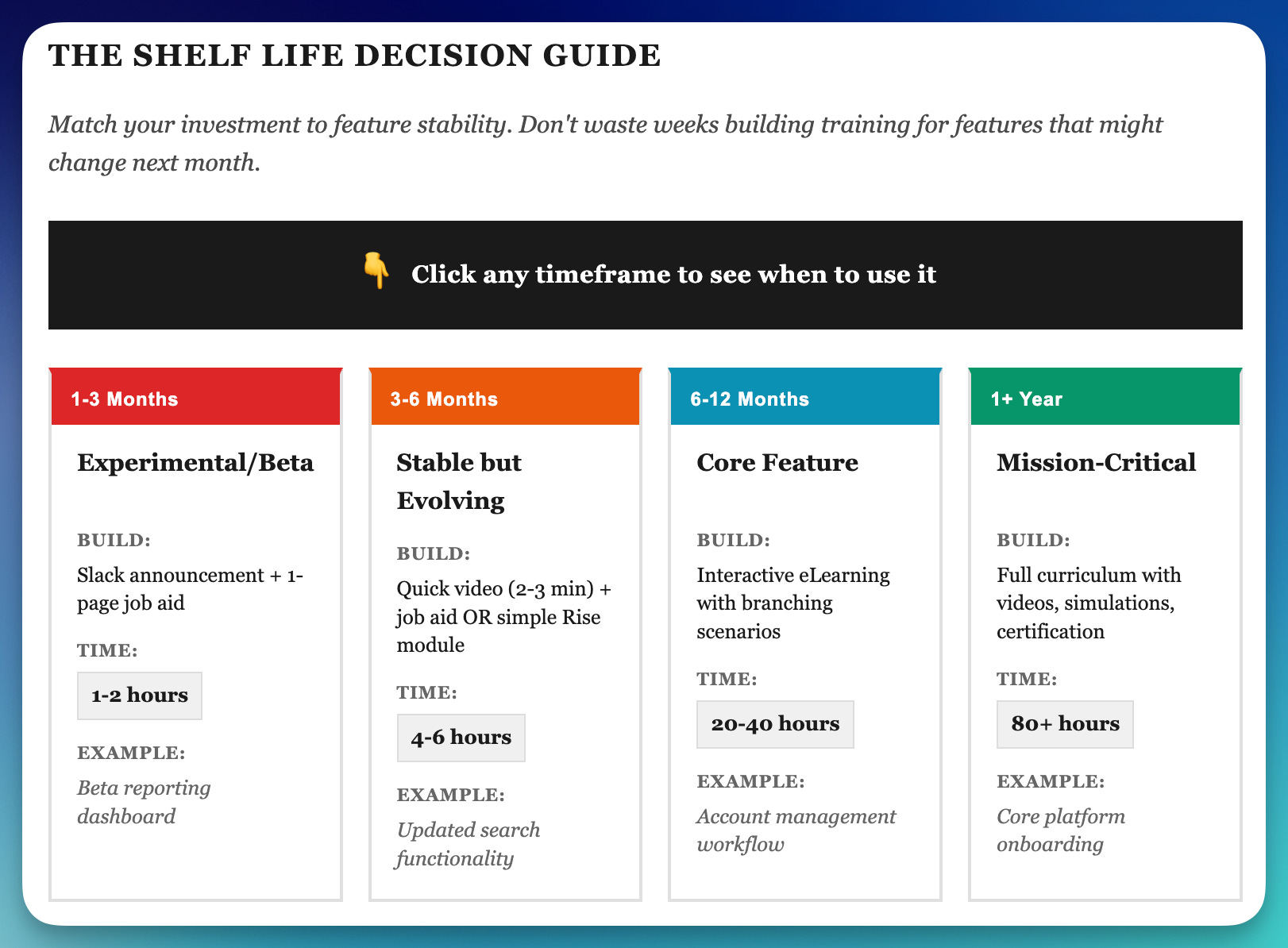
Potential Framework: “Decision logic for matching training investment to feature stability”
Key Question to Ask: “How do you decide what type of training to build? What questions do you ask before starting development?”
There it was. The pattern jumped off the screen like text lifting off the page. Claude had seen in thirty seconds what Matt couldn’t surface in twelve years.
I looked over and said: “Quick question. Do you approach training differently because you’ve worked at so many fast-moving companies?”
His response: “Yeah. But I thought everyone did that?”
No. They don’t. And that’s your differentiator hiding in plain sight in your resume.
Hidden patterns. Waiting for extraction.
The AI-Led Investigation: When Claude Asks Better Questions Than You Do
Claude had spotted the pattern. Now I needed Matt to reveal the framework behind it. The unconscious system he’d developed but couldn’t articulate.
Instead of conducting a traditional discovery interview (where I ask generic questions and hope to stumble onto something), I had Claude generate targeted questions based on patterns it had already identified.
STEP 2: THE AI-GENERATED INVESTIGATION - Partial Preview
Based on the patterns you identified, generate 5-7 targeted questions that would reveal:
1. The specific framework/process this person uses
2. Concrete examples of their approach in action
3. The “why” behind their decisions
...

Format each as: “I noticed [pattern]. Can you brain dump about [specific aspect]?”

[Full prompt available to paid subscribers below]
Claude generated investigation questions I wouldn’t have thought to ask:
Question 1: “I see you worked at 6 fast-moving tech companies where you repeatedly mention ‘rapid iteration’ and ‘product evolution.’ Do you approach training development differently in these environments? Can you brain dump about how you decide what type of training to build?”
Question 4: “I notice you list ‘strategic learning consultation’ at your current role. What questions do you find yourself asking stakeholders that others in your field typically skip?”
I showed these to Matt: “Claude generated some questions based on your resume. I am going to flip on my iPhone voice recorded…Just brain dump your answers, don’t overthink it.”
Twenty minutes later, I had five voice memos totaling maybe 15 minutes of audio.
Matt’s answer to Question 1:
“Oh yeah. So at [crypto company], we’d launch a feature on Tuesday and it would be completely redesigned by Friday. I learned fast that you can’t spend 40 hours building a polished Storyline course for something that’s going to change. So I started asking: ‘How long is this feature going to last?’ If it’s beta and might change in 3 months, I’d do a quick job aid and a Slack post. If it’s core functionality that’ll be stable for a year, then yeah, build the full course. Most LDs I talk to don’t ask that question. They default to building the same level of training for everything.”
There it was. The invisible pattern made visible.
The question he asks that other learning designers don’t:
“What’s the shelf life of this feature?”
Matt’s answer to Question 4:
“I always ask four questions before building anything:
Why should they care about this feature?
When does this matter in their workflow?
What’s the one thing they’ll try first?
What’s the shelf life of this training?
That last one (the shelf life question) determines everything else. Because if something’s changing in 3 months, I’m not spending 40 hours on it.”
And there was the framework. Complete. Systematic. Operating unconsciously for years.
To Matt, this was “just how I work.” To everyone else, it was a teachable methodology with real commercial value.
The Framework Synthesis: From Brain Dumps to Intellectual Property
At this point, I had something most experts never capture: the raw material of invisible expertise. Resume data showing environmental patterns. Claude’s analysis revealing unconscious specialization. Matt’s brain dumps exposing his systematic approach.
Now came the synthesis. Turning all of this into structured intellectual property.
STEP 3: THE SYNTHESIS - Partial Preview
Based on:
1. The resume/LinkedIn analysis
2. The patterns identified
3. The user’s responses to follow-up questions

Synthesize a structured framework that:
- Has 3-5 clear steps/questions
- Includes decision logic (if X, then Y)
- Contains real examples from their responses
...

[Full framework synthesis protocol available to paid subscribers below]
Within minutes, Claude had structured Matt’s unconscious approach into something he could actually teach:
The Fast-Changing Tech Training Framework™

Training designed for products that evolve faster than traditional courses
Core Philosophy: Match training investment to feature stability
The Four Questions:
Why should they care? (Motivation filter)
When does this matter in their workflow? (Context trigger)
What’s the one thing they’ll try first? (First action identifier)
What’s the shelf life of this feature? (Investment calculator)
Decision Matrix:
Common Mistakes This Prevents:
Over-investing in training for features that will change
Building comprehensive courses for beta functionality
Treating all features with equal training investment
Missing the window when training would be most useful
This framework came from Matt’s experience. His language. His examples.
But now it was structured, teachable, OWNABLE.
Intellectual property extracted from invisible expertise.
The Before/After Transformation
Before this conversation:
“I’m a Senior Learning Designer with 12 years of experience”
Generic LinkedIn profile
Portfolio showing work samples without methodology
No frameworks to discuss in interviews
Looked identical to every other experienced LD
After 24 hours:
The Fast-Changing Tech Training Framework™ (ownable IP)
Four-question assessment process (systematic approach)
Decision matrix for stakeholder conversations (visual differentiator)
Positioning: “Designing learning experiences that make complex technology easy”
Portfolio rebuilt around frameworks instead of samples
The difference: From “I just do my job” to “Here’s my systematic approach to solving this specific problem in this specific environment.”
From invisible expertise to intellectual property.
The Portfolio Transformation: Making Invisible Expertise Visible
The frameworks mattered. But Matt needed to show them, not just have them.
His old portfolio did what most portfolios do: proved he could do the work. Work samples. Project descriptions. Years of experience listed.
But it didn’t show how he thinks.
The questions he asks
The systematic approach
The framework that makes him different
Before extraction:
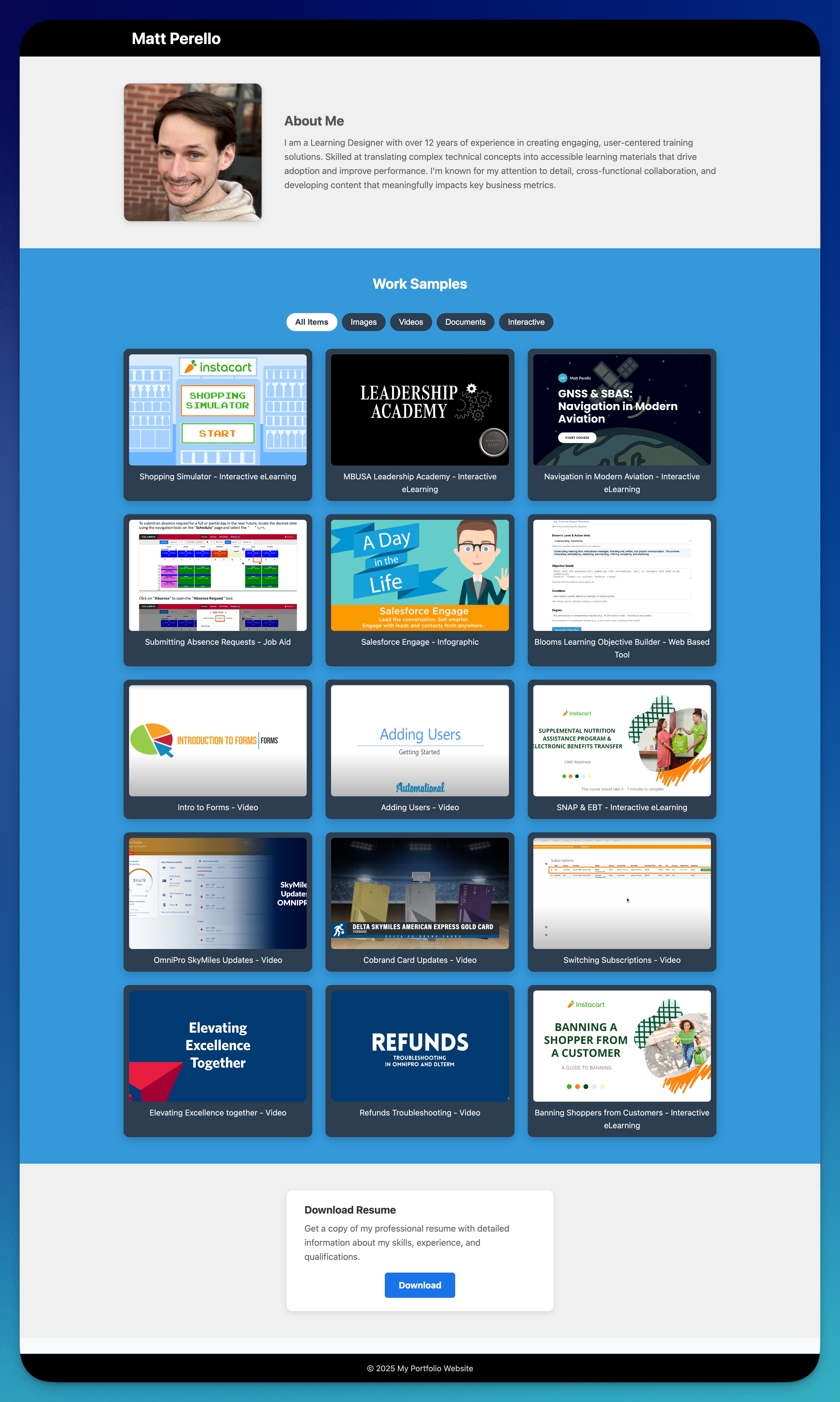
Generic headline. Work samples grid. Download resume button. Looked like every other LD portfolio.
After extraction:

His new site leads with positioning:
“Designing Learning Experiences That Make Complex Technology Easy.”
Frameworks section front and center. Decision matrix visible above the fold. Process methodology laid out in detail. Service offerings structured around the four questions.
The difference isn’t JUST cosmetic.
The old site showed what he’d made.
The new site shows how he thinks.
Hiring managers can now see his approach before the first conversation. Stakeholders understand his methodology before the first meeting. The portfolio went from “proof of work” to “proof of thinking.”
The complete portfolio rebuild process—how we turned the frameworks into a positioning site, content ecosystem, and LinkedIn strategy —deserves its own breakdown. But we are at 2k words so that will have to wait for another article.
This transformation—(resume to frameworks to portfolio) happened in 24 hours. No lengthy interview process. No months of discovery. Just the right extraction protocol applied to data that was already there.
The Content Multiplier Effect: From Frameworks to Full Ecosystem
The frameworks weren’t the end. They were the beginning.
That same night, we fed Matt’s frameworks back into Claude with a different prompt. One focused on content angles and LinkedIn positioning.
What came out in under an hour:
10 LinkedIn Content Angles - Each tied directly to his extracted frameworks:
“The Reality of Training in Fast-Moving Tech Companies” (built on his shelf-life framework)
“Translating Tech-Speak: Making Complex Systems Learnable” (his cross-company pattern)
“Building Training That Survives Product Updates” (the core differentiator)
20+ Complete LinkedIn Posts - Written in his voice, using his examples, showcasing his frameworks:
Not generic advice
Real stories from major companies
Specific numbers, specific outcomes
Each post demonstrating the framework in action
A 90-Day LinkedIn Publishing Strategy - Which angles to lead with, how to sequence the content, what to double down on based on engagement.

Total time from resume upload to complete content library: One night.
Matt now had:
Ownable frameworks (intellectual property)
A portfolio that shows how he thinks
Three months of LinkedIn content ready to publish
A positioning strategy for interviews
Proof points for every framework claim
The traditional approach: Months of interviews. Weeks of synthesis. Slow content creation. Hope something resonates.
The extraction approach: 24 hours from resume to complete thought leadership ecosystem.
Same frameworks powering everything. Portfolio demonstrates them. LinkedIn content teaches them. Interview answers prove them.
One extraction. Multiple outputs. All aligned.
Why This Works: Resume as Training Data
Here’s what makes resume-based extraction different from traditional discovery interviews:
Traditional approach: Schedule calls. Hope to catch patterns across hours of conversation. Transcribe everything. Manually analyze for frameworks.
Resume extraction: Your career already revealed the patterns. Years of unconscious choices compressed into document form. AI spots what you can’t see.
Your resume contains patterns invisible to human readers. AI can identify:
Repeated language across different roles that signals unconscious frameworks
Implicit specializations in environment choice (fast-moving vs stable companies)
Questions you likely ask that aren’t stated explicitly in job descriptions
Systematic approaches you’ve developed but can’t articulate
Your LinkedIn reveals expertise you dismiss as “normal.” AI identifies the differential. What you do that others in your field don’t.
The difference is three engineered triggers in the extraction prompt that force Claude to find differential expertise instead of resume summaries:
The Environmental Filter - catches company choice patterns you don’t notice
The Language Trap - identifies the specific words you repeat unconsciously
The Negative Space Question - reveals what you do that others in your field don’t
Without these triggers, you get skills lists. With them, you get frameworks.
The complete extraction protocol that made Matt’s transformation possible is below. Same process. Same prompts. Same three triggers. Tested across different industries and expertise.