

Last week I decided to get serious about a skill gap I’d been ignoring for months.
Not just “learn AI.”
Not only “get better at strategy.”
Something specific enough to understand systems design well enough to explain why most AI implementations fail and what to do instead.
I had a massive reading list with nine books. At my actual reading pace, that’s 4-6 months out (more of a podcast guy these days). And even then, I’d remember maybe 30% of the concepts and almost none of the connections between them.
The thing about a reading list is it feels like a plan. But it’s almost always a deferral.
So I tried something different and used AI to build personalized knowledge files for each book, uploaded them to NotebookLM, and generated overviews I could listen to while walking the dog.
I ended up with three hours of audio. Every concept mapped to
My actual work
My actual clients
My actual problems
And it included personalized translations, built around my specific friction before I ever pressed play (AI is so cool).
But, little did I know, building the files taught me more than listening to them did. By the time I pressed play, the hard cognitive work was already done. The translation was the learning.
Five steps, 2 prompts. Here’s how they work.
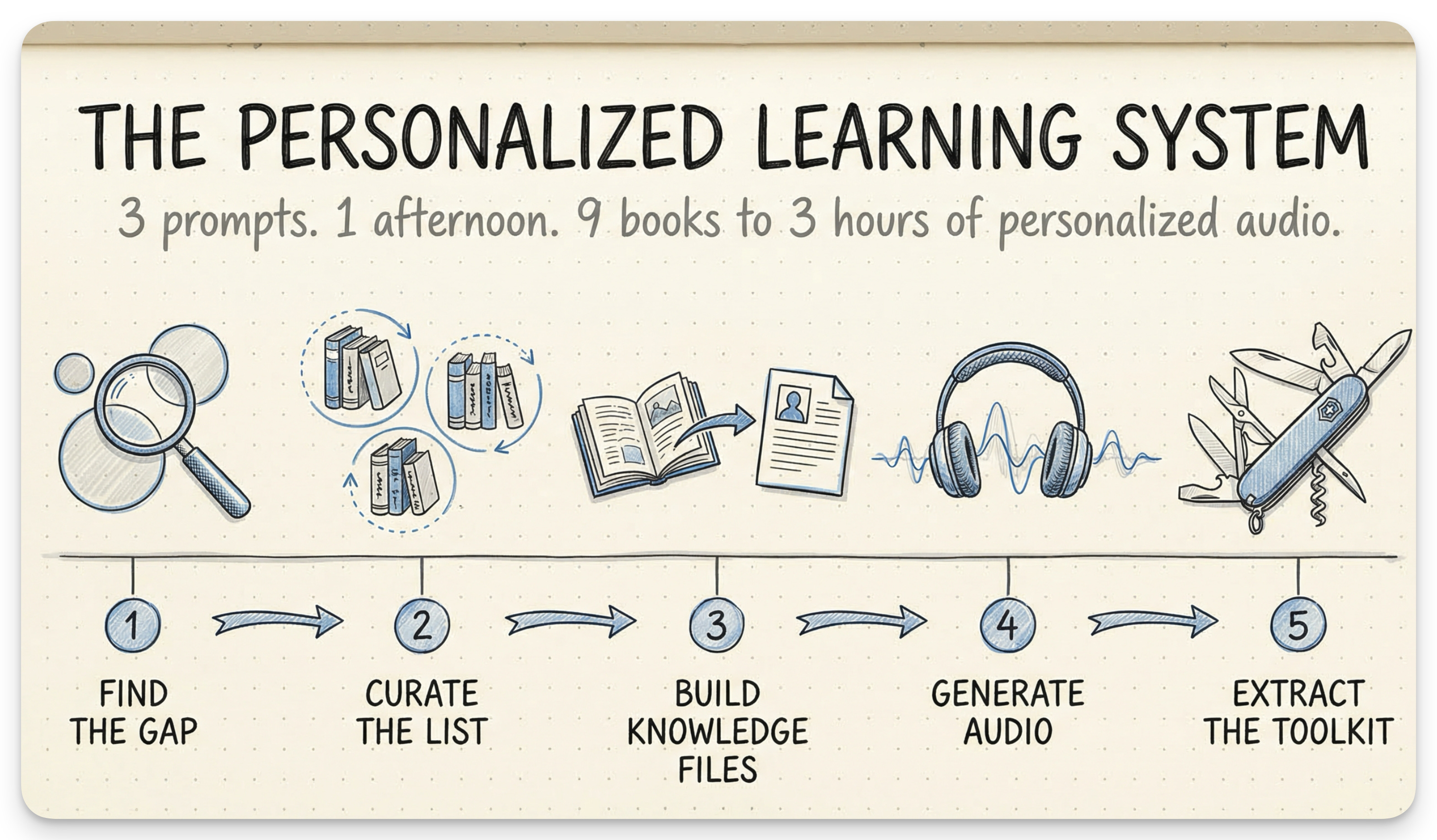
Step 1: Find the Real Skill Gap
Most learning fails before it starts. The gap gets named too broadly to ever close, and a broad gap has no finish line.
“Get better at leadership.” “Learn AI.” “Improve my writing.” Those are categories. You can spend years inside a category and have nothing concrete to show for it.
The way out is specificity. Start with what you’re actually doing, find where it breaks down, and then name what would fix it. Three questions do that work.
What’s the work you’re doing right now that matters most? Ground it in reality. Not your goals. Not your roadmap. What you’re actually doing this week.
Where does it get stuck, slow, or frustrating? The friction is the diagnostic. “I keep explaining the same thing over and over.” “Every project feels like starting from scratch.” “I can build the thing but I can’t explain why it works.”
If you could snap your fingers and be world-class at one thing tomorrow, what would make the biggest difference in that work?
When you name a gap specifically enough, the reading list writes itself.
“Learn AI” produces AI books.
“Understand why the systems I build for clients stop getting used after two weeks” produces books on human-centered design, lean manufacturing, and organizational behavior. A completely different shelf, built around a problem that actually has a solution.
The $1,000 Insight: the name you give your problem is basically a search query. “Get better at AI” returns AI books. None of them will tell you why your clients stop using the systems you build. The more specific you get about what’s actually broken, the more likely you are to find something that actually fixes it.
Step 2: Build Your Reading List
Take your skill gap and give it to Claude with your full context. Your work, where it gets stuck, your background. Ask for 6-10 books, clustered by how they connect to your gap, sequenced by where to start.
One ask that makes the whole thing work…
Ask for books that build the underlying skill, not books about your topic.
I was trying to understand AI adoption failure. The book that moved the needle most was written about lean manufacturing in the 1980s. Same underlying skill, completely different shelf, and I never would have found it searching “AI books.”
The $1,000 Insight: the skill you need and the domain that teaches it best are often completely different things. A book written about lean manufacturing in the 1980s taught me more about AI adoption than anything in the AI section would have. That only happens if you ask Claude for the underlying skill rather than books about the surface problem.
Step 3: Build the Knowledge Files
For each book, ask Claude to build a deep knowledge file (it’s good enough to do this now without the book itself). Every section gets written through the lens of your specific work, your specific friction, your specific clients and problems. The goal is a document that reads like it was written for you, because it was.
Each file should include:
What the book is really about, framed through your context
The 6-8 concepts that matter most for your specific situation
A mapping of those concepts to your actual challenges and projects
The core framework translated to your domain
10 diagnostic questions you could ask yourself or a client
Key quotes with one-line translations to your context
How this book connects to the others on your list
Target 3,000-5,000 words per file. Rich enough for at least a 15-20 minute audio overview.
To build the file, you have to articulate your context first. Your work. Your friction. Your specific challenges. That act of articulation is where the real learning happens (the prompt below will help you with this).
By the time you press play on the audio, the hard cognitive work is already done.
Most people read first and try to apply later. This flips the order. You apply first, then listen to reinforce what you already worked out.
The $1,000 Insight: every book contains the same words for every reader. What changes is what you bring to it. When you build the knowledge file, you’re forcing the connection between the book’s ideas and your actual work before you consume a single word. That forced connection is what makes it stick.
Step 4: Upload to NotebookLM and Generate Your Course
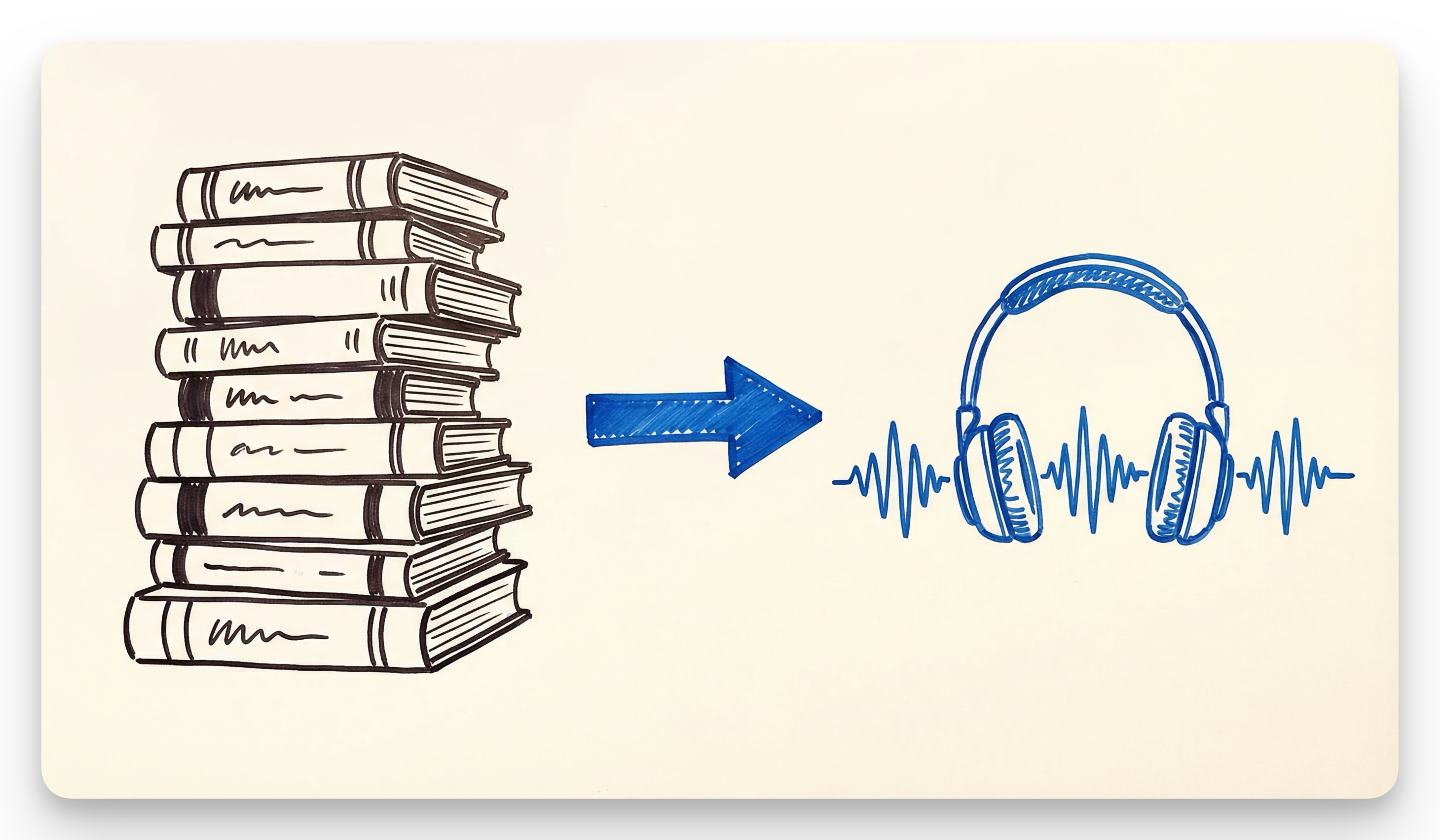
NotebookLM is a free Google tool. Go to notebooklm.google.com, create a new notebook, upload your knowledge files as sources, and hit “Generate” on the Audio Overview.
It produces a podcast-style conversation that walks through the material. Because your files are translations rather than generic summaries, the audio references your work, your problems, your language. You can also chat with the notebook directly and ask how a specific framework applies to a specific client situation.
The $1,000 Insight: NotebookLM doesn’t know anything about you. It works entirely with what you give it. Give it generic summaries and you get generic audio. Give it files you built around your own work, your own clients, your own problems, and the audio sounds like someone recorded it specifically for you. The quality of what comes out is a direct reflection of the quality of what goes in.
Note: You have a choice of per-book or combined
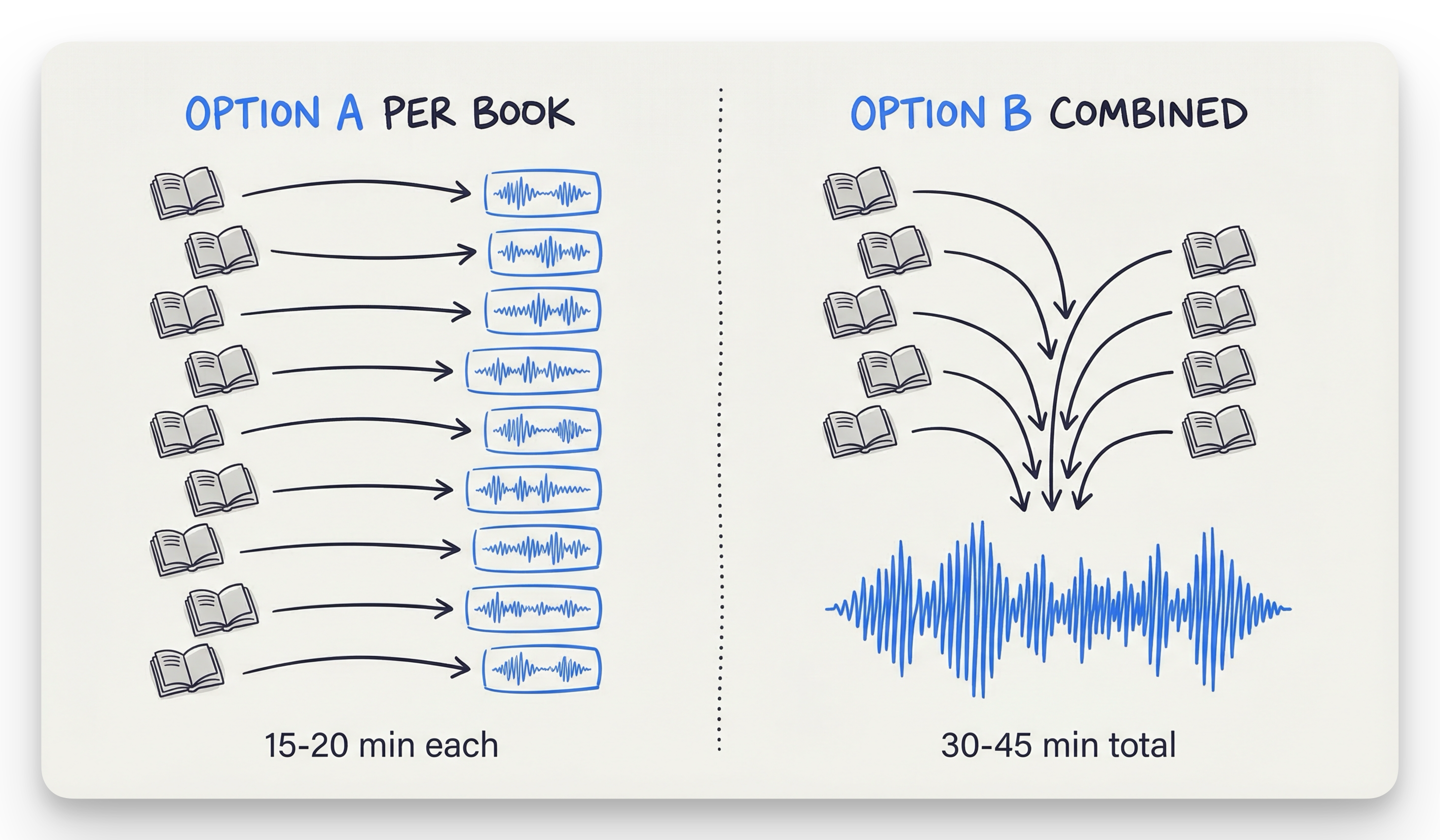
Option A: One Audio Per Book (Recommended to Start)
Generate a separate audio overview for each knowledge file. You’ll get 9 episodes, each 15-20 minutes. This works best if you want to listen during walks, commutes, or workouts and absorb one book’s frameworks at a time.
Option B: One Combined Audio (All 9)
Generate a single audio overview with all 9 files loaded. NotebookLM will find the connections between books and weave them together. You’ll get one longer episode (30-45 min) that cross-references concepts across your entire reading list. Better for seeing the big picture, but denser.
My suggestion: Start with Option A to learn each book individually, then generate the combined version after you’ve listened to a few. The combined audio hits differently once you’ve got the individual frameworks loaded.
Choosing Your Format
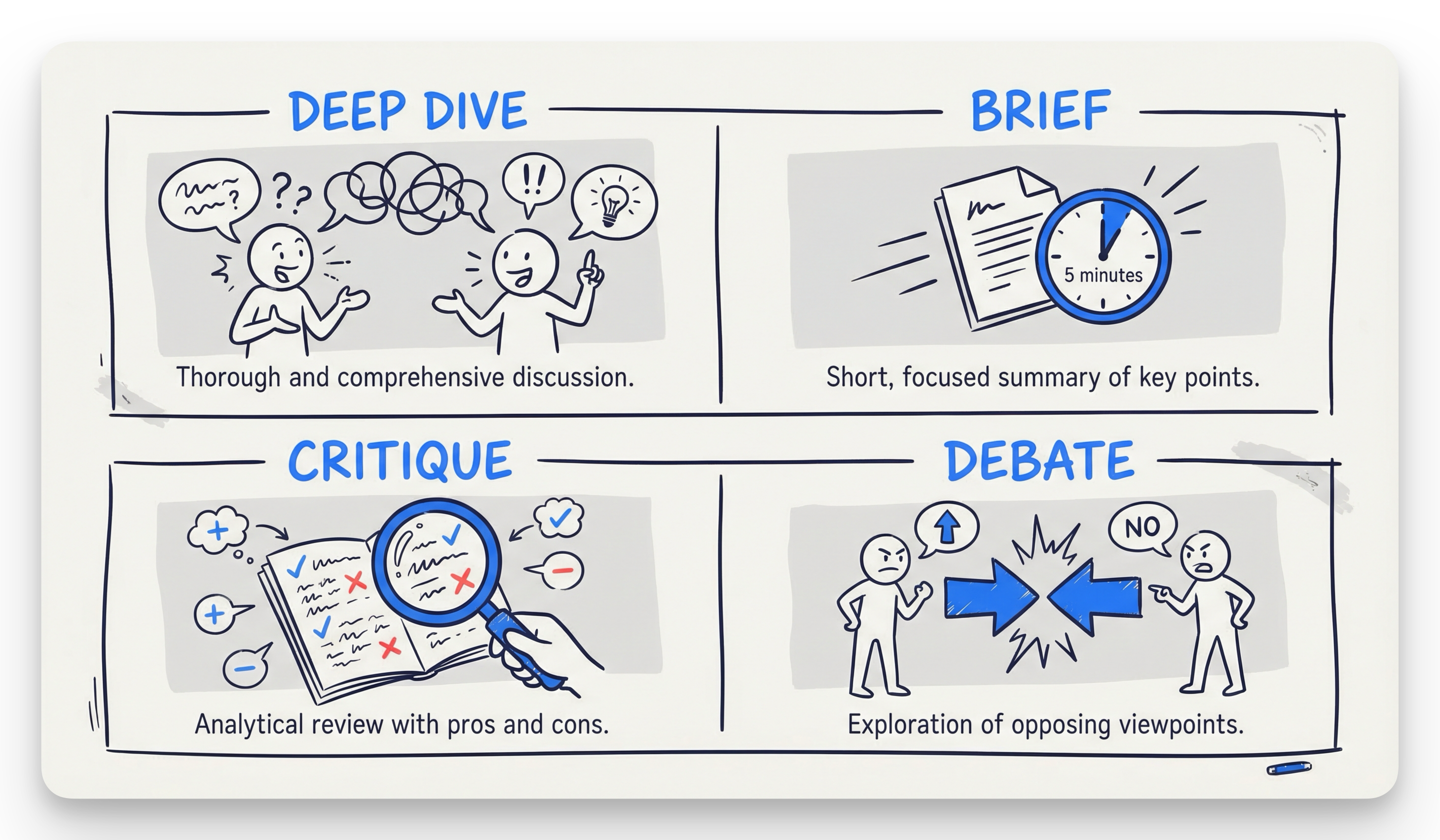
Start with Deep Dive for each book. It’s the most natural way to absorb the material. Use Brief if you’re short on time and want to triage which books matter most. Debate is surprisingly good for books like “Antifragile” where the ideas provoke strong reactions.
Video Overview is also available with three styles:
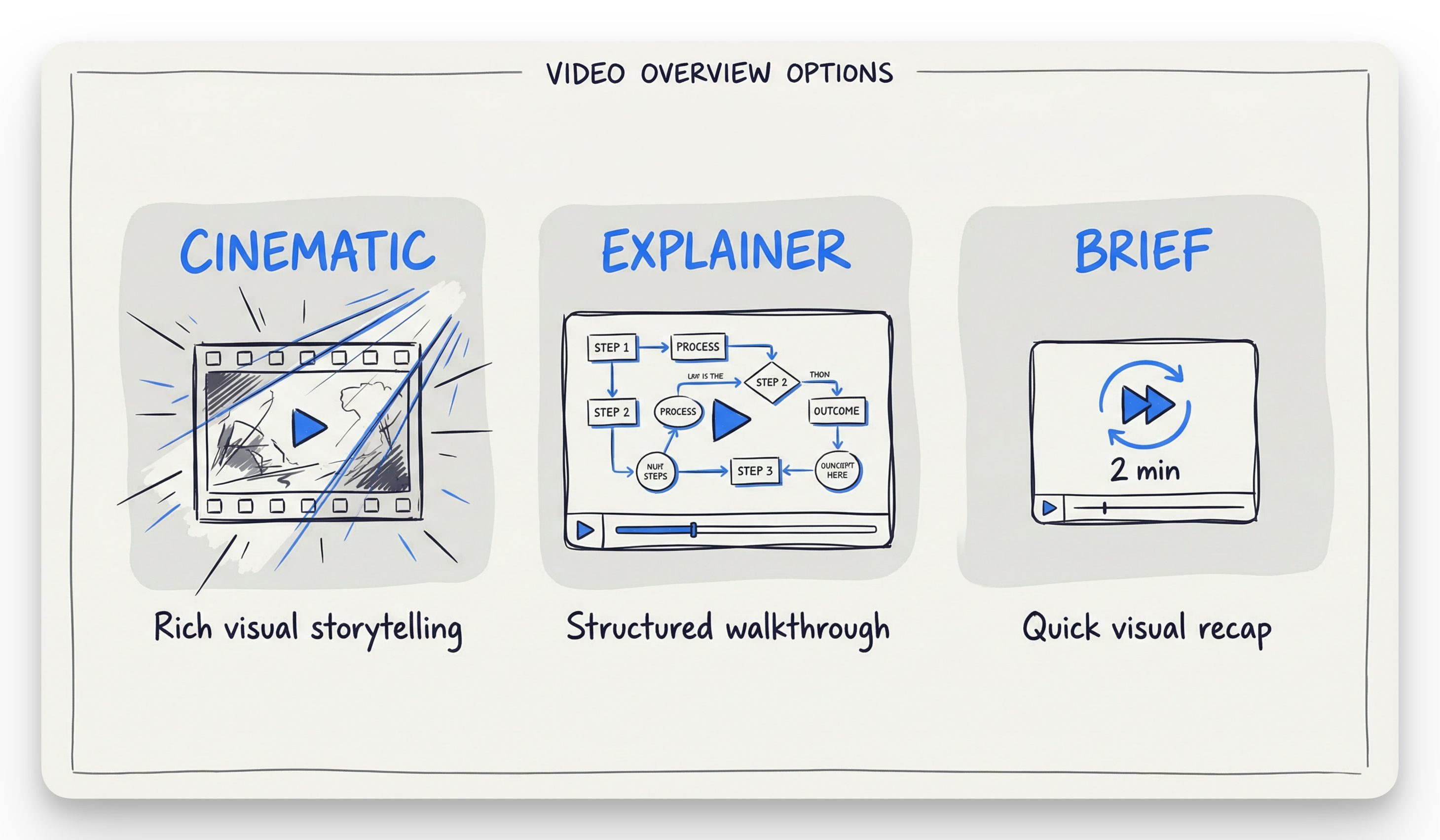
Video works especially well for books with spatial concepts (Meadows' system diagrams, Alexander's pattern relationships, Toyota's production flows). If you only generate one video, make it the combined all-9 version on Explainer. It'll map the connections between books visually.
The Key Field: "What Should the AI Hosts Focus On?"
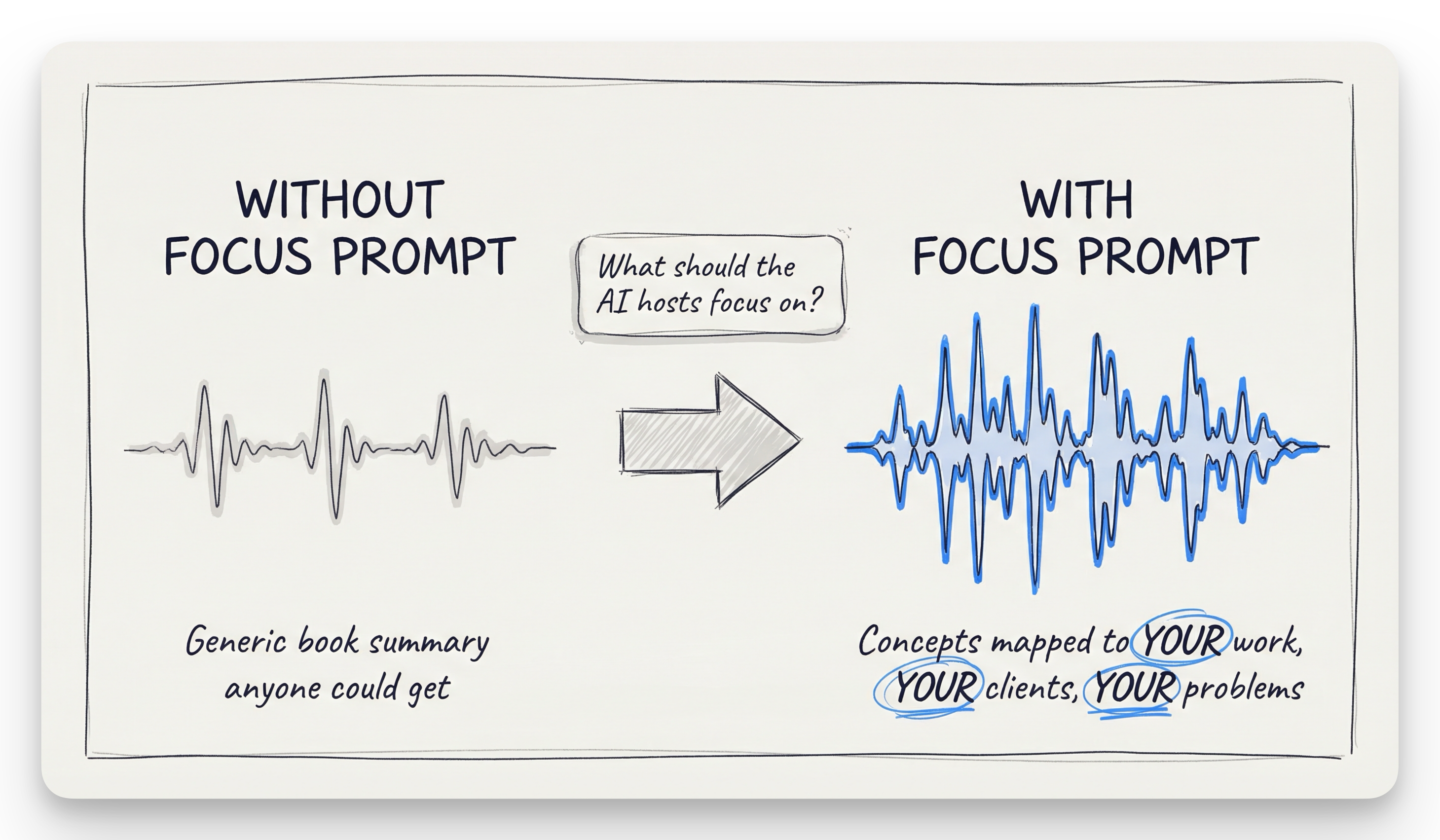
This is where you steer the output. Leave it blank and you'll get a generic overview. Fill it in and the episode becomes yours.
After generating, you can also chat with the notebook directly. Ask things like "How does Meadows' leverage points framework connect to Norman's design principles?" and it'll answer using your personalized context because that's what's in the source files.
Step 5: What You Can Do With What You Just Built
The knowledge files don’t stop being useful after the audio ends.
Each file produces 10 diagnostic questions mapped to your work. Across 9 books, that’s 90 questions. Pull the 15-20 sharpest ones and you have a diagnostic framework you can use with clients, in strategy sessions, or for your own quarterly reviews.
Every concept-to-work mapping is a potential article, talk, or post. The connection is already written. You built it into the file before you started.
What you will start to realize is that the frameworks compound. When you’re evaluating whether to take a project, change an approach, or give a client a recommendation, you’ve got 9 lenses available because you built 9 translations, each mapped to your actual work.
The $1,000 Insight: after you run these prompts, you don’t just have notes from 9 books. You have 90 diagnostic questions you can use with clients. You have concept-to-work mappings that are articles and talks waiting to happen. You have translated frameworks you can actually reach for when you’re in a meeting and need to explain something fast. Think of it as a toolkit you built, not a course you took.
The Meta-Lesson
The skill I was trying to build was systems thinking. The system I built to learn it turned out to be the lesson.
Most learning is passive. Read the book, highlight some lines, forget 90% within a month. This approach is active before it’s passive. You’re translating every concept into your own context before you start consuming it.
The books don’t change. Your context is what makes them useful. Two people running this system on the same 9 books will get completely different outputs (different files, different audio, different toolkits) because they brought different problems to the table.
That’s the whole thing. Two prompts, one afternoon, a walk with the dog (or four in my case).

Below are the two prompts that run this system (and three more to customize the experience)
The first one builds a reading list around the gap you actually have, pulled from domains you’d never think to search. The second turns any book into a knowledge file mapped to your exact clients, your exact problems, and the conversations where you need to sound like the most expensive person in the room.
You will also receive three prompts to customize the audio and video experience even further.
Every book you’ve read and forgotten is a framework you could have been charging for. These prompts fix that, starting with the next one.
The Prompts
Prompt 1: Reading List Generator
What you’ll get: 6-10 books clustered by how they address your specific gap, sequenced in the order to read them, with one sentence per book explaining exactly why it’s there. Takes about 60 seconds to fill in. Claude does the rest.
I need to close a specific skill gap. Here's my context:

─── MY SITUATION ───────────────────────────────────────

THE WORK I'M DOING RIGHT NOW:
[What you're actually doing this week — not goals, not aspirations]

WHERE IT GETS STUCK OR SLOW:
[The specific friction. "I keep having to explain X." "Every project starts from scratch." "I can build it but can't explain why it works."]

THE SKILL GAP I NEED TO CLOSE:
[One specific sentence. Not "get better at AI." Something like: "Understand why the systems I build stop getting used after two weeks."]

MY BACKGROUND:
[2-3 sentences: what you already know, what domain you work in, who you serve]

─── WHAT I NEED ────────────────────────────────────────

Generate a reading list of 6-10 books to close this gap.

Requirements:
- Recommend books that build the UNDERLYING SKILL I'm missing — not books about my topic. The best options often come from completely different domains.
- Cluster into 2-4 groups by how each cluster addresses my gap
- For each book: one sentence on why it's here and which part of the gap it closes
- Sequence them: which first and why

─── OUTPUT FORMAT ──────────────────────────────────────

Return:

CLUSTER NAME — [how this cluster addresses the gap]
• [Book Title] by [Author] — [one sentence: why it's here, which part of the gap]

Then a final paragraph: the sequencing recommendation and where to start.
Prompt 2: Knowledge File Builder
What you’ll get: A 3,000-5,000 word document that translates one book entirely into your context. A working file that produces personalized audio in NotebookLM and doubles as a diagnostic framework, content source, and decision tool.
Run this once per book. If you have access to Claude Code or Cowork, paste all your book titles in at once and let it run the prompt on every book in parallel. I gave it my full list of 9 and walked away. All 9 files were done in about 10 minutes.
Create a deep knowledge file for [BOOK TITLE] by [AUTHOR].

This file will be uploaded to NotebookLM to generate an audio overview.
Write everything through the lens of MY context, not a generic summary.
Tone: sharp thinking partner, not textbook.
Length: 3,000-5,000 words.

─── MY CONTEXT ─────────────────────────────────────────

[Paste the same four fields from Prompt 1: work you're doing, where it gets stuck, skill gap, background]

─── FILE STRUCTURE ─────────────────────────────────────

Build the file in this exact order:

SECTION 1 — WHAT THIS BOOK IS REALLY ABOUT
Reframe the book's thesis through my specific work. Not what the book says. What it means for me.

SECTION 2 — THE 6-8 CONCEPTS THAT MATTER FOR MY SITUATION
For each concept:
- The idea in 2-3 clear sentences
- How it connects to my actual work (use my language, my clients, my problems)
- One thing I could say in a conversation that shows I understand this

SECTION 3 — CONCEPT-TO-WORK MAPPING TABLE
Two columns: book concept on the left, my specific challenge or project on the right.

SECTION 4 — THE CORE FRAMEWORK, TRANSLATED
Explain the book's central framework in depth. Then rebuild it in my domain. Show me what it looks like applied to my actual work.

SECTION 5 — 10 DIAGNOSTIC QUESTIONS
Questions I could ask myself or a client, derived from this book's thinking. Specific enough to use in a real conversation.

SECTION 6 — KEY QUOTES WITH TRANSLATIONS
8-10 of the most powerful lines from the book. After each quote: one sentence translating it into my context.

SECTION 7 — THE THREE THINGS
If I forget everything else about this book, these three ideas are the ones that matter most for my work.

SECTION 8 — HOW THIS CONNECTS TO THE OTHER BOOKS
One paragraph: how the ideas in this book build on or challenge the others on my reading list.
Prompt 3: For Per-Book Audio
```
Focus on how each concept from this book applies to my specific work context.
When discussing frameworks, always connect them back to the practical examples
in the knowledge file. I care more about "how would I use this Monday morning"
than academic theory. Spend extra time on the diagnostic questions section
and challenge whether the book's frameworks hold up in real-world application.
```
Prompt 4: For The Combined All-9 Audio
```
These 9 books were chosen to close one specific skill gap. Focus on the
connections BETWEEN books, not just within them. Where do two authors agree
from completely different domains? Where do they contradict each other?
Which combinations of frameworks create something more powerful than either
book alone? Pay special attention to the “mapping table” sections that
connect book concepts to my real work.
```
Prompt 5: For Video (Combined, Explainer)
```
Walk through how these 9 books connect to form one coherent skill-building
system. Use a visual structure that shows which books feed into which
practical capabilities. Focus on the “three things to remember” from each
book and how they chain together.
A note on what you just built. The diagnostic questions alone are a client-facing framework waiting to happen. The concept-to-work mappings are content waiting to be written. The quote translations are the specific language you reach for when you need to explain something quickly under pressure. Most people who run these prompts think about what they learned. The better question is what they now have.
What skill gap are you ignoring? Hit reply and tell me. I’ll tell you if your reading list should include zero books about the topic you named.
I'm about to set this up right now! Thank you, Max!