

Michael Stelzner said something on his show that made my ears perk up. He was talking about those one-on-one calls where he feels like he's in "a little zone" and "gold comes out." He wishes a camera had been running, because he already knows it would be content.
Think about a call like that. Someone brings you a problem, you start talking it through, and somewhere in the conversation you find an answer you couldn't have prepared in advance. Then the call ends, and all that thinking is scattered through an hour of conversation.
He was describing the blind spot I'd come on to talk about.
When you describe yourself in an interview or a prompt, you leave out decisions you make without thinking. The version of you solving a problem with a client is the one AI rarely gets its hands on.
Our AI Explored conversation is above, and I've expanded on the method below.
A prompt that literally changed my life
I spent the first 16 years of my career in corporate marketing, working in pet healthcare and on baby brands. During COVID, I started consulting for smaller businesses and found that I loved the one-on-one work.
After COVID, I spent $10,000 getting certified in a messaging framework and came home ready to use it. Around the time I started using ChatGPT, someone sent me a prompt that recreated what I'd just paid to learn.
The painful feeling in my stomach was the 10k burning its way out.
Once I was mentally recovered I took a long, hard look at my career. If AI (which was in its VERY early stages) could already do this, what does that mean for me as a marketer in the next 3, 5, 10 years?
I knew something had to change and I better figure this puppy out. I started spending 10 or 12 hours a day learning, playing and experimenting.
Before long, I realized that 80% of my marketing consultations were now spent on me helping people understand AI and so I ripped the band-aid off and went all in.
I started doing one-on-one AI consulting and implementation calls. They were going well, but when I thought about "why" they were going so good I couldn't really put my finger on it.
In an attempt to practice what I preached, I put AI on the job and had it dig into all of my transcripts with clients.
The first, amateur prompting pass just uncovered that people kept repeating "I just thought about AI differently".
Interesting...I went deeper.
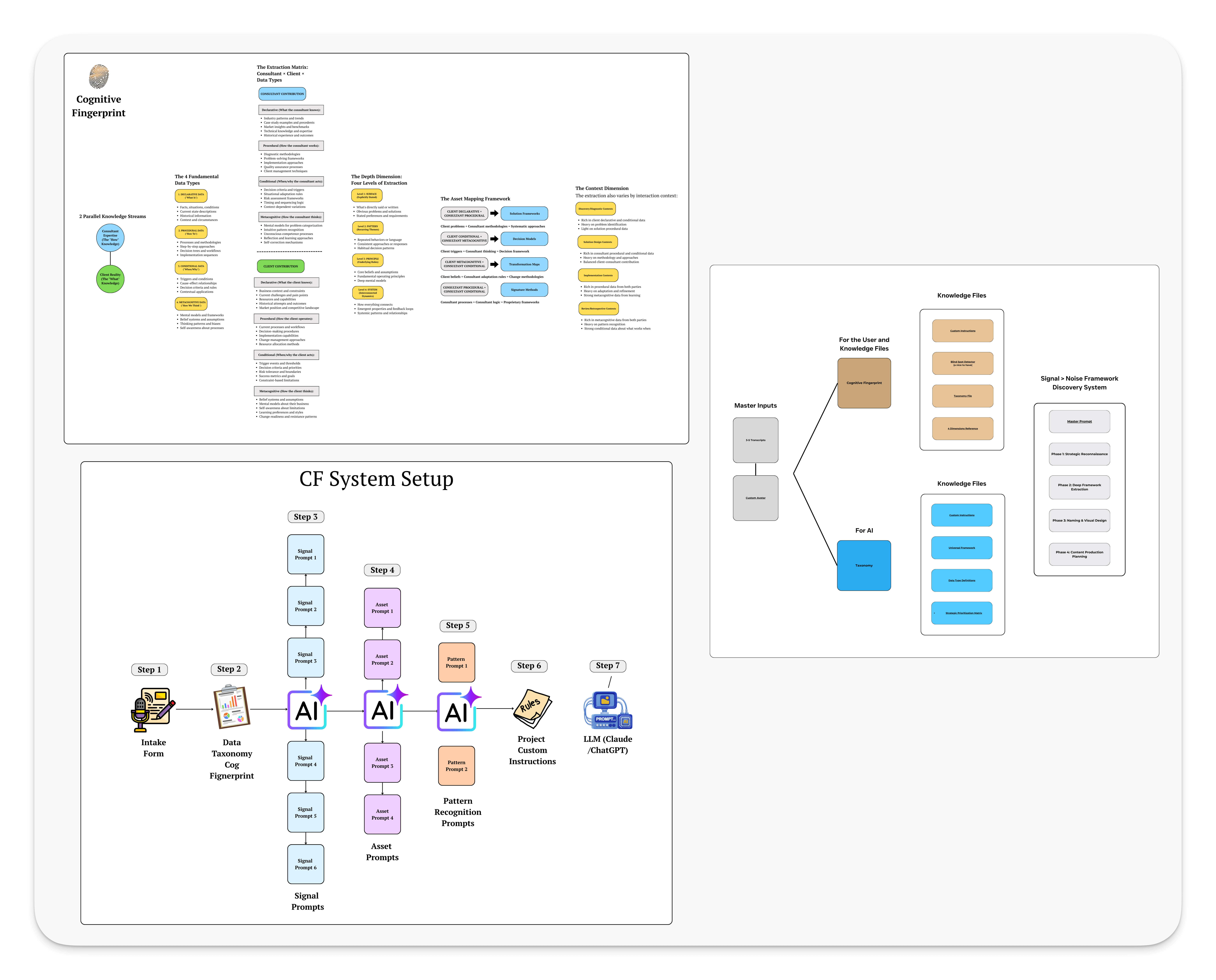
I started looking at the decisions that I made, the repeated patterns of how I introduced a problem then bridged to a solution, how I was able to spot (in advance) when people were getting overwhelmed and would scale things back and simplify.
I. Was. Hooked.
And if I was getting so much out of it, wouldn't other people too?
I started looking for those patterns in other people's transcripts and reading them back to them. They recognized something they did but hadn't found words for.
And that's how, in a very abbreviated version, Cognitive Fingerprint started.
An AI interview captures what you can explain
An AI interview can help you explain your work, but some of what makes you good has become so automatic that you don’t even realize you’re doing it. That’s unconscious competence. I was spotting overwhelm and simplifying the conversation before I’d recognized either as part of my process.
With a transcript, you can slow that moment down. The client says something, you change your approach, and the conversation goes somewhere else. You can read back through it and ask what you picked up on.
That was what pulled me deeper into my own calls. I could start to see how I was doing the work people valued. Then I could open another transcript and look for it again. You can ask AI to help with that search and show you the passages behind each pattern it suggests.
You can spot a bad headline before you can explain why
Michael described this as a copywriter. He can look at a headline, feel that something's off, and rewrite it. Explaining why he changed it is harder.
Philosopher Michael Polanyi wrote about knowledge we have trouble putting into words in The Tacit Dimension. His phrase was "we can know more than we can tell."
[Image placeholder: A transcript can reveal decisions you might leave out when describing your process.. We’ll generate and insert this.]
Imagine having a handful of Michael's original headlines next to his rewrites, with his comments alongside them. We'd have somewhere to start looking. Does he keep replacing broad promises with something the reader can picture? Does he pull a detail out of the article and put it in the headline?
Those are questions we'd test against the edits. As we found recurring choices, we could start describing what his eye catches when a headline feels off. A judgment that was hard to explain would have examples we could point to.
I call those recurring decision patterns decision DNA. They're useful context for AI because they show what you pay attention to and how it affects what you do next.
Collect calls where you're solving a problem
Start with conversations where you're responding to someone as you go. Client consultations and coaching calls are useful because the other person's questions can take you somewhere you hadn't planned. Sales calls, brainstorms, and employee one-on-ones can give you other examples.
Picture a client call where you arrive ready to explain something and realize halfway through that you need to back up. Maybe you ask them to show you what they've tried. Maybe an example gets the conversation going again. Those little adjustments are worth looking at.
You need the transcript, including what each person said. A meeting summary might reduce that whole exchange to "discussed implementation." I'd want to read what happened just before you changed direction.
I use Granola, which transcribes meetings without adding a bot to the call. If you already have transcripts from another meeting tool, start with those. Get permission to record and use the conversation before collecting someone else's words.
You can also capture your own thinking out loud. I use Wispr Flow when I start projects in Claude Code or Codex, and when something in a podcast makes me want to stop and work through an idea. Those notes give me material I might lose if I waited until I was ready to write about it.
💡 If you're wondering what to use, I put together a transcript-capture guide that compares 20 tools, including the ones I use.
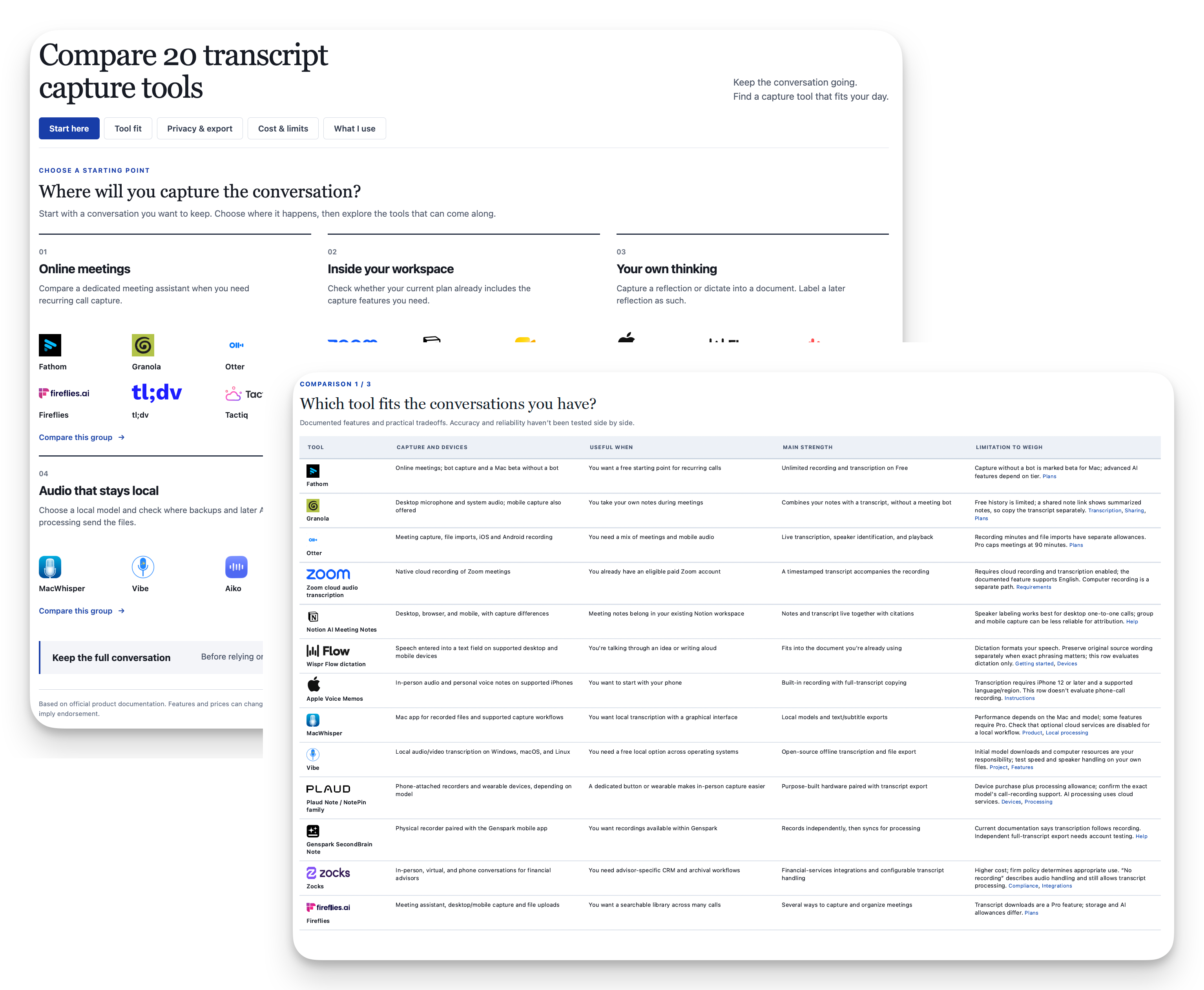
Start with where your conversations happen, then check how to get the full transcript out. You might already have what you need in a tool you're paying for.
I suggest starting with three to five transcripts from different situations, because I want to see a decision at least three times before I treat it as a recurring pattern.
I've processed more than a thousand files for one person. You can start much smaller. As the same patterns keep appearing, new transcripts become useful for checking whether anything has changed.
Save each transcript as a readable text file.
At the top, identify who was speaking and what kind of conversation it was. A client coaching session and an internal brainstorm put different demands on you. That context helps the model interpret why you responded a particular way.
Keep the transcript files in one folder so you can find them again when you compare patterns across calls.
Four layers I pull from a transcript
The names for these four layers sound a little academic. It helps to keep a real conversation in mind as you read them. Think about one where you knew what you wanted to explain, then had to adjust as you went.
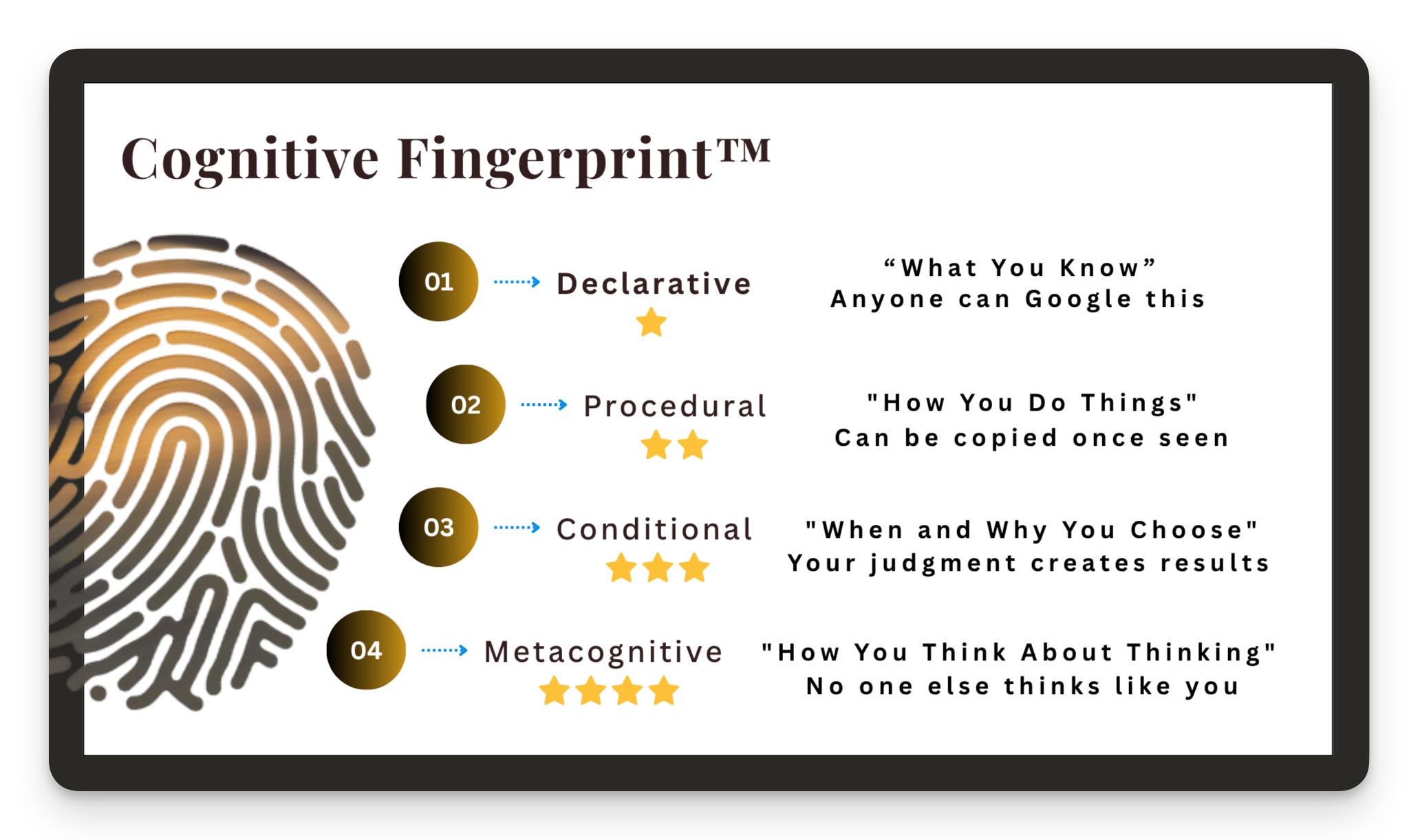
1. Declarative knowledge
What you know and can describe. Your account of what you do belongs here, including the expertise you'd put in a professional bio.
2. Procedural knowledge
How you do it. A transcript may show the sequence of questions you ask or the steps you take to work through a problem.
3. Conditional knowledge
When and why you choose a particular approach. What did the client say that made you ask another question? What would have led you to recommend something else? This is where I look for decision DNA.
4. Metacognitive knowledge
How you examine your own thinking. You might question an assumption or reconsider how you're approaching a problem. I've asked people to name the mental models they use, then compared their answers with what appeared in their transcripts. The two accounts can differ.
In my calls, the interesting question became what made me simplify at that particular moment. I could teach someone the steps of an AI workflow. Understanding when to slow down meant paying attention to the person trying to learn it.
That's why I spend time with the conditional and metacognitive layers. I want to understand the choices tucked inside an ordinary conversation, including the ones I made too quickly to notice.
Use the Four Layers prompt linked below with one transcript, then repeat with the next few calls. Compare the suggested patterns across them and keep the examples that support each one.
Turn those patterns into a file AI can use
After working through an archive of calls, a full analysis can run 20 to 30 pages. I trim that into a fingerprint file you can give AI as context when you start a project. It describes your recurring decisions and includes examples, so the model has something specific to refer to when it helps you.
For a first version, make a text document with the patterns you've checked against your calls. Give each pattern a short name, explain the decision it describes, and include the transcript passages that helped you recognize it.
Paste that document into a new AI conversation with your next request and ask it to use those examples when helping you.
Read its response to see whether it understood the pattern and applied it appropriately.
You can keep that file and reuse it when you change AI tools. Review it as your work changes, too. An approach that suited one kind of client may need adjusting for another.
There's a personal reason I love this work, too.
When I started reading patterns back to people, they recognized things they'd been doing without having words for them.
I knew that feeling from looking through my own calls, and now I was getting to share the experience.
Imagine trying to explain your work to a potential client with a few of those examples in front of you. You could show how you spotted a problem and decided what to do about it. Those examples can help you build an offer around how you work or put your approach into a facilitation guide.
With teams, comparing people's patterns can help you decide who should lead a project or how to explain an idea to a colleague. If a partner tends to ask for data while you tend to explain through stories, you can account for that when you prepare for a conversation.
A transcript gives you evidence to check. If a description of your thinking doesn't fit, go back to the exchange it came from. You should be able to recognize what the model is describing and question it when you don't.
Update & Prompt!
One announcement and one freebie below…
As a thank you to all my paid subscribers, I am adding a TON of CF resources to a Skool community. You paid membership to Substack ALSO includes the community (who doesn’t love a good BOGO?!).
Cognitive Fingerprint™ Lab is a Skool community built on the methodology you just read about.
Inside There Are 5 Pillars
The Fingerprint: Why you can’t see your own expertise. The science that explains why the thing you do better than anyone else feels like nothing special to you.
This is where most people realize they’ve been sitting on a goldmine and treating it like gravel.
The Map: The full territory sitting inside one recorded conversation, charted. Most people run ONE extraction, get ONE result, and stop. They think they got everything. They didn’t. This pillar shows you what you’re actually looking at when you record a session…
And how to pull out layers most people never even know exist.
Extraction: The prompts, workflows, and tools you run against your own calls. The Exception Finder below? That’s the shallow end. Inside the Lab, you get the full toolkit. The ones that find corrections you didn’t know you made. That spot the belief systems hiding in your repeated language. And turn hesitation into a teachable decision framework.
This is where your invisible judgment becomes something you can actually USE.
Your Method: Turning repeated patterns into a named method you can sell. Real intellectual property you are already sitting on. Or a SOP your team can run without needing you in the room. Because once you’ve captured your judgment, you can SCALE it.
You can train people using the exact distinctions that make YOU different.
You can hand off work you used to think only you could do.
And you can finally stop being the bottleneck in your own business.
The Guide Position: Pricing, positioning, and content built on what you found.
Once you know what you actually do that nobody else does…
You can TALK about it.
You can write about it in ways that make people say:
“Holy moly, this person gets it.”You can price yourself based on the value of that judgment…not the hours it takes to apply it. And you can position yourself as the person who solves a problem most people don’t even have language for yet. This pillar is about turning captured expertise into market position. The kind clients pay premium rates for.
Membership includes both this newsletter AND the Lab. Whichever door you come in through, you get both.
Since these two platforms don’t really talk to each other the quickest way in is vis the Skool link below.
OK OK…now for your prompt…
4 Layers Prompt
Pick a call you remember enjoying, one where you helped someone work through something and came away pleased with how it went. Get the free Four Layers prompt, enter your email to have it sent to you, and try it with that transcript.
When a suggested pattern catches your attention, read the conversation around it. See whether you remember why you asked that question or changed your approach. You might find yourself opening another call to see if you did it there, too.

