

Six months ago, I had never written a line of code in my life.
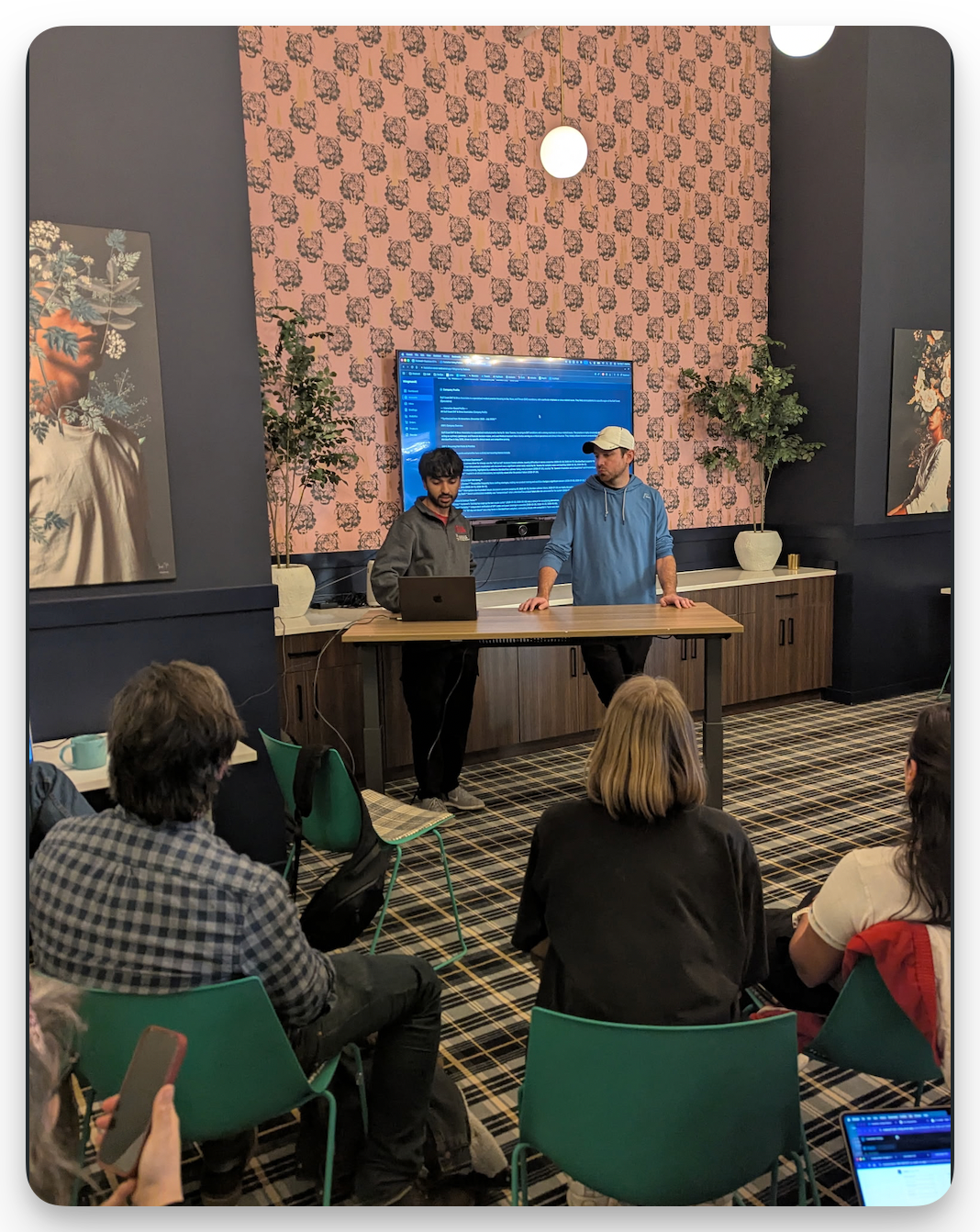
But last Saturday morning, I walked into a hackathon at 9am. A co-working space full of developers already on their laptops setting up GitHub repos, a term I had never heard of a few months ago.
I build growth strategies for businesses and help experts turn what they know into what they sell. I never thought I would be spending my weekend at a coding event, much less participating in one.
My family thought this was quiteeee funny. My brother called it “crossing the threshold into full nerd mode.” My girlfriend gave me the kind of supportive nod you give someone who just signed up for their first 5K and clearly has not trained.
But I showed up anyway…
…and was terrified.
Everyone else looked like they knew what they were doing. They had stickers on their laptops. Specific ones. The kind you earn, apparently.
I sat down with my partner Zain Merchant, opened my laptop, opened Claude Code, and just started building.
Hackathons in 2026 are interesting. The coding is the “easy” part. The AI handles a lot of it. What the room was short on was the other stuff...
What to build
Why it matters
Who to build it for
How to explain it in 60 seconds
By the end of the day, people were coming to our table to ask about the idea, not the code. What we thought they could improve on theirs. How they could bring it to market.
A judge who had built and sold multiple companies walked over, exchanged info, and told us he wanted to get coffee. He said it twice.
Best day I’ve had in months.
I posted from the hackathon while I was still there. I just wanted to tell someone.
That’s when I started noticing I wasn’t the only one walking around with this stupid grin these days.
The Stupid Grin Is Spreading
Jonathan Courtney runs AJ&Smart, one of the most well-known design agencies in Europe.
He used Claude Code for the first time a few weeks ago...
“It’s been the biggest change to my work ever. Like ever. There’s no comparison in my lifetime. That’s the same feeling you get when you start a business in the beginning. It’s like, oh my god, I can make anything.”
He built a $20,000 marketing funnel in three hours. By himself. For €10.
Andrew Wilkinson, investor and entrepreneur, wrote this publicly...
“For a decade, I was depressed about work. The best part of business is manifesting an idea, seeing a problem, then fixing it. The worst part is trying to herd cats. Claude Code has brought back my fire. If I wake up in the middle of the night, there’s a 50% chance I say ‘Fuck it’ and go downstairs to mainline Claude Code at 4am.”
Lazar Yavanovich is the first official Vibe Coding Engineer at Lovable.
Never written a single line of code. His take... non-technical people actually have an advantage because they don’t know what “shouldn’t” work. He calls it positive delusion. Assume everything is possible until proven impossible.
He built Chrome extensions that engineers said couldn’t be built on the platform. Built desktop apps. Someone on his team prompted their way into generating video inside the tool before it was even a feature. All because they didn’t know it was supposed to be impossible.
“If there wasn’t Lovable, I would have never built anything potentially in my life,” Lazar said. “And I don’t think that would have been a fun life to live.”
Nate, AI strategist, put it simply...
“The friction has now dropped enough that building software has stopped feeling like work and started to feel like play. And play produces very different things.”
Someone built an app that turns pet photos into Renaissance portraits. Your dog as a Baroque duke started as a joke but is doing six figures a month because someone was laughing while they built it.
Then there’s my friend. I’ll keep this vague to protect his privacy. A while back, he built a side project for our group. Just for fun, something useful he wanted to exist. That project caught the eye of a startup. They used it as the foundation for their product. He got equity.
That company just sold for more money than I will ever see in my lifetime.
Is that common? Of course not. But it started as play. It started as “wouldn’t it be cool if this existed.” There was no business plan or pitch deck. Just a guy building something for his friends on a weekend.
Something is happening that nobody’s writing about enough.
Adults are remembering what it feels like to make things.
I spent 18 years in marketing and consulting before I ever touched a builder tool. I had ideas for things I wanted to make. Lots of them. But they lived in a folder and they never got built because the gap between “I wish this existed” and “I made this exist” required skills I didn’t have, or money I didn’t want to spend, or a developer who needed three months and a detailed spec.
That gap closed….Fast. And when it closed, something I didn’t expect happened.
I started having fun. Not productive-fun. Not “this is a good use of my time” fun. The kind where you look up and three hours have passed. The kind where you text your friends at 1 am on a Tuesday. The kind where your family roasts you for going to a hackathon and you don’t care because you’re too busy being excited.
Jonathan said the same thing. Andrew said the same thing. Lazar said the same thing. My friend lived it years ago with a side project that became generational wealth.
The people having the most fun are learning the fastest, building the most interesting things, and stumbling into the best opportunities.
They followed the fun.
Following the Fun
Eight months ago I started playing with AI tools. Building things. Following curiosity wherever it went. I had zero plans to start a company. I just wanted to build a cool thing.
That play turned into a methodology. The methodology turned into a newsletter. The newsletter turned into a business. The business turned into the career I’d been looking for my entire adult life. I help people extract the expertise they can’t see in themselves. I use AI to surface patterns that humans can’t articulate. I help businesses in different industries do the same.
I love every day of it.
None of that was planned. All of it started because I built something for fun and couldn’t stop.
You probably have something like this. An idea. A tool you wish existed. Something your family would roast you for. Something that sounds fun but feels frivolous.
And the good news for you…
The cost of trying just collapsed.
The Playbook
Lazar laid out his path from hobbyist to the first professional vibe coder at Lovable. Simple and worth sharing.
Build in Public. Share everything. Every project, every failure. There are no secrets worth keeping.
Pick Your Platform. Choose the one that fits how you naturally communicate. Lazar picked LinkedIn because he talks in long-form. X requires a brevity that doesn’t match his cadence. Find yours.
Don’t Wait to Be Hired. Lazar was already doing the job before Lovable hired him. The role was recognition of reality, not a career change. “You don’t need a company to hire you. You can hire yourself as a professional vibe coder first.”
Send Apps, Not Resumes. Multiple hires at Lovable stood out by building an app that demonstrated their fit instead of sending a traditional application.
Go to a Hackathon. Show up knowing nothing. Sit down and start building. See what happens (sounds like a smart guy 😉).
“If you’re scared, just try it,” Lazar said. “It switches from fear to excitement immediately because then you see what’s possible firsthand. You should only be afraid if you’re doing nothing.”
I walked into a hackathon last Saturday knowing nothing. I walked out with new connections, a product idea with real potential, and the kind of energy I haven’t felt since I was a kid making things just to see if I could.
My family was right. Full nerd mode.
I’m keeping it.
Lazar’s Vibe Coding Toolkit
Lazar did a long-form interview where he broke down how he actually builds. The system. The specific rules, documents, and frameworks he uses to go from idea to working product without writing code.
I turned that interview into a complete starter kit. Everything below works without a terminal, without GitHub, and without writing code. If you can paste text into a chat window, you can use all of it.
The Idea Sharpener is a prompt you paste into any AI tool (Claude, ChatGPT, whatever you use). It walks you through five rounds of questions to turn a rough idea into a clear one-page build brief. You don’t need to know what you’re building yet. You just need to start talking.
The Framework Reference organizes Lazar’s entire system into a single document... his Five Beliefs, the Parallel Build Method, the PRD documentation system, the Three Wishes Rule for token management, the 4x4 Debugging Framework, and which skills he says actually matter going forward. All directly extracted from the transcript with no embellishment.
Five Planning Templates (master-plan, implementation-plan, design-guidelines, user-journeys, and tasks) are the exact document structure Lazar uses before he builds anything. Fill these in, or paste them into an AI tool with your Build Brief and let it fill them in for you. Your prompts become two words... “proceed with the next task.” The documentation IS the prompt.
The Lovable Custom Knowledge File is paste-ready agent rules you drop into Lovable’s Settings panel. It tells the AI how to behave on your project... read docs first, work one task at a time, don’t waste credits on unnecessary changes, and learn from mistakes. Two minutes to set up. Saves you dozens of credits per project.
The Step-by-Step Guide walks you through the whole process from start to finish... sharpening your idea, filling in your planning docs, setting up Lovable, writing your first prompt, and what to do when things break. No terminal. No GitHub. No code.
The kit also includes a bonus section for readers who want to go deeper with Cursor or Claude Code... same templates, different setup instructions.
Lovable does an incredible job loading up the users with resources but like anything, you got to know about them to use them. I placed my curated resource of Lovable resources and inspiration / resource sites that I am always using below.
🎨 I am also tossing in my “Ultimate Vibe Coding Design Guide” that you can feed any AI as a knowledge file and will help you level up all of your UI.
