


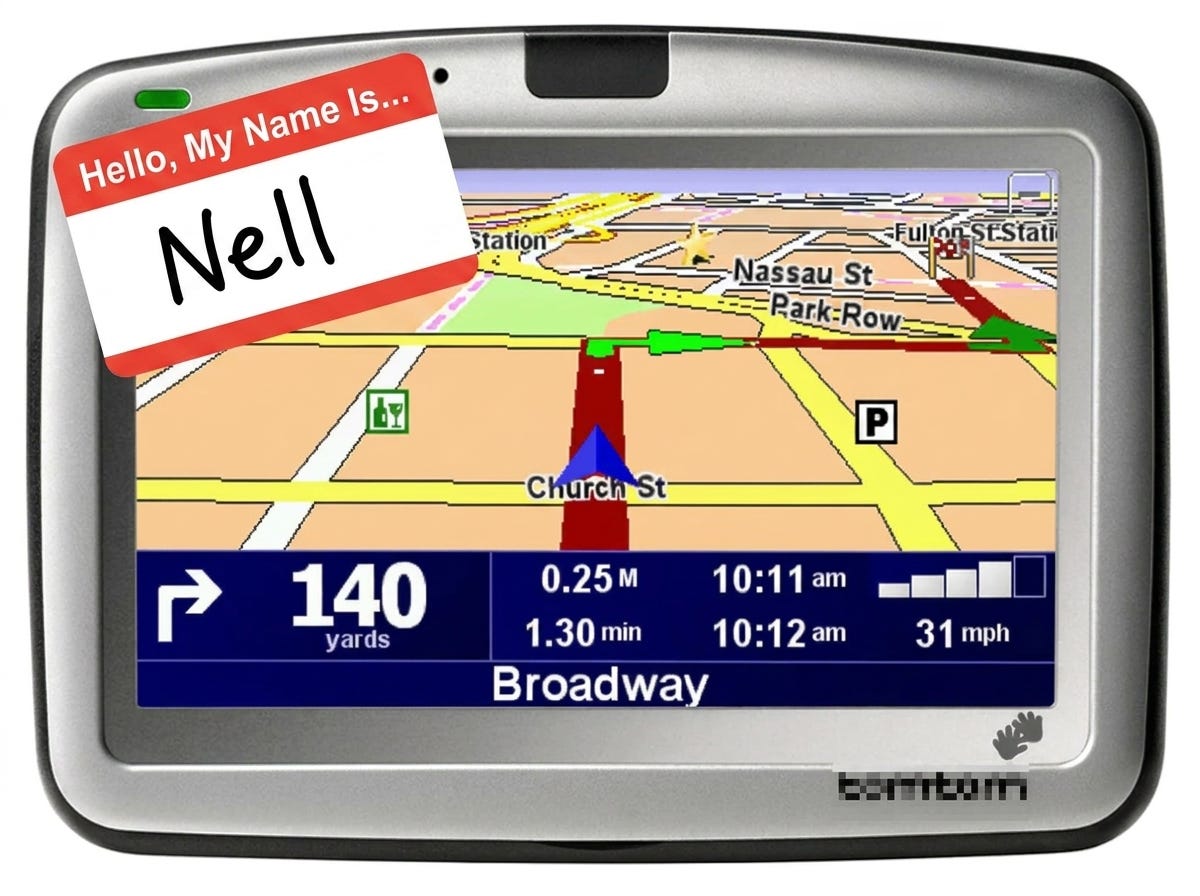
In the summer of 2010, Donna Cooper took her family on a day trip to Death Valley. It was a good day. Long, hot, the kind you end tired and know you’ll sleep good. When it was time to head home to Pahrump, she did what we all do…she asked the GPS for the shortest way back.
Donna called the GPS Nell.
Nell said go 550 feet, then turn right. At 550 feet there was a little path. Then a quarter of a mile and turn left. There was nothing there. Just desert, in every direction, in one of the hottest places on the planet.
“She had me running in circles for hours and hours and hours,” Cooper said later.
Three freakin days.
That is how long the Cooper family was lost. A search and rescue helicopter finally spotted them and luckily everyone survived.
The rangers in Death Valley call this “death by GPS” and it actually happens a few times a year. Around the same stretch, a mother and her son followed their GPS down an abandoned mining road and got stuck for five days. She barely lived but this time, the boy did not.
What unsettles the rangers is that the device is almost never wrong. It is too right. It computes the most direct line from where you are to where you want to be, and it sends you straight down a road that stopped existing forty years ago, with total confidence, in a calm voice, the whole way.
Here is the crazy part…
After three days in the desert, Donna Cooper did not lose faith in GPS.
She bought a new one. She named it Rosie.
We talk about trust like it is a decision. Cooper decided to trust Nell. Then she decided to trust Rosie. But that is not what happened, and you know it is not, because you have sat in that passenger seat too.
The trust was not a choice she made. It was a feeling the device created in her.
A confident voice, a clean line on a screen, an arrival time down to the minute.
And the feeling of being guided is so much stronger than the evidence of the road dissolving in front of you that the feeling wins, every time.
The tools that put you in danger are not the ones that fail you. A tool that fails you, you stop trusting. The dangerous ones are the ones that make you feel guided while they walk you somewhere you would never have driven with your own eyes open.
The Guided Feeling
You have had the guided feeling. The draft that appears in eight seconds, so smooth it reads like it was always there. The little clock in your head that says this used to take an hour, and now it takes ten minutes, look at me go!
And the feeling is real.
But what we are all forgetting to ask is whether the feeling is attached to anything.
And the problem is not the skeptics who refuse to touch the stuff. They are fine. They kept their eyes on the road.
The problem is the rest of us.
The experienced ones. The people who use AI well, feel sharp doing it, and have no idea the road stopped existing two turns back. We are producing more than we ever have.
But some of us are getting slower while we do it, and have no idea at all.
The Clock Disagrees With You

In early 2025, a research group called METR ran the study you would run if you were being honest with yourself. It’s like when you haven’t gone to the dentist in years and keep putting it off because ya just would rather not know.
They took 16 experienced developers. These were people working in their own codebases, projects they had contributed to for an average of five years, some with more than a million lines of code. They gave them 246 real tasks from their actual work.
Then they flipped a coin on each task:
AI allowed, or AI not allowed.
Before they started, the developers predicted AI would make them about 24 percent faster.
After they finished, they reported that it had made them about 20 percent faster.
The screen recordings said they were 19 percent slower.
No, not slower than they hoped. Slower than they were without the tool at all. The thing they reached for to speed up was the thing slowing them down, and the real kicker, the part that should really make ya feel funny, is that even after living through it, they still walked away believing the opposite.
The Confidence Is Wired Backwards
It goes one level deeper.
Microsoft and Carnegie Mellon surveyed 319 knowledge workers about when they actually think critically while using AI. The finding ain’t good, but honestly, makes a ton of sense.
The more you trusted the tool, the less you thought. High confidence in the AI predicted less scrutiny of what it gave you. High confidence in yourself predicted more.
Read that again, because it is doing something quiet and nasty. The better the tool feels, the more it sands down the exact reflex you would need to catch it being wrong.
I heard a story of a founder who knows his numbers like the back of his hand. He ran a board document through AI and forwarded it. A partner caught a figure that was off by a year. He had read it.
He just had not read it in the way he reads everything that does not arrive pre-formatted and “certain”.
The polish bought his trust before his judgment ever showed up to work.
You get in the habit of feeling like it is handled but it costs you the habit of checking, at the very moment checking is the whole job.
I catch myself in this moment all the time. These tools have gotten good. Real good. I will be working late at night and realize I have 3 Codex sessions, 2 Claude Code and a few Chrome browsers humming along.
It’s so much easier to keep tapping “approve” and trusting the AI and man…it feels damn good making that much progress.
But as one of my favorite sayings goes, “the bill always comes in the end.”
The Muscle Is Already Going
This is the one you cannot feel at all, because it is measured underneath feeling.
MIT’s Media Lab wired up 54 people with EEG and had them write essays.
One group used ChatGPT.
One used a search engine.
One used only their own brain (crazy I know).
They watched the brain activity the entire time.
The brain-only group lit up the widest with the most connected networks.
The search group was less.
The ChatGPT group showed the weakest neural connectivity of the three.
The cognitive engagement scaled down in lockstep with how much the tool was doing.
It’s the cognitive version of taking the escalator every day and then being surprised, months later, that the stairs leave you winded.
But here is the most surprising/unsurprising part…
The AI group could not quote their own essays. Sentences they had produced minutes earlier…couldn’t recall them. Because in a real sense they had not written them. They had watched them get written.
The researchers call this cognitive debt.
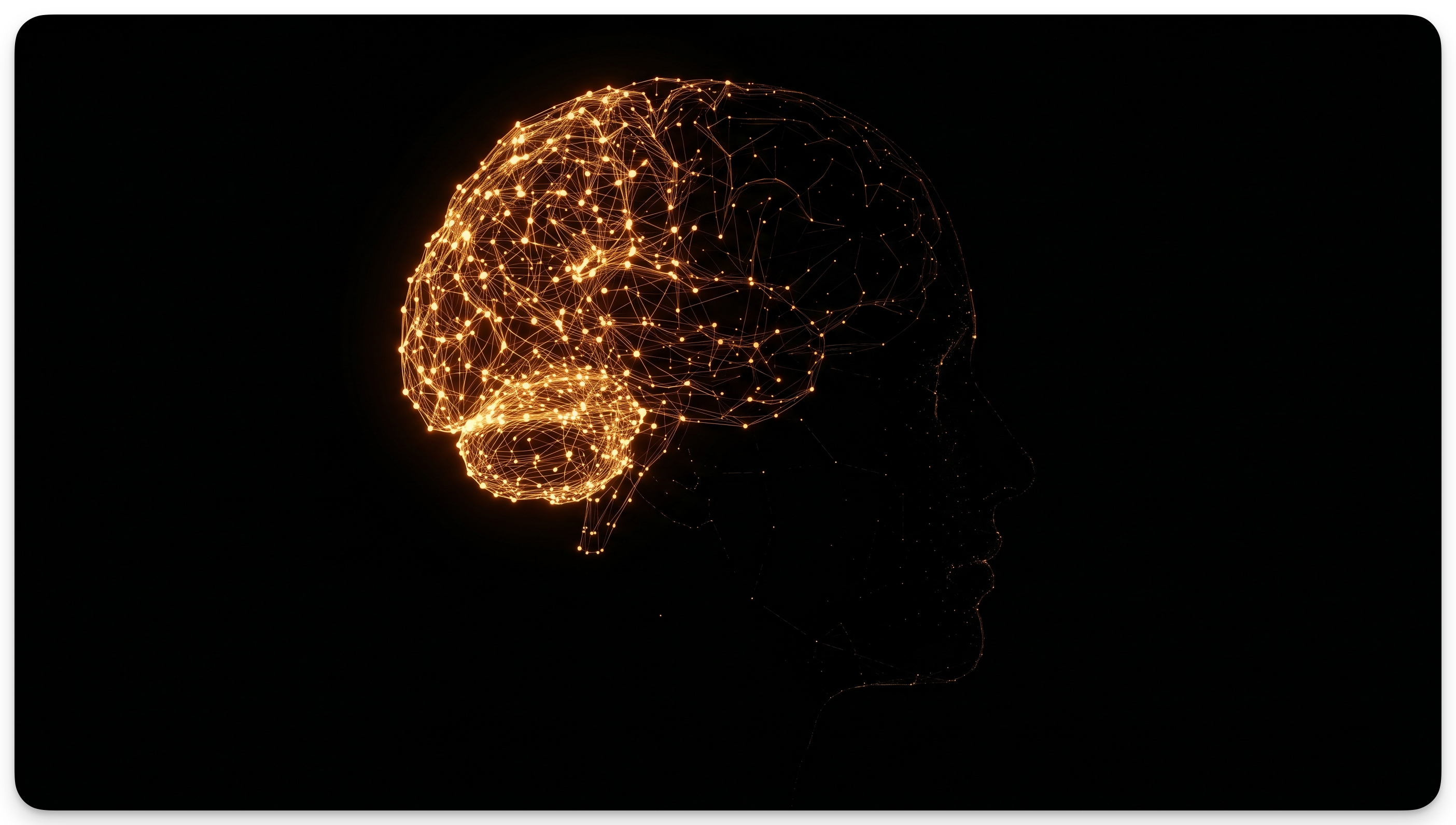
It feels like nothing and that’s precisely the problem. The bill arrives later (see!), in the one moment you need to think without the tool, and reach for the muscle that’s no longer there.
Why Your Gauge Stopped Working
For your entire career until about two years ago, the feeling of being good and the fact of being good rolled together.
You felt fast because you were fast.
You felt sharp because you had done the reps that morning, that year, that decade.
The feeling was a trustworthy gauge for one boring reason.
There was no way to feel productive without actually being productive. Producing the work was the proof. They were the same event.
But AI has started pulling them apart.
For the first time you can have the complete sensation of expert output with almost none of the underlying work, and your internal gauge has no idea anything changed. It still thinks it is counting reps…but it’s counting vibes. The needle that ran your whole career came loose from the engine, and it still swings, confident as ever, pointing at nothing.
Your Company (Or Your Client) Is Running the Same Thing
Now zoom out to a team, or to a client you advise.
A group ships 30 percent more this quarter. Leadership reads that as a win and raises the number for next quarter. Nobody measures the thing that does not show up in the dashboard:
Whether the people producing the work still understand it well enough to defend it, fix it, or rebuild it when the tool is down.
The organization optimizes the one thing it can see and goes blind to the one thing it cannot.
The startup asks, what can we produce now. The question that would actually protect them is the one nobody asks out loud because it’s not convenient now.
What can we still do when it stops working? Because we all know it will stop working eventually.
A Test Worth Running This Week
So here is something to try.
Pick a task you always hand to AI. The one you have fully outsourced because at this point it would feel stupid not to. Do it once this week without the tool. Time both versions.
Then notice two things.
The clock, which tells you whether you were actually faster.
And the harder one. The parts you could not do as cleanly as you remember being able to.
That second reading is important. The stopwatch measures speed.
The struggle measures the muscle.
You are not doing this to feel bad, or to go back to grinding everything out by hand like a monk. You are doing it to reconnect the gauge. Use AI to move faster through the parts that do not require you. Stay inside the parts that do. Keep your eyes on the road even while ol’ Nellie is talking.
Watch It Run Backwards
Let me show you the reverse happening.
I know a Fractional CMO. Let’s call him Reza. He runs marketing for three companies at once and is sharp, fast, and exactly the kind of person who should be using AI hard. And boy was he. Positioning memos, campaign briefs, board updates, all of it drafted in minutes by asking Claude to write the thing and then cleaning it up.
Then a founder he works with stopped him in a meeting. Pushed on one line of a positioning memo. Asked him why he had recommended going after the mid-market instead of staying upmarket. A simple question. The reasoning should have been right there.
It was not there.
Reza knew the memo said it. He could not reconstruct why it said it, because in a real sense he had not decided it. He had watched it get decided. He recovered, the way we all do, but he drove home knowing exactly what had happened. The gauge had been reading full the whole time the tank was draining.
So he changed one thing. Not the tool. The order.
Now, before Claude writes a word, he opens the first prompt in the pack and it refuses to draft anything. Instead it makes him talk first. He brain-dumps his actual take, messy, into voice mode for ninety seconds. Then the second prompt does not write the memo either. It interrogates him.
“You said mid-market. What changed your mind from the upmarket play you ran last quarter? Name the specific signal. If you cannot name it, say so and we will flag it as an assumption, not a finding.”
Reza answers out loud. The thing that used to be invisible, the actual decision, gets dragged into the light where he has to stand behind it. Only then does the third prompt sharpen what he built, and it flags two lines where his reasoning is still thin and tells him so instead of papering over them.
Same memo with roughly the same words…Maybe ten minutes slower.
“But now it’s mine,” he said. “I could feel the difference in the next meeting. When she pushed, I was already standing there.”
That’s it. Not doing it the hard way. Doing it in the order that keeps you grounded while it happens.
What the Test Can’t Do
You now know the gauge is disconnected. You know which group you are in, the one that drafts and stays inside the thinking, or the one that generates and copies. And you have the one test to feel it for yourself this week.
Here is what the test cannot do.
It cannot rewire your default. The moment a real deadline lands and the tool is sitting right there, helpful and instant, willpower loses. You will reach for the fast version, because feeling fast is the one thing that never feels like a cost. Reconnecting the gauge in your live daily work is not a decision you make once. It is an order of operations you install so the thinking happens whether or not you are disciplined that day.
Your Competence Is Reading This Right Now
And it is already filing objections.
It will feel like:
That study was just developers, my work is different.
It will feel like:
I am the careful one, I always check the output.
And the last one, the quiet one:
I can tell the difference between real speed and the feeling of speed.
That last one is the exact belief those developers were holding while the stopwatch called them liars.
Feeling like you can tell the difference isn’t the same as being able to. And that confidence is the first thing AI takes from you. Not by making you feel worse, but actually by making you feel better.
Every serious practice ever built knows this and builds around it. Sprinters do not trust how fast the race felt. They trust the tape. Musicians record themselves because the playing always feels better than it sounds. The move at the center of mastery, in every field, is the same.
An external instrument, brought in on purpose, because the internal one lies in your favor.
You’ve lived with the gap between feeling good and being good your whole career. The difference now is that something finally learned to sit inside it, speak in a calm voice, and give you directions you’ll actually follow.
Donna Cooper named hers Rosie.
What’s yours called?
-Max
Knowing the gauge is loose won’t reconnect it.
That is what The Sanity Pack is.
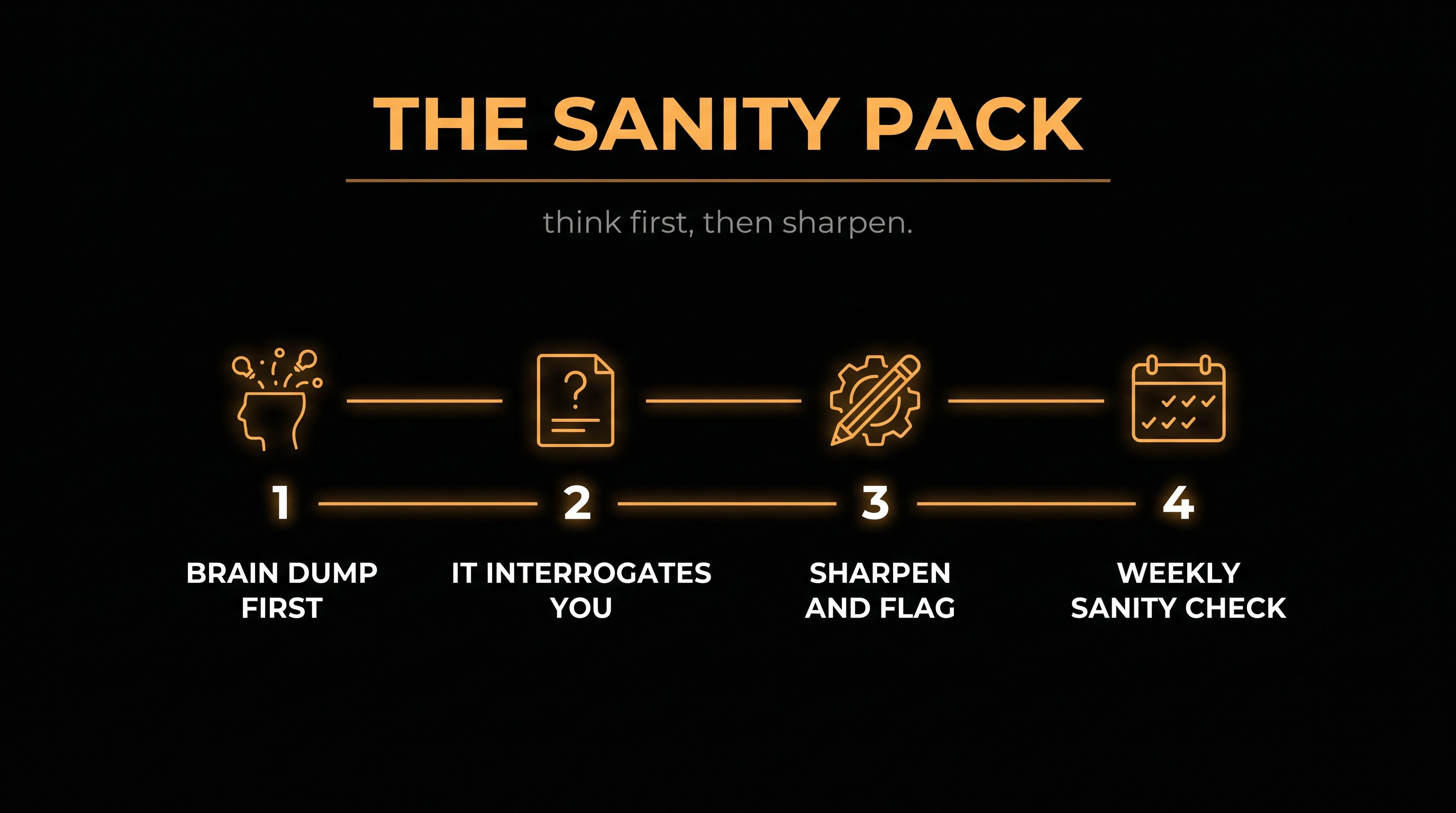
Four prompts you paste into Claude or ChatGPT that flip your default from generate-then-copy to think-then-sharpen, the move that kept the MIT study’s second group with their brains on the line.
You get the four prompts, a voice-mode version for thinking out loud the way Reza does, a one-page weekly self-audit to catch yourself drifting, and the full worked example.
Run them on one real task this week. If they don’t catch something you would have shipped and couldn’t defend, reply and I’ll refund you. Keep the prompts anyway.
It’s below.
