

🚀 UPDATE: I was a little delayed getting this one out so I am leaving the grandfathered price for the full community package (Skool + SS) at $20 until Midnight tonight, 9/5
A waste-management owner spent 30 years learning to “read” dumpsters.
Sounds weird, right?
But he could drive past one and instantly know if there was a deal there. The trash inside told him something. The way it was painted told him something else. The rust patterns. The placement. All of it. His new salespeople? They just saw a dumpster.
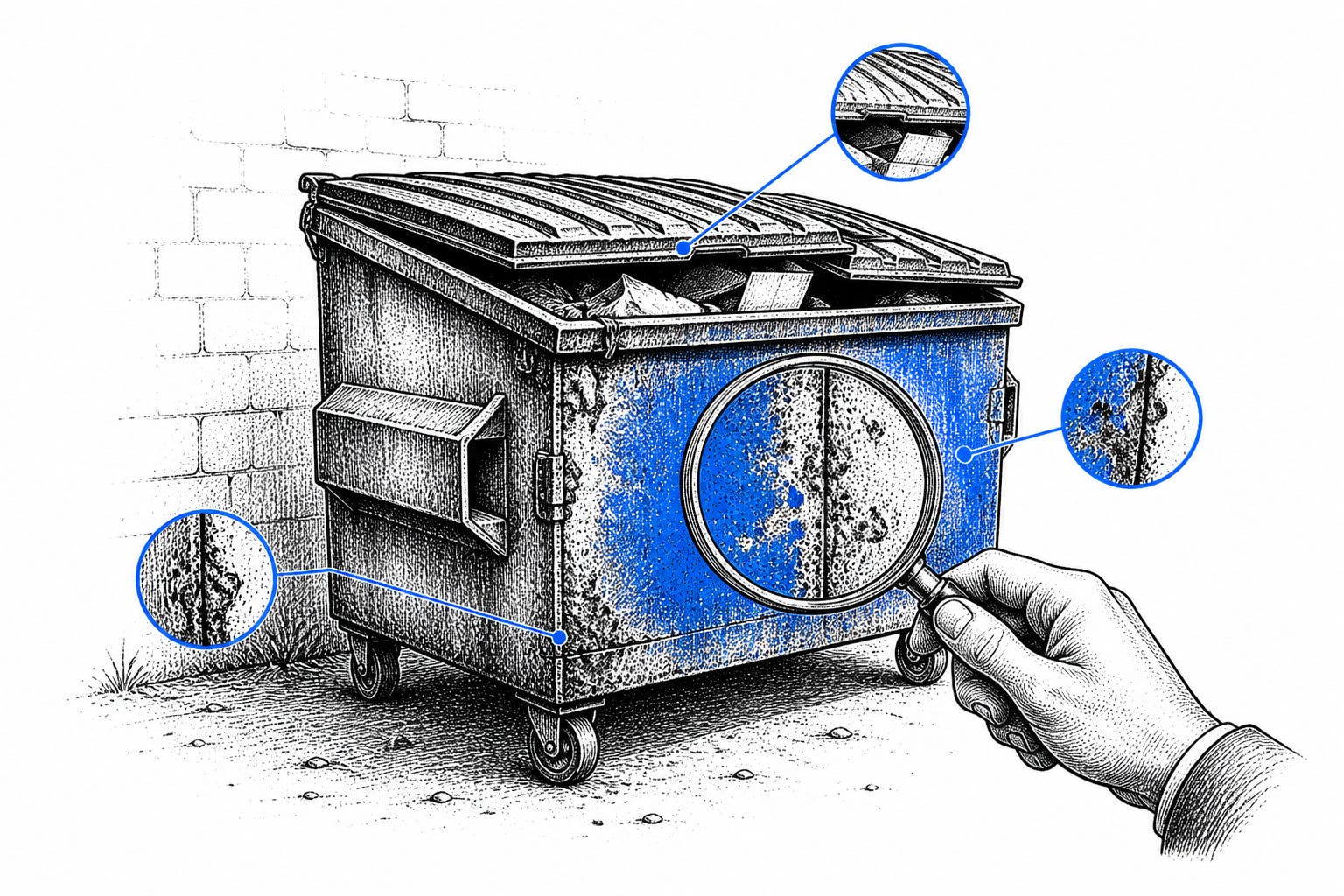
And when it came time to train his staff, he couldn’t explain what he was seeing. It was so natural at that point, all so effortless. It was invisible to him, so he never thought to explain it in the training manuals. “Reading” a dumpster felt like doing his job, nothing else.
Thirty years of market knowledge like this can disappear because nobody ever called it knowledge in the first place.
The first two pieces in this series explained why expertise goes invisible and why AI makes that a real problem now. This one is about what to do before it disappears for good.
Why Asking For Someone’s Process Never Works
Ask an expert how they do their work and they’ll usually hand you something that sounds pretty nice. It will give all of the “official” steps, maybe a framework, and the rules they remember learning. What most SOPs look like.
That stuff has value. But it almost never contains the moments where their skill actually changed the outcome.
The real material shows up when the plan stops working.
When the expert hits a wall and breaks from the normal process.
When they catch something that wasn’t in the brief.
When they fix someone’s work without being able to say exactly what rule they just applied.
That’s why transcripts, corrections, hard cases, lost deals, rewrites, and odd calls hold so much more than a normal interview. The expert has stopped explaining. They’re applying the method live, in real time, fully inside their zone of genius.
The Evidence Judgment Leaves Behind
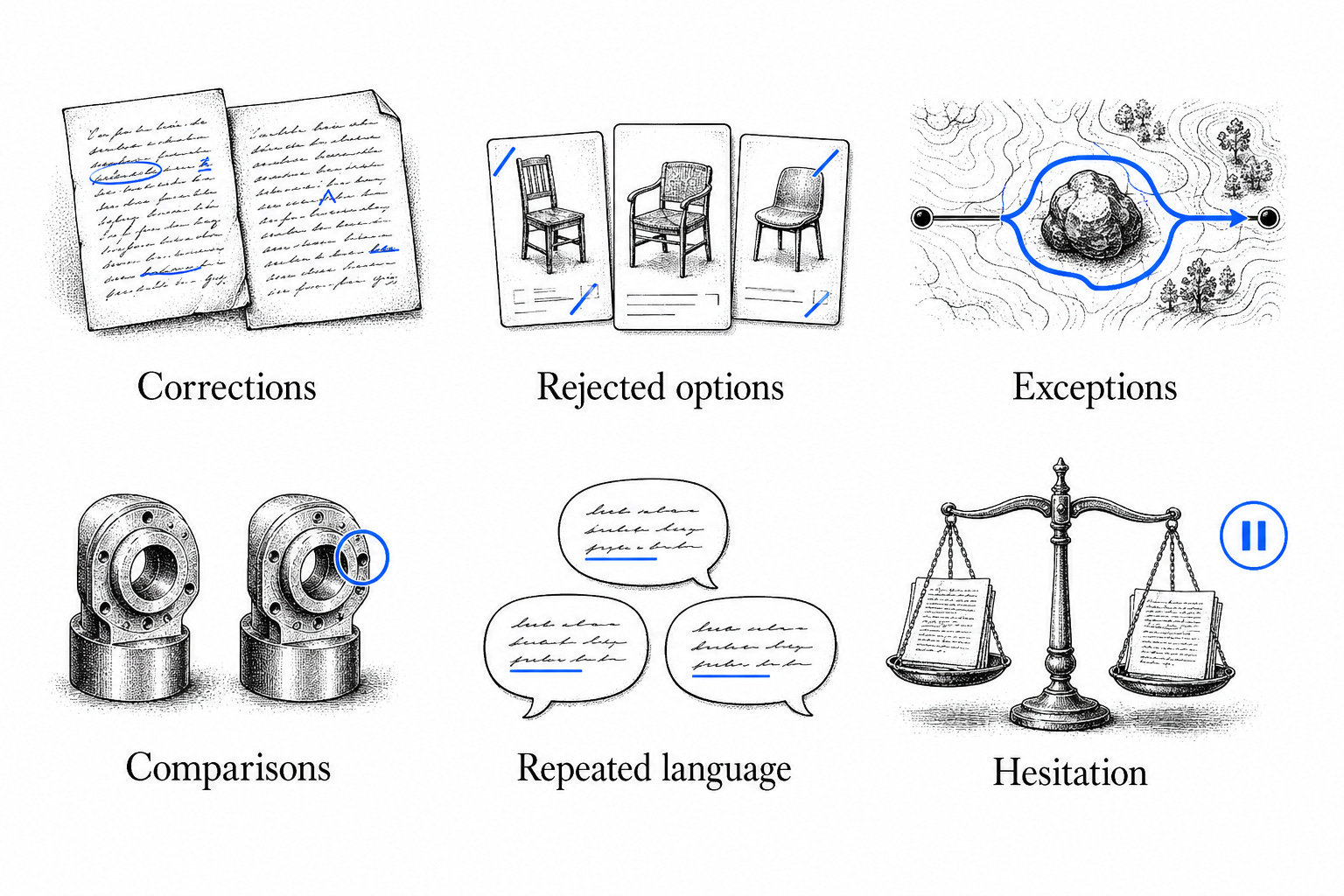
Judgment leaves evidence behind. You just need to know where to look.
1. Corrections
When an expert changes an AI’s output, a teammate’s work, or their own first draft, put the two versions side-by-side.
The gap between them is the standard.
My client could tell when AI output read like a telegram instead of a magazine. That distinction lived in her head until she made the correction.
One fix like that is just an anecdote.
Line up enough corrections and sort them by what changed and why, and a pattern starts to show up that someone else could actually learn from.
Every time you change something, you’re applying a standard. The standard is the valuable part.
The edit is just the evidence of it.
2. Rejected options
The option an expert turns down often says more than the one they pick.
Most people only write down what they decided and what they shipped.
Write down what got rejected too. And when. And why.
A list of final answers shows you a preference.
A record of good options getting cut shows you judgment.
That’s the real difference between knowing what someone chose and knowing how they actually think.
3. Exceptions
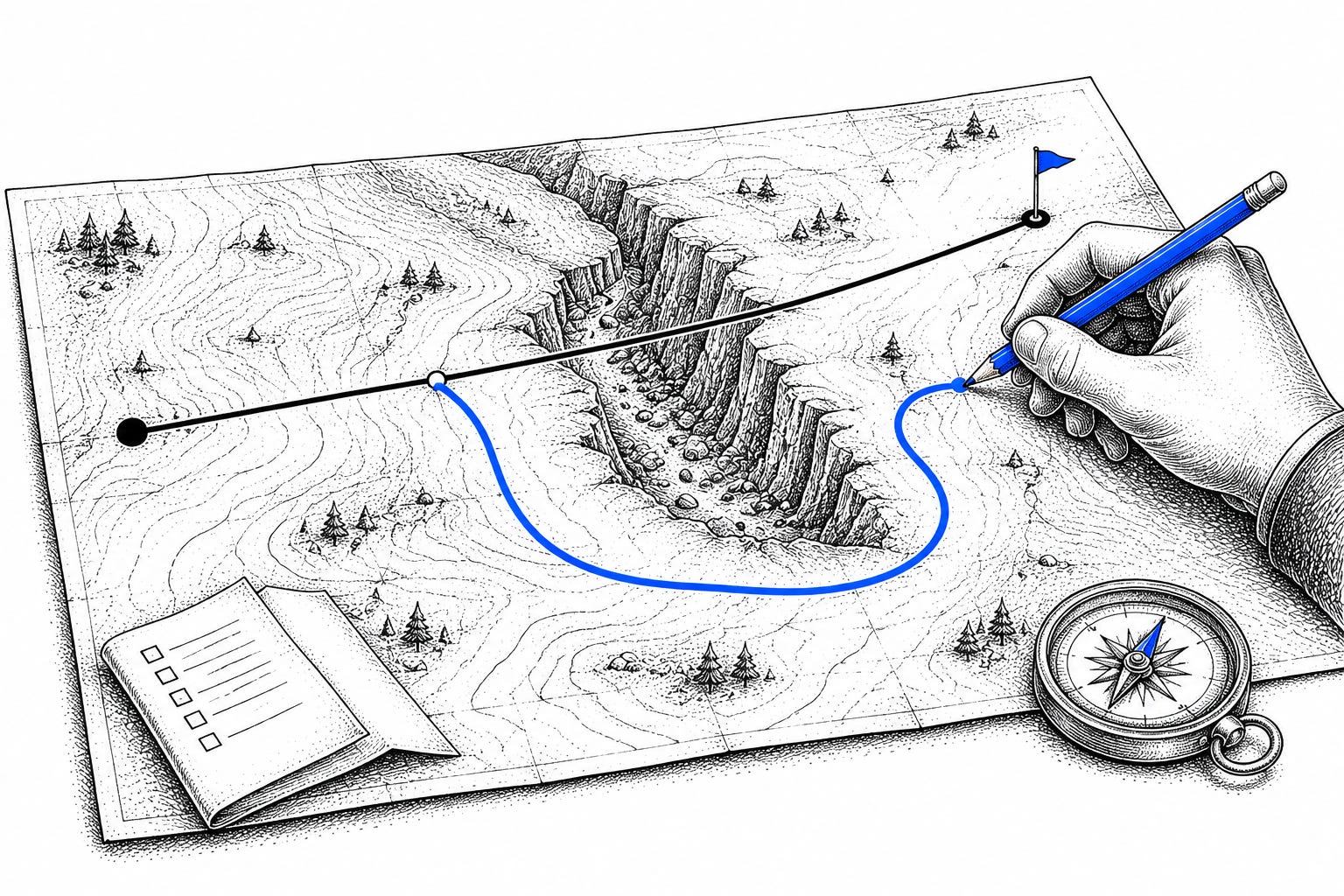
Every process eventually hits a case it wasn’t built for. The exception shows you what the expert thinks the process is actually protecting.
They break from it because they can see that following it here would give the wrong result, even though they still believe in the goal the process was built for.
The philosopher Donald Schön called this reflection in action. The situation stops matching the theory, and the practitioner adjusts on the spot.
That adjustment usually carries more real skill than the plan it just broke.
Gary Klein studied how firefighters, military commanders, and ER staff decide things under pressure. They almost never weigh options side by side. They recognize a pattern and move.
It’s fast because the experience runs deep, and the exception is where you finally get to see that depth.
4. Comparisons
Experts are always comparing the case in front of them to cases they’ve already seen.
“This looks like that one, except for this one thing.”
That one thing might be the whole decision.
The comparison shows you two things at once.
What the expert thinks is similar.
What they think is different.
The similarity tells you which bucket they put the case in.
The difference tells you what actually separates cases inside that bucket.
Most frameworks flatten this out. They name the bucket and lose the variation.
The variation is where the judgment actually lives.
5. Repeated language
My client had a phrase she used with certain patients.
She called it the “Museum of Faith.”
When I showed her that phrase back to her, she corrected it.
“Museum of Toxic Faith.”
At first I thought it was just a word swap, but I quickly realized it was a belief.
A belief about what faith and hope does when it keeps someone holding onto a future that’s never going to show up, the line between hoping and actually changing and about the moment encouragement turns into a way of dodging something the patient already knows.
She’d never said that belief out loud before.
It only showed up because she rejected a phrase that almost fit.
The words an expert keeps repeating, the images they keep reaching for, the phrasing they correct.
That’s judgment made visible.
You don’t need to interview anyone for this.
You need to notice what they say more than once, and what they refuse to let stand.
6. Moments of hesitation
A pause can show you two standards fighting each other.
The expert is weighing two readings that both have evidence behind them. Both could be right.
The hesitation is the second right before one of them wins.
That moment holds more useful information than the confident answer that comes after it.
The confident answer already settled the fight.
The hesitation shows you the fight itself.
If you only write down conclusions, you lose the reasoning.
The reasoning is the part someone else would actually need to learn.
How Do You Know You Actually Captured Something Real?
How do you know what you’ve captured is real, and not just a story that happens to sound good?
A captured pattern earns more trust under a few conditions.
It shows up three or more times: One correction could just be a preference. The same correction across five different cases is probably a real standard.
You can point back to the original words or decision: The pattern isn’t a summary someone made up. You can trace it back to something the expert actually said or did.
The expert can correct your read on it: Show them what you found. They tell you whether it’s real. They might sharpen it. They might reject it outright. Either way, it gets better through their response.
The pattern predicts what they’ll do next time: This is the real test. If you’ve actually captured something, it should help you guess what they’ll notice, reject, or care about in a brand new case. If it does that, it’s earned its keep.
It keeps the contradictions instead of smoothing them over: Real experts hold two competing ideas at once. They know when a rule applies and when it should bend for another one. If your write-up makes someone sound simpler than they are, you probably lost something important.
This is what separates the real thing from a flattering personality summary or an AI-generated framework mill.
A pretty description description isn’t enough.
The interpretation has to survive getting tested against another real decision.
What a captured pattern can turn into
Three people I’ve worked with saw a different future once their judgment finally got written down.
A founder pictured his team walking into client calls “super confident, not really worried if I’m on the call or not.”
The patterns he’d never said out loud became something his team could actually learn. His private judgment turned into something the whole team could run on.
Another pictured content built from the thinking inside his firm’s client conversations instead of generic SEO filler.
Thinking that used to stay trapped in conversations turned into something he could publish. His firm could finally say what it actually knew.
A third could start giving AI more than a vague adjective about tone.
Her corrections could turn into real examples of her standards, examples a model could actually learn from instead of guessing at what “magazine” meant.
These are real results from early sessions, not a promise about what everyone will get.
This work is still new (well, new compared to legends like Gary Klein and Polany).
What I’ve seen so far is what people recognized and pictured once they saw their own judgment reflected back at them.
It doesn’t yet prove every one of those ideas got adopted for the long haul.
The evidence for what this can become keeps growing.
It isn’t finished yet.
What Capture Can’t Do
Some expertise only comes through doing something together, or watching it happen, or seeing enough cases in person.
Words won’t carry all of it.
Some judgment should stay private too. It might hold confidential material or a real edge that shouldn’t get handed out.
The goal here is a useful translation, not a perfect copy.
This loops back to the sapphire labs from Article Two.
The visiting researchers never turned into copies of the original technicians. They just got close enough to reproduce the result.
That’s the real bar.
You don’t need to know everything, you just need to get close enough.
The Beginning
I’m giving you a prompt below that’s one of the tools I’ve built over the past two years.
It’s part of a methodology I call Cognitive Fingerprint™.
And if you just ran it on one of your calls…
You probably found something you didn’t know was there.
Maybe a pattern you repeat without thinking, a standard you apply but never named or a break in routine that reveals what you’re ACTUALLY protecting when you break your own rules.
That’s just the start.
Cognitive Fingerprint™ Lab
These three articles are building toward something bigger.
And a change in what this newsletter is becoming. Because here’s the truth…
A newsletter can show you the territory.
It can give you a prompt like the one above and can prove the method works.
But it can’t give you the FULL toolkit or walk you through extracting patterns from YOUR calls.
It can’t show you how to turn those patterns into something teachable, scalable, or valuable.
And it can’t give you a place to actually DO this work… with others who are doing the same thing.
For that, you need the Lab.
Cognitive Fingerprint™ Lab is a Skool community built on the methodology you just read about.
Inside There Are 5 Pillars
The Fingerprint
Why you can’t see your own expertise.The science that explains why the thing you do better than anyone else feels like nothing special to you.
This is where most people realize they’ve been sitting on a goldmine and treating it like gravel.
The Map
The full territory sitting inside one recorded conversation, charted.Most people run ONE extraction, get ONE result, and stop.
They think they got everything. They didn’t.
This pillar shows you what you’re actually looking at when you record a session…
And how to pull out layers most people never even know exist.
Extraction
The prompts, workflows, and tools you run against your own calls.
The Exception Finder below?
That’s the shallow end.
Inside the Lab, you get the full toolkit.
The ones that find corrections you didn’t know you made.
That spot the belief systems hiding in your repeated language.
And turn hesitation into a teachable decision framework.
This is where your invisible judgment becomes something you can actually USE.
Your Method
Turning repeated patterns into a named method you can sell. Real intellectual property you are already sitting on.
Or a SOP your team can run without needing you in the room.
Because once you’ve captured your judgment, you can SCALE it.
You can train people using the exact distinctions that make YOU different.
You can hand off work you used to think only you could do.
And you can finally stop being the bottleneck in your own business.
The Guide Position
Pricing, positioning, and content built on what you found.
Once you know what you actually do that nobody else does…
You can TALK about it.
You can write about it in ways that make people say
“Holy moly, this person gets it.”
You can price yourself based on the value of that judgment…not the hours it takes to apply it.
And you can position yourself as the person who solves a problem most people don’t even have language for yet.
This pillar is about turning captured expertise into market position.
The kind clients pay premium rates for.
Membership includes both this newsletter AND the Lab. Whichever door you come in through, you get both.
Right now, it’s $20 a month. That price is absurd. I know it.
But I know how amazing this stuff is and I’ve been only giving it out to my one-on-one clients.
I’ve seen founders extract their own decision frameworks and realize they can finally train their teams properly.
I’ve seen consultants pull positioning language straight from their own client calls and turn it into content that actually differentiates them.
I’ve seen people who thought they “just did their job” discover they had a methodology worth naming.
But I do want to reward the early-birds, so the price is going up.
At midnight tonight, September 5th, new memberships move to $25 (and will probably keep rising).
Anyone who joins before then keeps $20 for as long as their subscription stays active.
I was supposed to close the $20 price last night but I got delayed getting this article out.
So I’m leaving the door open until tonight at midnight, 9/5.
After that?
It’s $25 for everyone new.
And it’ll go higher from there.
Now, go find something you knew, but didn’t know, about how awesome you are.
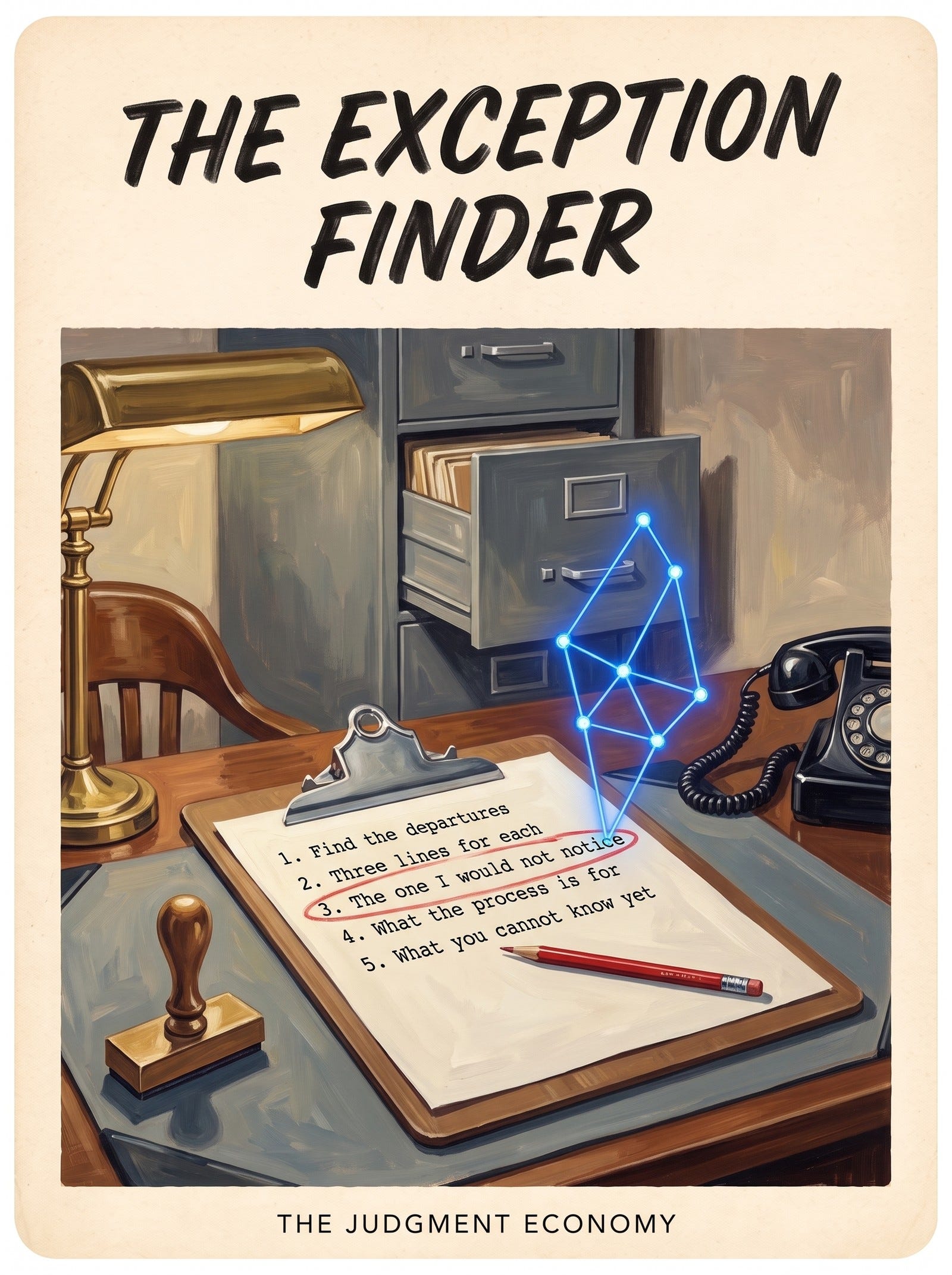
The Exception Finder
The exception is the fastest place to catch your own judgment firing.
Every time you skip a step, change the order, or break a rule you normally follow, you are protecting an outcome the process was built for.
Pick one recorded call, thread, or session from the last month where you remember going off-script, or the one where you suspect you did.
If you have a checklist, template, or SOP you normally follow, paste it too. If you do not, the prompt will work from the routine visible in the rest of the same recording.
Take out client names, but keep your own so the model knows which speaker is you.
Paste the prompt below into Claude or ChatGPT, then paste the work underneath it.
The Prompt
You are an outside observer reviewing a piece of my work. I am an experienced [your role]. Below is a transcript, thread, or session. In it, I am the speaker labeled [your name as it appears]. Everyone else is a client, colleague, or interviewer, and their decisions are not the subject. If I have included a checklist, template, or written process, treat that as my usual process. If I have not, build the usual process from the routine stretches of the recording itself, the moments where I did the ordinary thing in the ordinary order. The subject is where I departed from that process and why.
Rules:
Work only from what is on the page. Quote my exact words for every finding. If you cannot quote it, do not claim it.
Do not invent a framework, a name, or an acronym. Describe what I did in plain language.
Ignore what I said I was doing. Look at what I actually did: the step I skipped, the order I changed, the rule I broke, and the thing I did that no process called for.
Do not flatter me. If a departure was a shortcut or a mistake, say so. If you find fewer than two departures, say that too.
If you cannot tell which speaker is me, stop and ask before you begin.
Steps:
Step 1. Find the departures. Look for moments where I skipped a step, changed the usual order, broke a rule I otherwise follow, answered something the process never asked, or stayed with something longer than the process allows. List up to five. Quote each one, and quote the routine version from elsewhere in the recording or from my written process.
Step 2. For each departure, write three lines.
What the process would have had me do at that moment.
What I did instead, in one plain sentence.
What result I seem to have been protecting by departing.
Step 3. Find the departure I would not have noticed. Identify the exception that looks most like ordinary conversation. Say what was actually happening in it.
Step 4. Name what the process is for. From the departures, write one sentence describing the outcome my process exists to protect, as I appear to understand it, and one sentence describing when I believe the process should give way. Quote the evidence for both.
Step 5. Tell me what you cannot know yet. Everything above comes from one source, so each finding is a candidate, not a pattern. List the two or three departures most worth checking against my other recordings, and say what you would look for.
Format: short headers, quotes in italics, no summary at the end.
[PASTE YOUR TRANSCRIPT, THREAD, OR SESSION HERE]
Part 3 of The Judgment Economy
I relate strongly to this article about invisible expertise. Admittedly, I’m much less interested in the AI connection, and more interested in how experts transfer their knowledge to others.
As a coach, I mostly work with professionals who are deep subject matter experts at what they do. Sometimes they are managers, but usually not.
BTW, I really like your dumpster story. May I use it?
One of the most common coaching discussions I have is how they themselves become better coaches, mentors, and delegators.
One of my starting points is to paraphrase Arthur C. Clarke – “Any sufficiently advanced technology is indistinguishable from magic”. Or, in my words, "what is common sense to you looks like voodoo and magic to others."
We also have innate cognitive biases in place, such as the Curse of Knowledge, which happens when you know a fact or skill so well that your brain cannot easily imagine what it was like not to know.
Or the much more famous Dunning-Kruger effect, which results in people with low knowledge overestimating their ability, while experts will underestimate themselves.
There is also the problem that how we codify our knowledge in our head is highly individualistic, which results in SOPs and knowledge banks that don’t make a lot of sense to anyone except the expert who wrote it.
Perhaps one of the development tasks for senior experts is therefore slightly counterintuitive:
When I am on autopilot? How do I become consciously aware again of the knowledge I don’t think about?